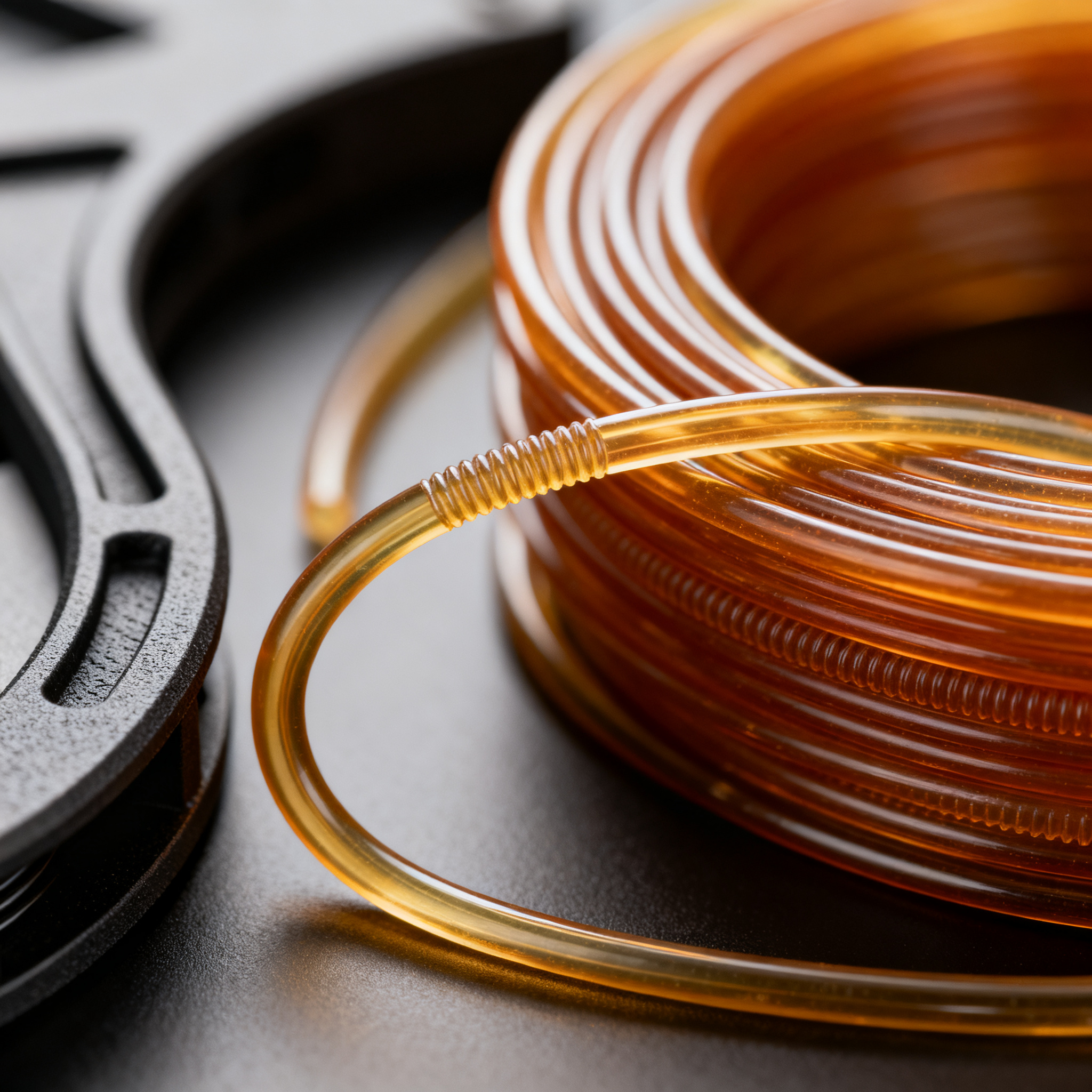
Flexible Filament: which one really bends without breaking?
Non tutti i filamenti definiti “flessibili” si comportano allo stesso modo. Alcuni si rompono dopo poche curvature, vanificando l’investimento e compromettendo la durata del pezzo stampato.
Choosing the right flexible material makes the difference between a functional component and mechanical failure. TPU and TPE dominate the consumer market, but their performance under repeated stress varies enormously.
TPU vs TPE: who wins in the field?
TPU offers greater resistance to elongation than TPE, but the latter guarantees a superior surface finish in many applications.
TPU (thermoplastic polyurethane) is the most common choice for applications requiring mechanical strength. Its molecular structure gives it excellent elastic memory and resistance to abrasion.
TPE (thermoplastic elastomer) stands out for its ease of printing and surface quality. It offers greater softness to the touch, a feature appreciated for cases and grips.
| Properties | TPU | TPE |
|---|---|---|
| Elongation resistance | High | Medium |
| Surface finishing | Medium | Higher |
| Printability | Medium | High |
| Abrasion resistance | Excellent | Good |
Shore A hardness determines the final behavior. TPU 95A offers the best compromise between flexibility and dimensional accuracy for most uses.
Cyclic bending test: who survives?
Practical tests show that some flexible filaments break after less than 100 bending cycles, while others withstand thousands of stresses.
The fragility of composite materials is a real problem. Filaments with additives like carbon or glass fibers show greater rigidity but lose elasticity. Even if stored correctly, they can break in the PTFE tube during feeding.
Laboratory tests on reinforced filaments have revealed that chamber heating does not improve the situation. On the contrary, temperatures of 65°C can increase fragility instead of reducing it.
CF (carbon fiber) and GF (glass fiber) filaments weaken the polymer matrix even after printing. Their usefulness for flexible applications is questionable.
Pure flexible filaments, without rigid additives, maintain consistent performance over time. Humidity remains the main enemy: hydrolysis causes bubbles and weak points that compromise cyclic resistance.
Real compatibility with your printer
Not all flexible filaments work on Bowden extruders: the distance between gear and hotend creates feeding problems with materials that are too soft.
Direct drive extruders represent the ideal solution for TPU and TPE. The minimal distance between motor and melting zone eliminates the risk of filament compression in the tube.
Bowden systems require filaments with a minimum hardness of 95A. Softer materials tend to bend in the long tube, causing clogs and failed prints. The print speed must drop below 40 mm/s to ensure a’constant feeding.
- Direct extruder: TPU from 85A to 95A, speed up to 60 mm/s
- Bowden: only TPU 95A or higher, maximum speed 40 mm/s
- Hotend temperature: 210-230°C for TPU, 200-220°C for TPE
- Heated bed: 50-60°C recommended for optimal adhesion
The’0.6 mm nozzle facilitates the’extrusion of flexible materials compared to the classic 0.4 mm. The reduced pressure decreases the risk of filament deformation before melting.
Casi d’uso concreti: dove conviene davvero
From gloves to cable cases, not every application requires the same type of flexibility. Shore hardness determines the suitability of the material.
Gaskets and seals require TPU 85A-90A to ensure sufficient deformation under pressure. Elastic memory must be high to maintain the seal over time.
Belts and transmission elements require TPU 95A. Abrasion resistance prevails over softness, while dimensional precision becomes critical for coupling with pulleys.
Protective cases and covers benefit from TPE for surface quality. L’aesthetic appearance matters as much as impact protection, and TPE offers more pleasant textures to the touch.
Grip elements and grips work better with TPU 90A-95A. The high coefficient of friction combines with sufficient mechanical strength for prolonged use.
Conclusion
Choosing the right flexible filament can make the difference between a working prototype and a mechanical failure. TPU 95A on a direct drive extruder represents the ideal starting point for most applications.
Shore hardness, extruder type, and l’final application determine which material to adopt. Avoid reinforced composite filaments if flexibility is a priority: rigid additives compromise l’elasticity.
Try TPU 95A on a direct drive extruder for the best compromise between durability and precision. Keep the filament dry and print at moderate speeds for reliable results.
article written with the help of artificial intelligence systems
Q&A
What is the main difference between TPU and TPE in terms of performance?
TPU offers greater tensile and abrasion resistance, making it suitable for demanding mechanical applications. TPE, on the other hand, stands out for ease of printing, superior surface finish, and greater softness to the touch. The choice depends on the balance between structural performance and aesthetic quality.
Why are flexible filaments reinforced with carbon or glass fibers not recommended for flexible applications?
Filaments reinforced with carbon or glass fibers increase rigidity but weaken the polymer matrix, reducing elasticity and cyclic resistance. Practical tests show that these materials can break after fewer than 100 bending cycles. For flexible applications, pure filaments without rigid additives maintain consistent performance and greater long-term durability.
What are the requirements for printing TPU with a Bowden extruder?
Bowden extruders require flexible filaments with a minimum hardness of 95A Shore, because softer materials tend to bend and compress in the PTFE tube causing jams. The print speed must drop below 40 mm/s to ensure consistent feeding. For softer materials, a direct extruder is preferable.
In which applications is it advantageous to use TPU 95A and why?
TPU 95A offers the best compromise between flexibility and dimensional accuracy, and is ideal for belts, transmission elements, and grips requiring abrasion resistance. On a direct extruder it allows speeds up to 60 mm/s, while on Bowden it represents the minimum usable hardness limit. Its elastic memory and mechanical resistance make it versatile for most functional applications.
How does humidity affect the performance of flexible filaments?
Humidity causes hydrolysis in flexible filaments, generating bubbles and weak points that compromise cyclic resistance and the lifespan of the printed part. Even pure filaments, if not stored properly, can lose their elastic properties over time. Keeping the material perfectly dry is essential to achieve reliable results and prevent premature breakage.