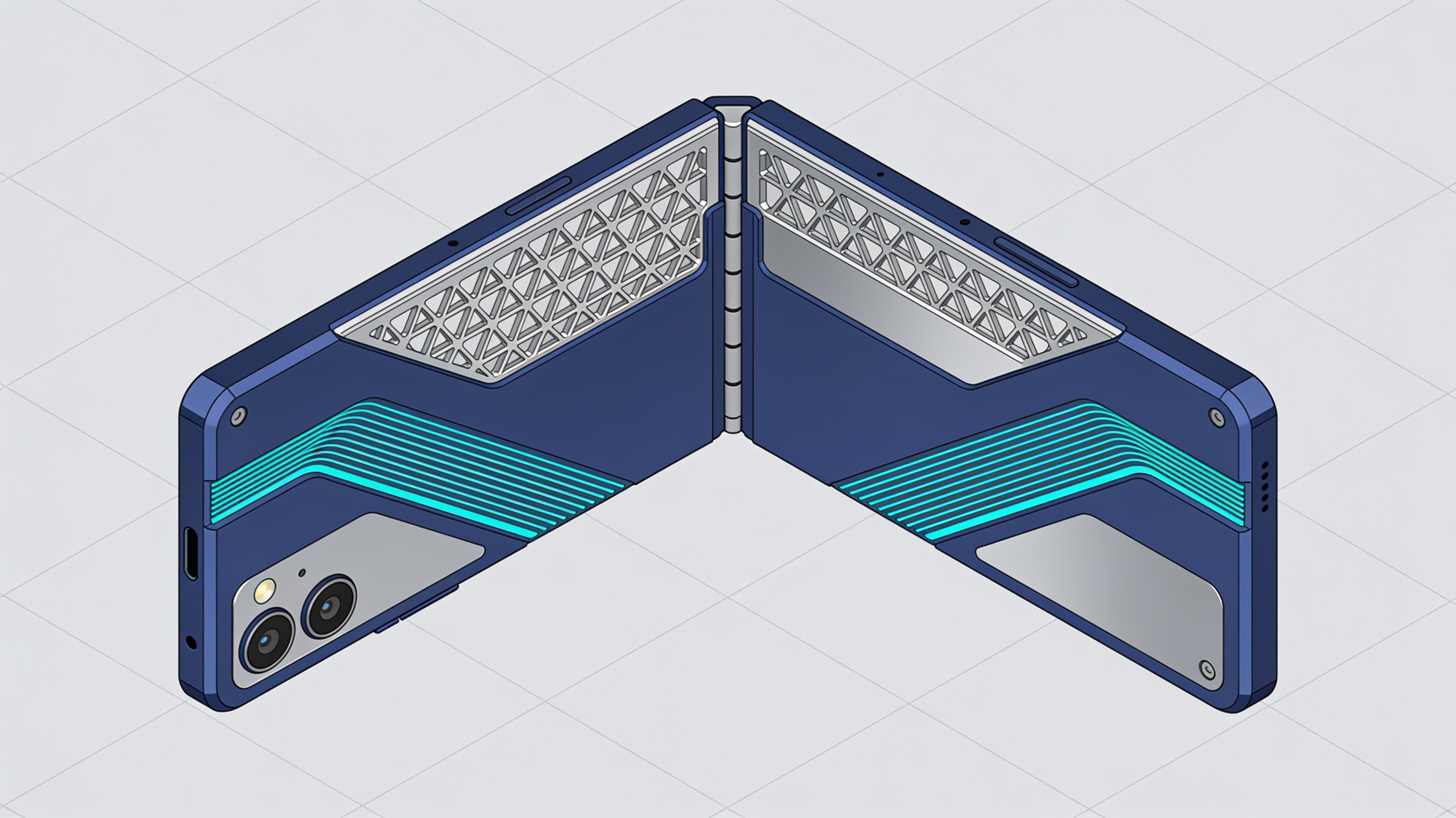
Apple brings 3D printing to its first foldable iPhone
Apple has unveiled iPhone Duo, its first foldable smartphone, which integrates a hinge cover made using 3D printing in 100% recycled titanium. The component represents a new application of additive manufacturing in Apple's production, after smartwatch cases and the USB-C port of the iPhone Air.
The choice of 3D-printed grade 5 titanium for this critical element marks an evolution in the technology's use by the Cupertino giant. The component is finished with micro-blasting to create a visual contrast with the mirror finish of the rest of the frame.
Technical specifications of the iPhone Duo
Apple's first foldable adopts a book-style configuration with a 7.6-inch internal display and maintains IP68 certification.
The iPhone Duo measures 5.2 mm thick when open and 11.3 mm when closed, with a weight of 254 grams. The 5.4-inch Super Retina XDR external display offers 90% of the screen area of the iPhone 18 Pro in a compact format.
The 7.6-inch internal panel features a nano-texture finish to reduce reflections. Both displays share the same aspect ratio, ensuring visual continuity when content moves from one screen to the other.
- External display: 5.4-inch Super Retina XDR
- Internal display: 7.6-inch foldable OLED
- Open thickness: 5.2 mm
- Weight: 254 grams
- Frame: Grade 5 titanium
- Certification: IP68
The hinge: over 100 components for a precise mechanism
Apple clarifies that only the external cover of the hinge is 3D printed, while the complete mechanism integrates over 100 engineered components.
The iPhone Duo's hinge has been designed to precisely control opening and closing, while also supporting the central part of the display. The mechanism includes internal support ribs to reinforce the structure and increase its rigidity.
The antenna divisions with ceramic fiber inserts further improve the rigidity of the frame. Apple describes the hinge as an element that offers “a smooth and satisfying feel with every use”.
It is important to note that Apple does not claim that the entire hinge is 3D printed. The element identified as additively manufactured is specifically the “hinge cover”, that is, the external cover of the complex mechanism.
The production process: likely LPBF
Although Apple has not officially communicated the process used, the use of 100% recycled titanium suggests the use of laser powder bed fusion.
TCT Magazine considers it likely that a metal powder bed process (LPBF) is used, consistent with that used by Apple in previous titanium applications. However, the company has not yet publicly communicated the specific process, machine, supplier, or parameters used.
The use of fully recycled titanium is consistent with Apple's previous additive manufacturing applications. The choice aligns with the company's plan to achieve carbon neutrality by 2030.
The iPhone Duo contains 35% recycled materials overall. The battery cobalt and the hinge cover titanium are 100% recycled. 60% of the energy used in the supply chain comes from renewable sources.
3D printing in foldable smartphones: Apple is not alone
Other manufacturers such as Oppo and Honor have already adopted additive manufacturing for similar components in their foldable devices.
The application of 3D printing for the hinge cover follows similar examples from other manufacturers. Oppo used the technology for the Find N5, while Honor used it in the Magic V2.
Apple had already integrated metal 3D printing into the cases of Apple Watch Series 11 and Apple Watch Ultra 3. The iPhone Air had seen the use of the technology for the USB-C port.
An evolution in the use of additive manufacturing
The hinge cover represents Apple's first application of 3D printing in a mechanically critical component of a smartphone.
This application marks an evolution from Apple's previous uses of the technology. The hinge is the most mechanically distinctive and stressed point of a foldable smartphone.
The choice of grade 5 titanium responds to the need for “incredible strength” required by the component. Micro-blasting creates an aesthetic contrast that visually distinguishes the hinge from the rest of the device.
The packaging of the iPhone Duo is made with 100% fibers and can be recycled by consumers at home, completing the product's sustainable approach.
article written with the help of artificial intelligence systems
Q&A
Which part of the iPhone Duo is made with 3D printing?
Only the external hinge cover is made via 3D printing, not the entire mechanism. The hinge assembly actually integrates over 100 distinct engineered components.
What material is used for the 3D-printed hinge?
The hinge cover is made from 100% recycled Grade 5 titanium. This component is subsequently finished with micro-blasting to create a visual contrast with the frame.
What 3D printing technology is Apple likely using?
Although not officially confirmed, the use of recycled titanium suggests the employment of Laser Powder Bed Fusion (LPBF), also known as DMLS or SLM. This hypothesis is supported by industry analyses such as those from TCT Magazine.
What are the dimensions and weight of the iPhone Duo?
The smartphone measures 5.2 mm in thickness when open and 11.3 mm when closed, with a total weight of 254 grams. It also maintains IP68 certification for water and dust resistance.
How are the iPhone Duo displays configured?
The device adopts a book-style configuration with a 7.6-inch foldable internal display and a 5.4-inch external one. Both screens share the same aspect ratio to ensure visual continuity.