Iran captures Anduril underwater drone made with large-format 3D printing
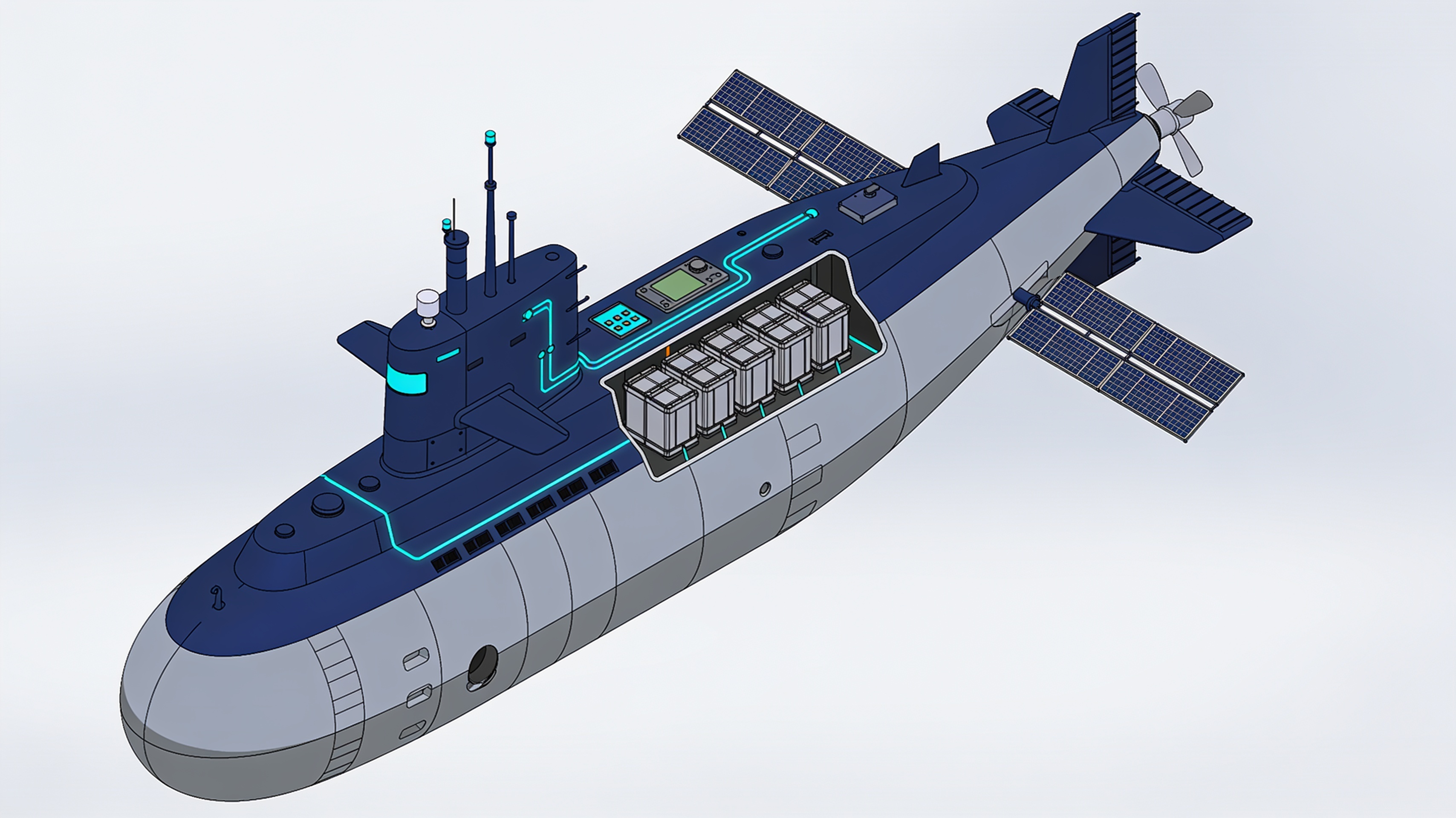
An autonomous underwater vehicle Dive-LD from Anduril Industries has ended up in the hands of Iranian forces at the Strait of Hormuz. The case draws attention to a platform that integrates large-scale robotic additive manufacturing, software autonomy, and modular architecture.
On September 8, 2026, the Navy of the Islamic Revolutionary Guard Corps of Iran (IRGC) announced the recovery of what it described as an advanced US unmanned submarine. The released photographs show an AUV compatible in hull shape, tail fins, and openings with Anduril's Dive-LD.
- Dive-LD drone recovered by Iran at the Strait of Hormuz on September 8, 2026
- Vehicle 5.8 meters long built with LFAM (Large Format Additive Manufacturing) technology
- The US confirms the loss but speaks of a malfunction, not an operational capture
- Declared autonomy up to 10 days, operational depth up to 6,000 meters
Conflicting versions of the incident
*US and Iranian authorities provide divergent accounts of the event, with no independent confirmation available.*
The United States acknowledged the loss of an underwater drone. However, a Pentagon spokesperson stated that the vehicle had suffered a malfunction more than a day earlier and had remained unusable at sea.
Washington clarified that it was a less recent model, used for reconnaissance of regional waters. According to the official US version, the vehicle contained no sensitive data or classified sonar or radar.
There is currently no independent confirmation of the Iranian description of an actual operational “capture.” The identification of the vehicle as belonging to the Dive-LD family, however, is substantially confirmed.
Technical characteristics of the Dive-LD
*The vehicle represents an example of large-scale robotic 3D printing applied in the military and underwater domain.*
The Dive-LD (Large Diameter Autonomous Undersea Vehicle) is an AUV approximately 5.8 meters in length and 1.2 meters in diameter. It is designed to carry out long-duration autonomous missions without personnel on board.
Anduril declares an operational endurance of up to about 10 days. The maximum reachable depth is 6,000 meters, a value that allows access to most of the ocean floor.
| Parameter | Declared value |
|---|---|
| Length | approximately 5.8 m |
| Diameter | approximately 1.2 m |
| Maximum autonomy | approximately 10 days |
| Operating depth | approximately 6,000 m |
| Payload volume | over 1 m³ |
The system has over one cubic meter of available volume for payload. This feature allows the configuration to be modified according to the mission without completely redesigning the vehicle.
The role of additive manufacturing
*Large-format 3D printing (LFAM) has been integrated into the development of the Dive-LD through collaborations with national laboratories and specialized suppliers.*
The Dive-LD combines software autonomy, modular architecture, and Large Format Additive Manufacturing (LFAM). This large-scale robotic 3D printing technology has been used in the vehicle's production process.
Large-scale robotic 3D printing technology that allows the production of components of significant size, reducing time and costs compared to traditional methods. In the naval and defense sector, it enables rapid prototyping and customization of platforms.
The original Dive-LD project comes from Dive Technologies, a startup founded in Boston by Bill Lebo and subsequently acquired by Anduril Industries. Dive Technologies used the BAAM (Big Area Additive Manufacturing) system developed by Cincinnati Incorporated in the early developments.
The collaboration with Oak Ridge National Laboratory (ORNL) supported the integration of additive technologies into the project. This partnership made it possible to leverage advanced expertise in large-scale additive manufacturing.
Implications for additive manufacturing in the defense sector
*The case highlights how large-scale 3D printing is becoming strategic for advanced military applications.*
The incident brings into the spotlight the growing use of additive manufacturing in critical military applications. The ability to produce large, complex components reduces development times and increases operational flexibility.
The final destination of the naval supply chain supported by the Dive-LD project is the U.S. Navy. The integration of LFAM technologies into operational platforms demonstrates the maturity achieved by these production processes.
Anduril's family of autonomous vehicles also includes the Dive-XL, another model that shares the design approach based on modularity and additive manufacturing.
article written with the help of artificial intelligence systems
Q&A
When and where was the Anduril drone recovered by Iran?
The recovery took place on September 8, 2026, in the Strait of Hormuz by the Navy of the Islamic Revolutionary Guard Corps. Authorities announced the discovery of what they describe as an unmanned US submarine.
What are the dimensions and endurance of the Dive-LD drone?
The vehicle is approximately 5.8 meters long with a diameter of 1.2 meters and is designed for autonomous missions lasting up to 10 days. It can operate at declared maximum depths of 6,000 meters, covering most ocean floors.
What 3D printing technology was used to build the drone?
The Dive-LD is built using LFAM (Large Format Additive Manufacturing) technology, a form of large-scale robotic additive manufacturing. This technique enables the construction of large hulls with a modular architecture.
What is the official US version of the incident?
The Pentagon confirmed the loss of the vessel, attributing it to a technical malfunction that occurred more than a day before the Iranian recovery. Washington maintains that the drone was inoperable and carried no sensitive data or classified systems.
Did the recovered drone contain weapon systems or classified data?
According to the official US account, the vehicle was an older model used for reconnaissance and did not contain sonar, classified radar, or sensitive data. There is no independent confirmation of weapons on board.