Mix colors without threads? Here's how
The new color mixing tool in Bambu Studio allows you to obtain infinite shades without having to buy dozens of spools: here's how it really works.
How visual mixing works in layers
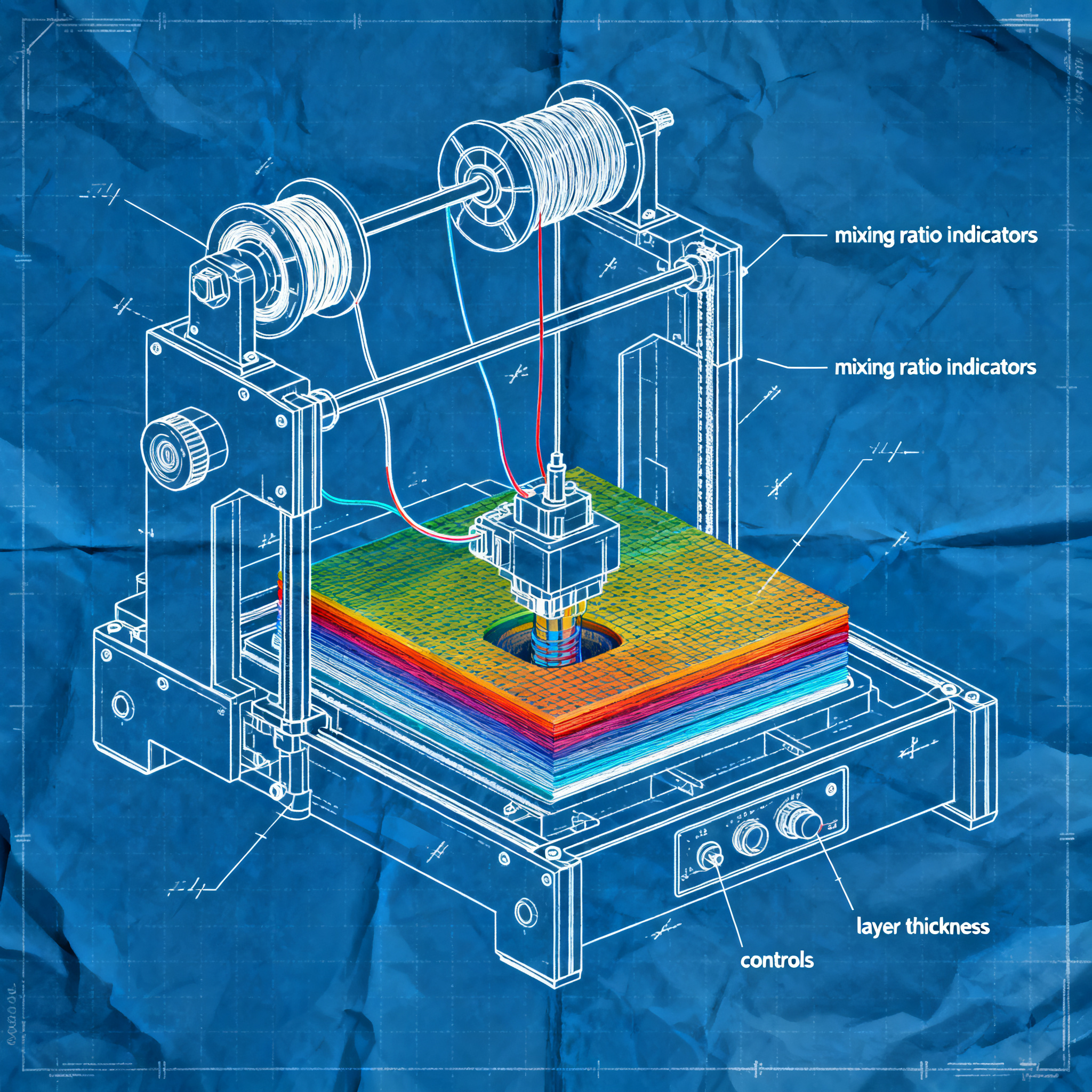
The color effect is generated by alternating layers of different filaments, leveraging the visual resolution of the human eye.
Bambu Studio 2.5.3 introduced the Color Mixing, a function that creates new shades starting from two or three already loaded filaments. The key point is that the software does not physically fuse the materials.
The chromatic result comes from the controlled alternation of layers or patterns of different materials. When the layers are thin enough, the eye perceives an intermediate tint rather than the separate individual colors.
- The system alternates layers of different filaments to create an optical effect
- No chemical fusion occurs: it is a principle similar to half-tone printing
- Yield depends on the Transmission Distance, that is, the material's capacity to let light pass through
The principle is based on the concept of Transmission Distance, described by developer Ratdoux. If the material allows some light to pass through and the layers are thin, the observer no longer distinguishes separate colors but sees a combined tone.
Add a mixed filament in Bambu Studio
The ‘Add Mixed Filament’ function allows you to define custom combinations between PLA, PETG or other compatible materials.
Access to the function occurs via the button “Add Mixed Filament” in the filament list. The system allows you to define a “mixed filament” via a ratio between two or three filaments of the same type.
In Normal mode Normal, the user adjusts the color ratio to achieve a uniform tint. Bambu Lab shows the CMYK kit as an example: a few base spools generate a much wider range of color combinations.
Procedure
- Filament selection: Choose two or three filaments of the same type already loaded in the project.
- Ratio definition: Set the percentage ratio between colors in Normal mode.
- Application to the model: Assign the mixed filament to the desired parts of the 3D model.
The most evident advantage is the ability to obtain many more tints from a smaller number of spools. This becomes more interesting on multi-nozzle machines, as it reduces the purge impact compared to single-nozzle solutions.
Gradient mode: seamless transitions
With Gradient mode, you can transition smoothly from one color to another, ideal for decorative finishes or advanced prototypes.
The Gradient mode builds progressive transitions between two colors. The software automatically manages layer alternation to create continuous gradients.
This feature is particularly useful for text, decorations, panels, and surfaces with light gradients. Visual rendering depends on the part's geometry and surface orientation.
In release 2.5.3, Bambu Lab also added Filament Track Switch support for H2C and X2D multi-extruder platforms, which allows routing filament from the AMS to both nozzles and reducing unnecessary steps.
The system does not completely replace traditional multicolor flows. It is an evolving tool that makes a logic previously reserved for advanced users and experimental forks more accessible.
Digital mixing limits and best practices
Some precautions avoid common errors and ensure consistent results, especially with different materials or complex structures.
Bambu Lab defines Color Mixing as an experimental function. Inclined surfaces, top layers, and highly curved areas may have less predictable results compared to vertical walls.
The function is based on the approach developed by Ratdoux in the fork OrcaSlicer-FullSpectrum on GitHub. Bambu Lab acknowledges that the color prediction part comes from this open-source community work.
| Appearance | Advantage | Limit |
|---|---|---|
| Color variety | Infinite shades from a few spools | Optical effect, not real blending |
| Geometries | Excellent on vertical walls | Less predictable on curves and top layers |
| Machines | Effective on multi-nozzle | Not universal for every printer |
For optimal results, use materials of the same type and focus mixing on geometries with well-defined vertical walls. Always verify the preview before starting the print.
Color mixing in Bambu Studio opens up unprecedented creative scenarios, but requires targeted configuration for professional results. Try creating a multicolor model today and discover how a few clicks can transform your printing workflow.
article written with the help of artificial intelligence systems
Q&A
How does visual color mixing work in Bambu Studio?
Visual mixing is based on the controlled alternation of layers of different filaments. When the layers are thin enough, the human eye perceives an intermediate shade instead of the individual colors.
What is the main advantage of using Color Mixing in Bambu Studio?
The main advantage is being able to obtain many more shades starting from a reduced number of spools, reducing costs and simplifying material management, especially on multi-nozzle machines.
What does 'Transmission Distance' mean in the context of color mixing?
Transmission Distance indicates the material's ability to let light pass through. If the material is semi-transparent and the layers are thin, the eye perceives a combination of colors instead of individual tones.
What are the two available modes for color mixing in Bambu Studio?
The two modes are Normal, which allows obtaining uniform tints by adjusting color proportions, and Gradient, which creates smooth and continuous transitions between two or more shades.
What limitations does the current color mixing system in Bambu Studio have?
The system is considered experimental and may produce less predictable results on inclined surfaces, top layers, and curves. Moreover, it works best with materials of the same type and on vertical walls.