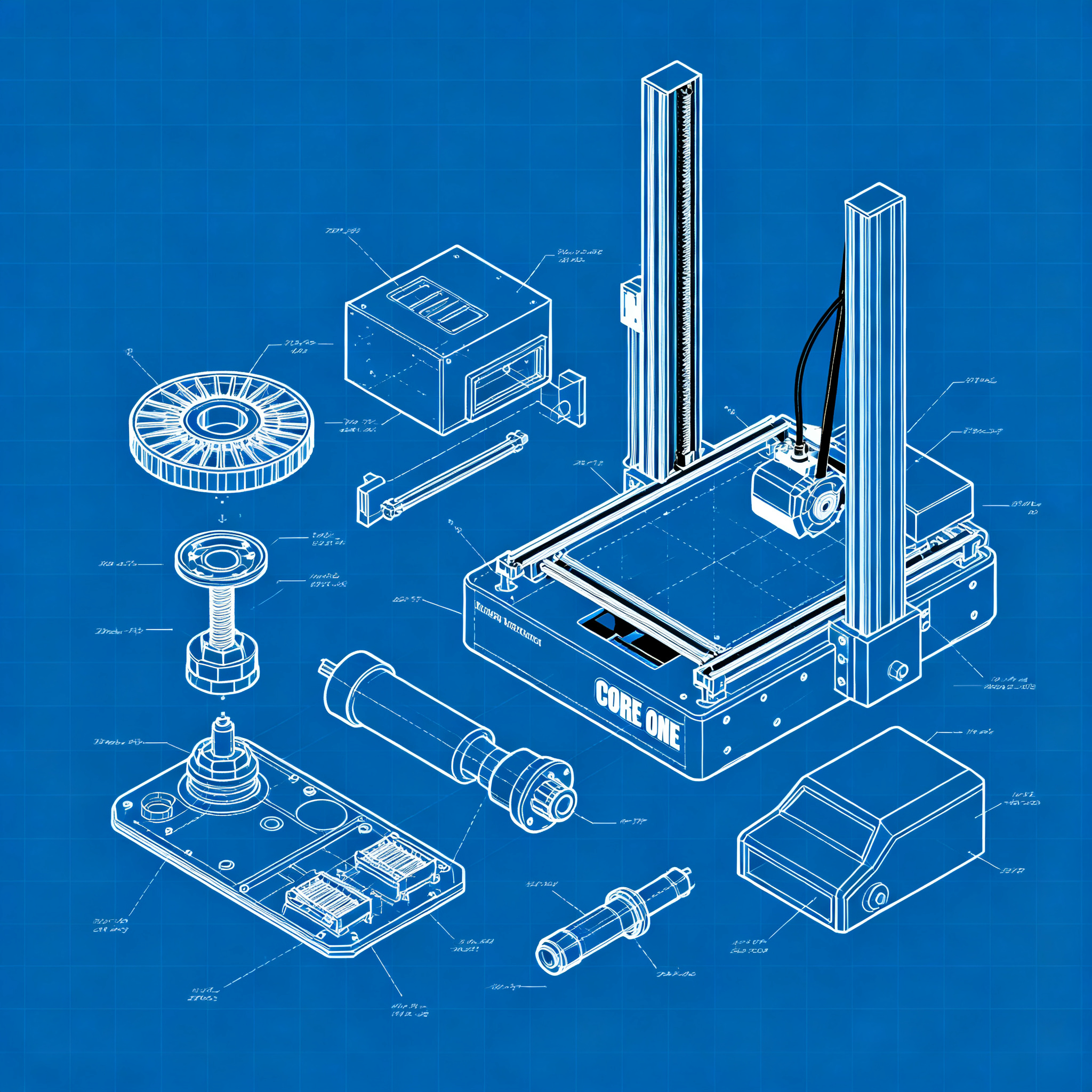
Can you really 3D print the CORE One?
Prusa has released the complete CAD files for the CORE One under a new open-source license designed to balance maker freedom and company protection. Discover what you can concretely do with these files.
Prusa Research has published the complete CAD files for the CORE One and CORE One L under the Open Community License (OCL), a license created specifically for hardware. The files are immediately downloadable in STEP and Fusion 360 formats.
The new license allows modifying, sharing, and using designs even in internal commercial contexts. However, it is not permitted to sell complete machines or remixes based on these files without a separate agreement with Prusa.
- Complete CAD files available in STEP and Fusion 360
- OCL License: allows modifications, sharing, and internal productive use
- Direct sale of machines or derivatives prohibited without agreement
- Includes patent protection and right to repair
What is the OCL and why it changes everything
The Open Community License redefines the terms of sharing for open hardware projects, opening new possibilities for advanced users without giving up protection for the original work.
The OCL is a single-page license, written to be understandable without the intervention of lawyers. It includes practical examples directly in the document to clarify what is and is not allowed.
The license arises from a concrete problem: traditional licenses for software (GPL, Creative Commons) do not work well for physical hardware. The GPL requires about 6,000 words of complex definitions and forces permission for commercial exploitation. A corporation could therefore take your design, mass-produce it, and “respect” the license simply by uploading a messy zip file online.
Creative Commons BY-NC licenses come closer to the goal, but explicitly exclude patent rights. You might own the copyright on the file, but be sued for the mechanism inside it. The OCL instead includes a explicit patent license grant, creating a safe harbor for those who use the files legitimately.
Modify and produce: what you can do today
Discover exactly which actions are allowed on the CORE One CAD files and how to integrate them into your personal or business projects.
As a maker or hobbyist you have complete freedom. You can download the files, inspect them, and learn from the complete structure of the assemblies. You can modify them and share your modifications under the same OCL license.
For companies, OCL resolves the ambiguity of “Non-Commercial” licenses. It is possible to build and modify machines based on the original designs for their own internal production. You can use these designs to manage your own business and earn; you are simply not allowed to earn by selling the machines themselves directly.
What you can do concretely
- Download and study: Upload the STEP files in Fusion, Blender, or your preferred CAD to plan modifications or workshop layouts.
- Create accessories: Design mods, upgrades, or custom accessories for your CORE One.
- Produce spares: Print or produce spare parts to keep your machines running, both at home and in the company.
- Share: Publish your modifications in the community under the same OCL license.
The right to repair is encoded in the license. Under strict interpretations of “Non-Commercial” licenses, even a company producing a spare part to repair its own machine could violate the terms. The OCL removes this ambiguity.
Clear limits: where freedom stops
Even with an open license, there are well-defined constraints on resale and direct commercial redistribution that protect the original work.
The main restriction is clear: you cannot commercially exploit the design files selling the product or remix without a separate agreement. This means you cannot start a production of CORE One clones and sell them.
The OCL also includes a clause against text and data mining automated. Products under OCL cannot be subject to systematic data collection or mining activities without explicit permission. This protection is particularly relevant in the era of AI training on public datasets.
The OCL applies to intellectual property, not physical products. If you purchase a CORE One, that machine is yours and you can do what you want with it. The license regulates what you can do with the design files.
The license is not recognized as “open source” according to the definitions of OSI (Open Source Initiative) or OSHWA (Open Source Hardware Association), which explicitly require the possibility of selling derived products. Prusa is aware of this distinction and has chosen this path anyway to protect the community's work from predatory exploitation.
A case in point: designer Soozafone released her Lucky 13 figures under Creative Commons. A foreign entity filed a US design patent on her models and now demands over $10,000 a year in royalties, threatening the original upload as well. Prusa is funding the legal battle, but the OCL would have provided additional legal weapons: breach of contract in addition to prior art evidence.
Conclusion
The opening of the CORE One files marks a turning point in the open-source hardware movement. The OCL represents a pragmatic attempt to break out of the vicious cycle: openly sharing and seeing your work exploited, or closing everything and losing what made the project valuable.
The license is not perfect and the community continues to discuss its limitations. But for the first time it offers a specific tool for hardware that balances openness and the sustainability of the model.
Download the files from the Prusa Research blog, read the OCL license carefully, and start designing: the future of open hardware is already here.
article written with the help of artificial intelligence systems
Q&A
What CAD files has Prusa released for the CORE One and under which license?
Prusa has released the complete CAD files for the CORE One and CORE One L under the Open Community License (OCL), an open-source license specifically created for hardware. The files are available in STEP and Fusion 360 formats.
What does the OCL license allow you to do with the CORE One files?
The OCL license allows you to modify, share, and use the files even for internal commercial purposes, such as producing accessories or spare parts. However, it is not permitted to sell complete machines or derivatives without a separate agreement with Prusa.
What concrete activities can I perform with the CORE One CAD files?
You can download and study the files to learn or design modifications, create custom accessories or upgrades, produce spare parts for personal or business use, and share your modifications under the same OCL license.
What limitations does the OCL license impose on the CORE One files?
It is not allowed to directly sell complete machines or remixes based on the files without an agreement with Prusa. Furthermore, using the files for automated text and data mining activities is prohibited without explicit authorization.
Why did Prusa create the Open Community License (OCL)?
Prusa created the OCL to overcome the limitations of traditional licenses, which do not adequately protect physical hardware. The OCL includes an explicit patent rights grant and clarifies modification rights, internal use, and repair rights, preventing predatory exploitation.