90% Uptime? The truth about industrial 3D printers
Not all 3D printers defined as “industrial” can withstand the challenges of continuous manufacturing: here is how to measure their real uptime.
What does industrial uptime really mean?
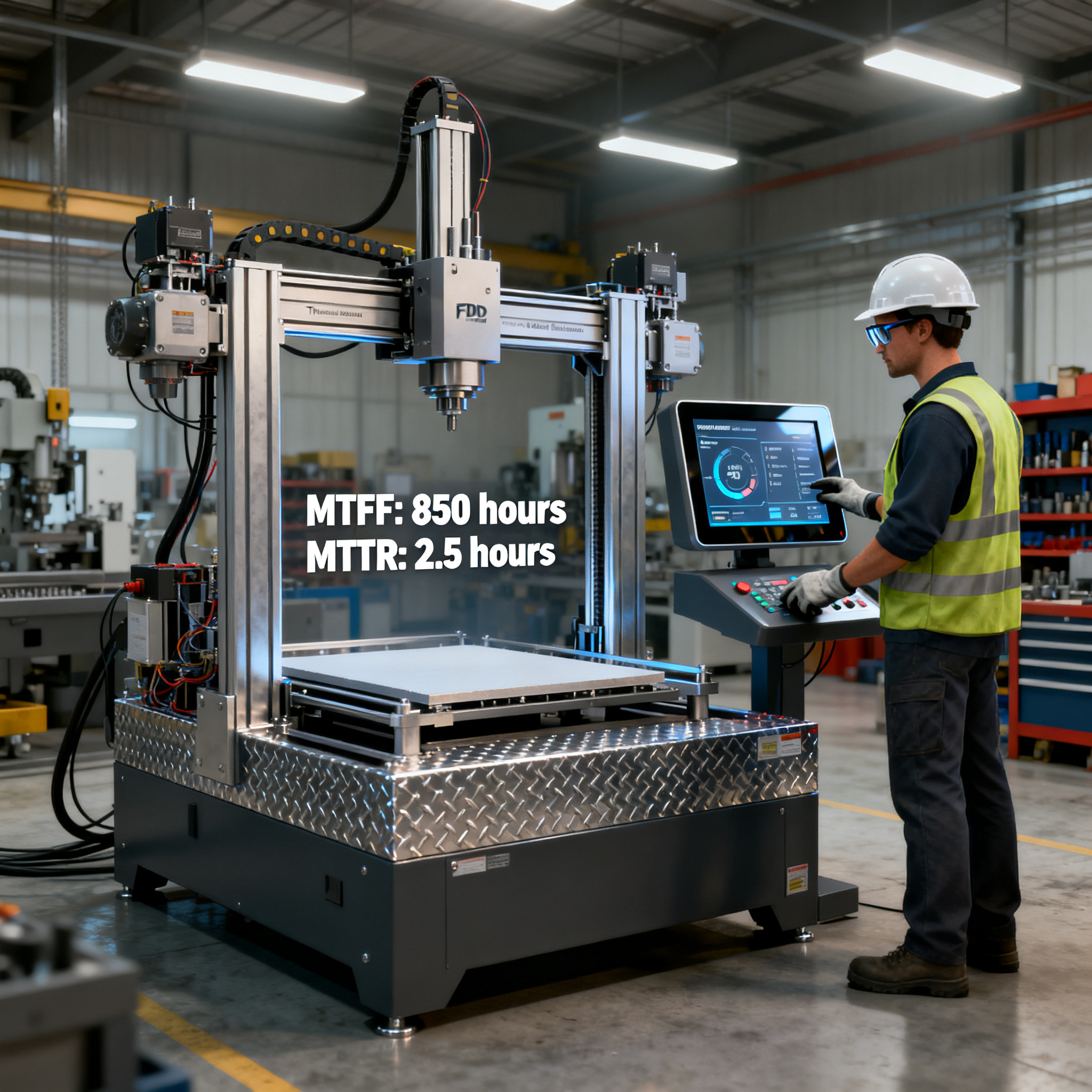
Real uptime goes beyond theoretical availability: a clear judgment metric such as MTBF and mean time to recovery is needed.
When a manufacturer declares “industrial performance”, the first parameter to verify is actual uptime. It is not enough for a machine to reach high temperatures: measurable operational continuity is required.
Uptime above 90% represents the minimum standard for serious manufacturing. This means less than 73 hours of downtime per year on continuous production. MTBF (Mean Time Between Failures) becomes the true indicator of reliability.
- MTBF: mean time between consecutive failures
- MTTR: mean time to recovery after downtime
- Operational availability: percentage of effectively productive time
- Calibration: frequency of realignment interventions
Systems with open-source electronics and complete documentation allow for rapid diagnostics. Vision Miner states that its 22 IDEX V4 handles 80-90% of high-temperature FDM applications precisely thanks to automatic calibration routines that reduce setup times.
The difference between hobby and industry emerges in construction details. Welded steel frames, external motors with Trinamic drivers, and mechanical auto-leveling systems maintain calibration over time without frequent interventions.
Main sources of downtime in professional systems
Extreme temperatures, components subject to wear, and human interventions represent the main bottlenecks.
Thermal management is the first cause of downtime in high-temperature systems. Printing PEEK or ULTEM requires actively heated chambers up to 100°C, beds at 200°C, and nozzles at 500°C. Every thermal component represents a potential point of failure.
Systems with passive heating show irregular thermal distribution. This generates mechanical stress on components and increases the risk of part deformation, which leads to rework or scrap.
| Cause of downtime | Impact on uptime | Solution |
|---|---|---|
| Calibration drift | Medium-high | Mechanical self-leveling |
| Nozzle wear | Medium | Abrasion-resistant materials |
| Thermal instability | High | Actively heated chamber |
| Operator errors | Variable | Automation and training |
Mechanical wear affects especially systems that process composite materials with carbon fibers. Standard nozzles wear out quickly, requiring frequent replacements that halt production.
Human interventions remain a critical variable. Machines that require frequent manual calibration or complex setup procedures multiply the opportunities for error. One-touch automation drastically reduces this source of downtime.
Benchmark: who truly holds up over time?
A comparison based on real operating data and service reports shows who offers greater operational stability.
Field performance data separate promises from reality. Vision Miner reports that its 22 IDEX V4, after five years of industrial use in military, oil & gas, and medical sectors, has demonstrated above-average reliability.
The platform reaches speeds of 500 mm/s with accelerations of 15,000 mm/s² while maintaining precision. The automatic belt tensioning system and filament depletion detection keep production constant.
Desktop FDM printers offer tolerances of ±0.5 mm, while industrial systems reach ±0.2 mm. This difference becomes critical in aerospace and automotive applications where mechanical integrity is non-negotiable.
Manufacturers like Stratasys and 3DGence develop proprietary material portfolios designed for greater reliability. The cost is 5-6 times higher than consumer filaments, but the consistency of results justifies the investment in regulated environments.
3DGence declares speeds up to 400 mm/s with dual extrusion on INDUSTRY F421 models. Compatibility with certified materials and integration with proprietary SLICER 4.0 and CLOUD software guarantees complete traceability.
Remote control via CLOUD allows real-time monitoring, print queue management, and direct diagnostic assistance. This reduces MTTR because technicians can intervene before a minor issue becomes a prolonged downtime.
Invest in continuity, not in specifications
Choosing an industrial 3D printer means investing in operational continuity: the numbers don't lie.
The difference between a 15,000 euro machine and a 150,000 euro machine is not only in the maximum temperatures. It is in the ability to maintain those temperatures constant, day after day, without drift or unexpected stops.
Rigid frames eliminate vibrations that create microscopic imperfections. These structural weaknesses compromise the vertical strength (Z-axis) of critical components. In aerospace or medical, a failure can cost human lives.
Real uptime only emerges after months of continuous production. Asking for detailed field performance reports, verifiable MTBF data, and references from clients in regulated industries is the only way to assess actual reliability.
Verify uptime and reliability data before purchase — ask for the complete field performance reports.
article written with the help of artificial intelligence systems
Q&A
What is the minimum acceptable uptime standard for an industrial 3D printer?
Uptime above 90% is the minimum standard for serious manufacturing. This means less than 73 hours of downtime per year in continuous production.
What are the main metrics for evaluating the reliability of an industrial 3D printer?
Key metrics are MTBF (mean time between failures), MTTR (mean time to recovery), operational availability, and calibration frequency.
Which construction factors most influence the uptime of a professional 3D printer?
Welded steel frames, externalized motors with Trinamic drivers, mechanical self-leveling, and automation reduce manual interventions and improve long-term stability.
Why is thermal management crucial for the uptime of high-temperature industrial printers?
Extreme temperatures required for materials like PEEK or ULTEM increase the risk of thermal component failures. Actively heated chambers help maintain thermal stability and reduce downtime.
How do abrasive materials affect the uptime of 3D printers?
Composite materials with carbon fibers cause rapid nozzle wear, requiring frequent replacements. Nozzles made from abrasion-resistant materials can mitigate this issue.