AM PravaH 3.0 introduces component-scale simulations and support for WAAM
Paanduv Applications has released AM PravaH 3.0 “Enchanting Eagle”, which takes metal additive manufacturing simulation beyond the local melt pool scale. The new version includes a part-scale thermomechanical analysis module and tools dedicated to wire-arc deposition.
The simulation of metal additive processes must address an intrinsic challenge: physical phenomena operate at very different dimensional scales. The updated software responds to this complexity with new computational capabilities.
From the melt pool to the complete component
Traditional simulations focus on local dynamics, but the final deformation of a component arises from the accumulation of thousands of thermal events distributed over time and space.
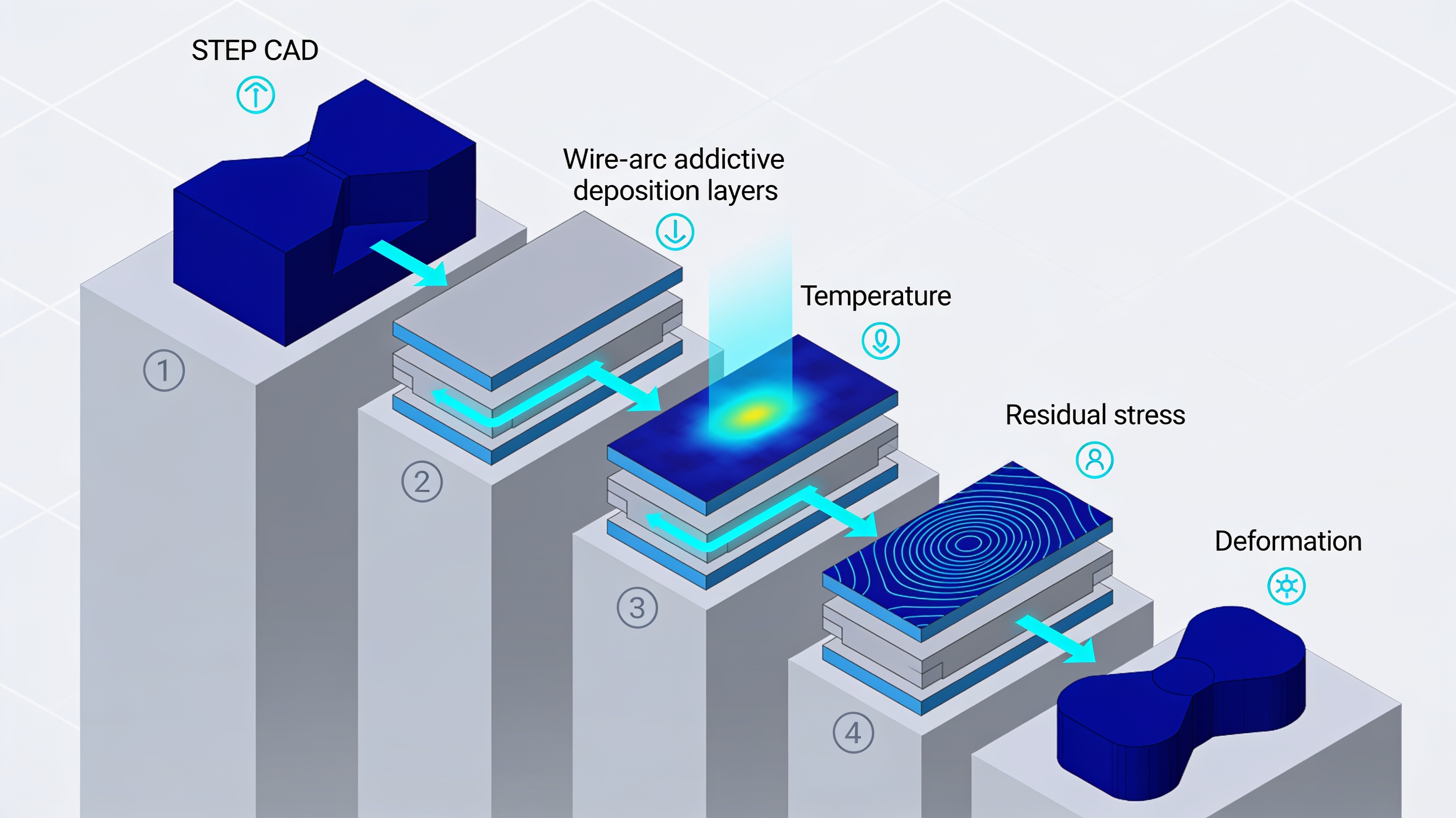
The new Part-Scale module uses finite element methods to analyze the thermomechanical response at the level of the entire component. This scale is essential for predicting how a part will behave after removal from manufacturing constraints.
The results provided by the module include temperature distributions, deformations, and residual stresses. Direct import of STEP files simplifies the transition from CAD geometry to the analysis model.
- Part-Scale module for component-scale FEM thermomechanical analysis
- Support for Wire Arc Additive Manufacturing (WAAM) processes
- New path definition functions for LPBF
- Import of CAD geometries via STEP files
Approximations required for computational feasibility
A component-scale model cannot represent every powder particle while maintaining reasonable computation times. Effective descriptions are needed that balance accuracy and computational cost.
When using a moving heat source, such as formulations inspired by the Goldak model, the size and distribution of the energy input require calibration against the actual process. It is not enough to select a known model to obtain accurate results on any machine or alloy.
Discretization, boundary conditions and material properties remain critical choices that the user must define according to the specific objectives of the analysis.
Extension to Wire Arc Additive Manufacturing
WAAM has profoundly different physics from powder bed processes: energy levels, bead dimensions, deposition rates and thermal phenomena change radically.
The extension to WAAM represents one of the most significant innovations of version 3.0. To correctly configure a simulation of this process, specific parameters are needed: current, voltage, travel speed, wire feed, trajectory and pauses between passes.
The layering of relatively large beads, typical of WAAM, generates different deformation dynamics compared with Laser Powder Bed Fusion. Models must capture these differences to provide reliable predictions.
WAAM deposits larger beads with higher energy inputs than LPBF. This leads to different thermal gradients, different cooling rates, and consequent variations in residual stresses and final deformations.
Multiple scales, integrated tools
Effective simulation of additive manufacturing requires tools that operate at different scales: from the local physics of the melt pool to the global mechanical response of the component.
AM PravaH 3.0 positions itself as a solution that covers this spectrum. The ability to analyze both local thermal dynamics and overall deformation allows engineers to optimize processes with a more complete view.
The first verified documentation of the release dates to November 4, 2026. Paanduv Applications has not confirmed an earlier date for the original release.
article written with the help of artificial intelligence systems
Q&A
What are the main new features of AM PravaH 3.0?
Version 3.0 "Enchanting Eagle" introduces a Part-Scale module for FEM thermomechanical analysis at the component scale, support for Wire Arc Additive Manufacturing (WAAM), new path definition functions for LPBF, and CAD geometry import via STEP files.
What does the new Part-Scale module allow you to analyze?
The Part-Scale module uses finite element methods to analyze the thermomechanical response of the entire component. It provides temperature distributions, deformations, and residual stresses, useful for predicting the part's behavior after removal from manufacturing constraints.
Why does component-scale simulation require approximations?
A component-scale model cannot represent every powder particle while maintaining reasonable computation times. Effective descriptions are needed that balance accuracy and computational cost, for example by calibrating the moving heat source against the actual process.
What parameters are needed to simulate WAAM in AM PravaH 3.0?
Configuring a WAAM simulation requires specific parameters such as current, voltage, and travel speed, since the process has profoundly different physics from powder bed processes in terms of energy levels, bead dimensions, and deposition rates.
How are CAD geometries imported in AM PravaH 3.0?
Direct import of STEP files simplifies the transition from CAD geometry to the analysis model. This allows thermomechanical simulations at the component scale to be set up more quickly.