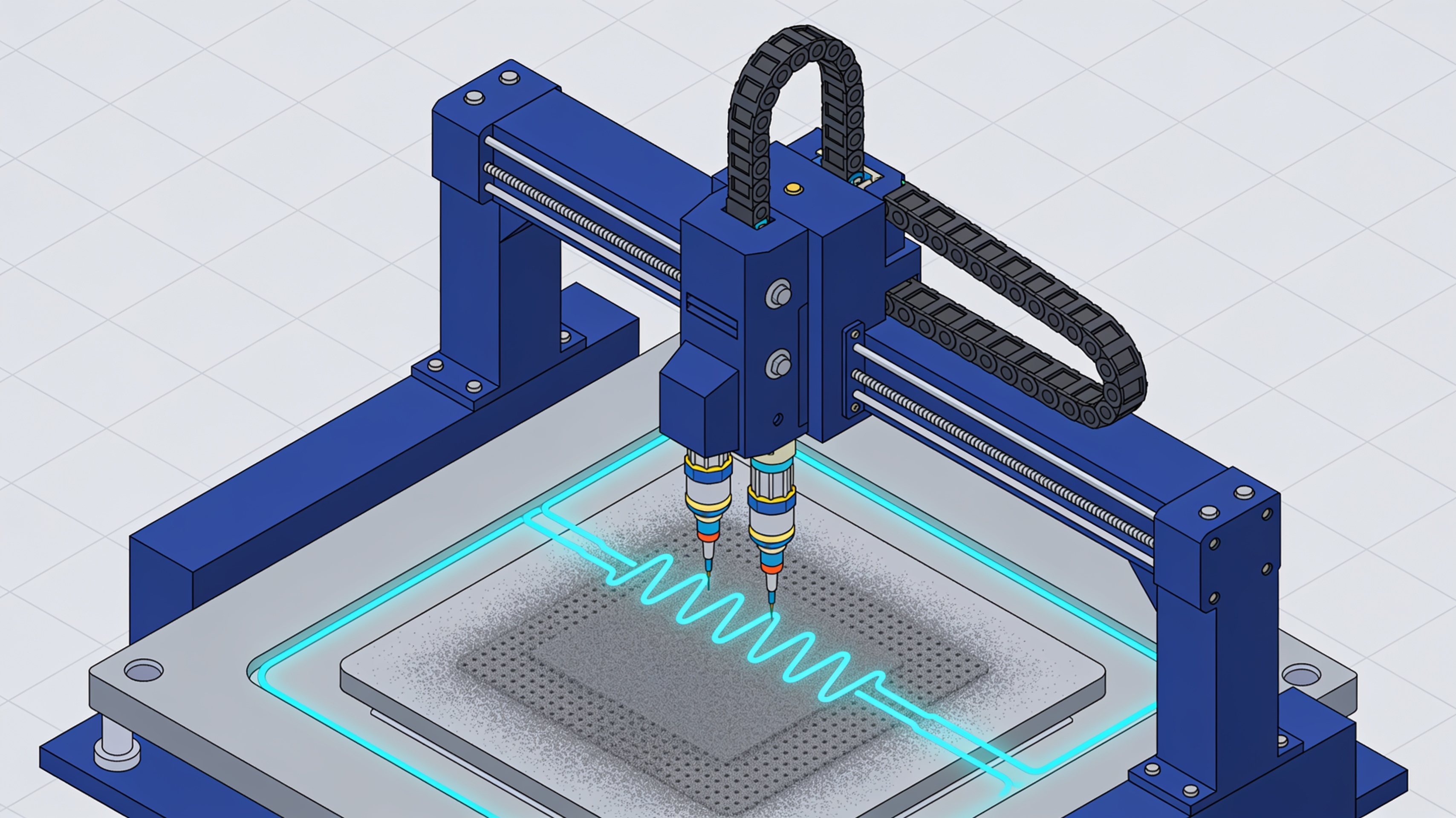
MatterWave: mechanical waves to control solidification in metal 3D printing
The US startup MatterWave has developed a retrofit module that transmits calibrated mechanical vibrations during the cooling of molten metal. The goal is to solve one of the most critical problems of laser powder bed fusion: the inability to control the solidification phase, which generates residual stresses, cracks, and variability between components.
According to the first results reported by the company, the fatigue life of components can increase by up to ten times compared with conventional prints.
- Daedalus is a retrofit module that is installed on the build platform of existing LPBF printers
- It transmits mechanical vibrations (phonons) during solidification to control the crystalline structure
- Fatigue life can increase by up to 10 times compared with traditional prints
- Compatible with most LPBF machines on the market
The problem of passive cooling
Laser powder bed fusion has reached high maturity in the melting phase, but cooling remains an uncontrolled process that limits the alloys that can be reliably printed.
Today only a few metal alloys can be printed with repeatable results. The main cause is the cooling and solidification phase, which occurs passively. When the melt pool solidifies without control, residual stresses and cracks are generated.
The consequences are costly: long post-process heat treatments, extensive qualification testing, and poor batch-to-batch repeatability. This limits the adoption of the technology in critical sectors such as aerospace.
How Daedalus works
The module introduces vibrations at specific frequencies during solidification, directly influencing the nucleation and orientation of metal crystals.
Daedalus consists of a series of stacked transducers that are installed at the build platform. During printing, the module transmits calibrated mechanical vibrations to the melt pool as it solidifies.
These vibrations are phonons, the mechanical counterpart of photons. The frequency and amplitude are adjusted based on the thermomechanical properties of each material. In this way, the system influences the crystalline structure of the metal in real time.
Phonons are quanta of vibrational energy that propagate through matter. In Daedalus's case, they are used to modify the metal's behavior during the transition from liquid to solid.
From academic research to retrofit
Alex Tiliță has dedicated more than fifteen years to research on metal additive manufacturing, concluding that the key is to control the formation of crystalline structures during cooling.
The CEO and founder of MatterWave developed the technology during his PhD and postdoc at the Hong Kong University of Science and Technology. Starting from wave physics, he identified cooling as the critical point for improving fatigue life and repeatability and for reducing heat treatments.
Initially MatterWave intended to build a proprietary printer. After relocating to the United States, however, the team changed strategy. The LPBF machines already available on the market were sufficiently advanced: it made more sense to focus on the proprietary technology rather than developing an entire machine from scratch.
Compatibility and applications
Since the module interfaces only with the build volume, it can be adapted to almost all existing LPBF printers.
Daedalus is designed as a universal retrofit. This strategic choice allows MatterWave to reach a much broader market than that of a single proprietary machine.
Potential customers' interest focuses on hard-to-print alloys such as Hastelloy, which emerged during the International Conference on Advanced Manufacturing. These superalloys are critical for high-temperature applications but have a high tendency to crack with conventional LPBF processes.
Outlook
MatterWave's technology represents an innovative approach to a structural problem in metal 3D printing. If the preliminary results are confirmed at industrial scale, active control of solidification could significantly expand the number of alloys that can be reliably printed.
The choice of the retrofit model lowers barriers to adoption: users can integrate the technology into existing machines without replacing the entire installed base. The effectiveness on different materials and complex geometries remains to be verified.
article written with the help of artificial intelligence systems
Q&A
What is Daedalus by MatterWave?
Daedalus is a retrofit module that is installed on the build platform of existing LPBF printers. It transmits calibrated mechanical vibrations during the solidification of molten metal to control its crystalline structure.
What benefits does solidification control through vibrations offer?
According to the first results reported by the company, the fatigue life of components can increase by up to ten times compared to conventional prints. Solidification control also aims to reduce residual stresses, cracks, and batch-to-batch variability.
Why is passive cooling a problem in LPBF?
In laser powder bed fusion, cooling and solidification occur passively and uncontrolled. This generates residual stresses and cracks, requires long post-process heat treatments and extensive qualification testing, and limits the alloys that can be reliably printed.
How do the mechanical vibrations used by Daedalus work?
The module uses stacked transducers installed on the build platform that transmit phonons, the mechanical counterpart of photons, to the melt pool. Frequency and amplitude are adjusted based on the thermomechanical properties of each material to influence nucleation and crystal orientation.
Is Daedalus compatible with existing LPBF printers?
Yes, Daedalus is designed as a retrofit module compatible with most LPBF machines on the market. It is installed at the build platform without replacing the printer.