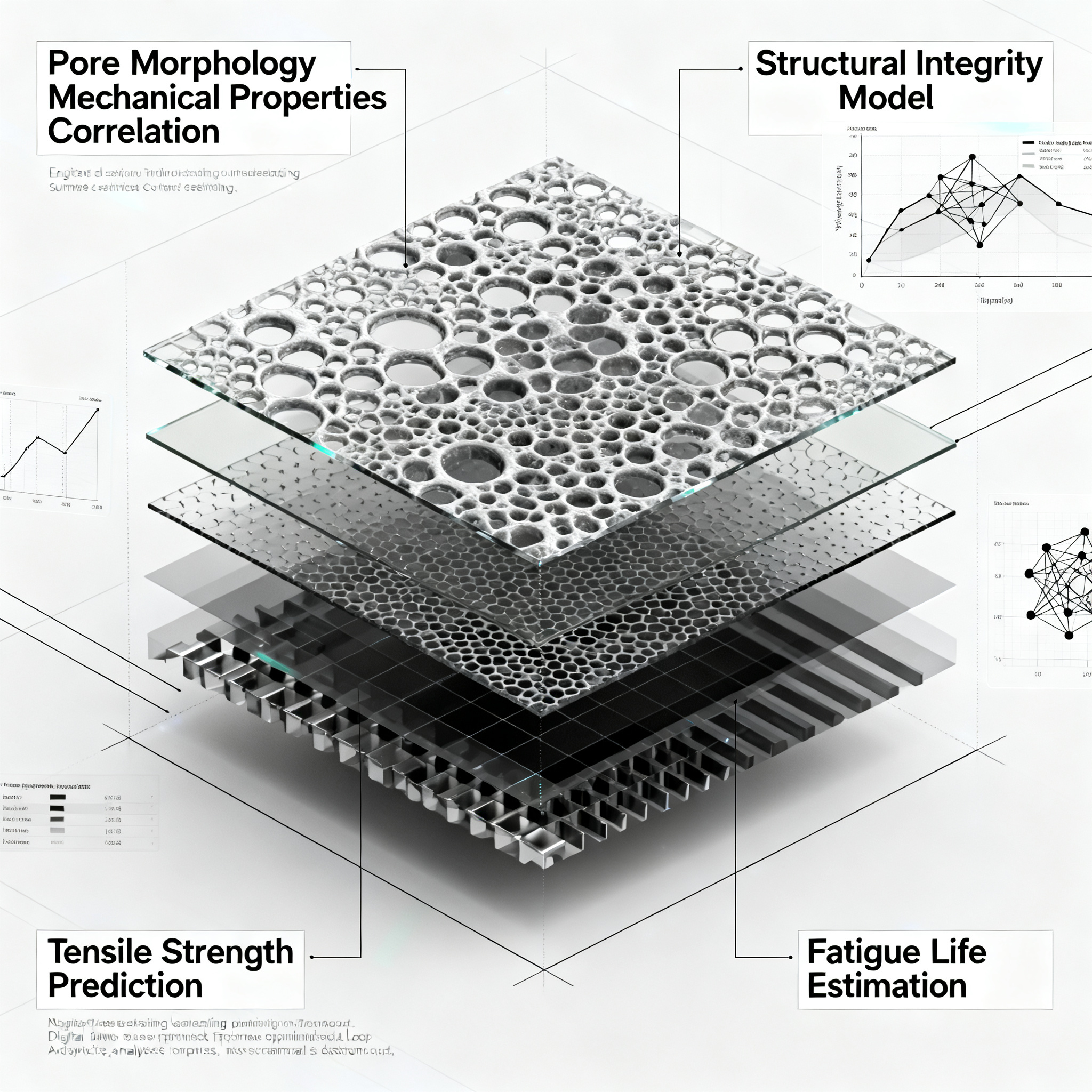
AI reads defects in LPBF metal: how mechanical property prediction works
An artificial intelligence model developed by the Korea Institute of Materials Science (KIMS) and the Max Planck Institute reveals how microscopic defects affect the mechanical performance of components produced with Laser Powder Bed Fusion. The system correlates pore morphology and mechanical properties, predicting strength and ductility without destructive testing.
The quality challenge in LPBF metals
Microstructural defects compromise the reliability and mechanical performance of metal printed components, making traditional quality control methods insufficient.
Metal 3D printing with LPBF technology enables complex geometries for aerospace, defense, and medical sectors. The laser fuses thin layers of metal powder, building the component layer by layer. Final quality depends on parameters such as laser power, scan speed, track spacing, and melt pool behavior.
Pores and lack-of-fusion zones reduce strength, ductility, and fatigue life. The problem is not only the presence of the defect but also its shape, position, and distribution. Two components with identical porosity percentage can behave differently if the defects are small and dispersed or large, elongated, and concentrated in critical zones.
- Study published in Acta Materialia (January 2026) by KIMS and Max Planck Institute
- Researchers: Jaemin Wang, Seungyeon Lee, Jeong Min Park, Dierk Raabe
- Focus: correlation between pore morphology and mechanical properties in LPBF
- Materials analyzed: steels, aluminum alloys, and titanium
Many control methods treat porosity as a single value: the percentage of voids in the volume. However, this data is not sufficient to evaluate the operational reliability of a component. The effect of defects varies based on their size, shape, irregularity, and spatial distribution.
How AI maps critical pores
Through the analysis of tomographic images, AI identifies the shape, size, and distribution of pores that are decisive for material fracture.
The AI model developed uses GAMI-Net, a two-stage interpretable system. It analyzes tomographic images of printed components, identifying morphological characteristics of pores: size, shape, non-circularity, and spatial distribution.
The approach goes beyond simple measurement of total porosity. Irregular or elongated pores influence strength differently than spherical defects. Larger pores tend to concentrate local stresses, increasing the risk of fracture.
| Traditional evaluation | AI approach |
|---|---|
| Total pore quantity measure | Analyze shape, size, and distribution |
| Provides synthetic data | Links defects to mechanical properties |
| Intervenes after production | Predicts risks during process design |
| Does not explain performance loss | Identifies interpretable relationships between parameters and behavior |
The system processes large volumes of data that would be impossible to analyze manually. It is able to identify hidden patterns among process parameters, defect morphology, and final mechanical behavior.
Prediction of mechanical properties
Predictive models correlate defect morphology with material properties, avoiding costly destructive tests and enabling early optimization.
The AI model establishes quantitative relationships between pore characteristics and mechanical properties such as strength and ductility. This predictive capability eliminates the need to perform destructive tests on every single production batch.
The interpretable approach allows for understanding which variables most influence performance. Parameters such as scanning speed, powder density, and other operating conditions are directly correlated to the final result.
AI does not replace the metallurgist's experience but complements it by simultaneously managing many data points. It makes complex relationships between variables that are difficult to isolate in the LPBF process readable.
For applications where components must withstand loads, vibrations, and cyclic stresses, this distinction is crucial. Sectors such as aerospace and defense require high levels of reliability: understanding how defects arise and affect performance becomes therefore essential.
The method supports the qualification and development of the digital twin. Instead of demonstrating quality piece by piece through final inspections, it is possible to prove that a qualified process generates consistent and repeatable results.
Real-time process optimization
With immediate feedback from AI, it is possible to intervene during production to improve final quality and reduce waste.
The integration of AI into the production chain enables closed-loop control. Sensors continuously monitor the process, while AI evaluates any deviations and suggests parameter corrections before critical defects form.
AI-based optical monitoring systems are already present on many industrial machines, offering a detailed layer-by-layer view. Engineers can thus visualize process data in real time, benefiting from greater repeatability and reduced feedback times.
This approach significantly reduces post-process inspections, which can represent more than half the cost of a certified metal component. For large aerospace parts, a complete inspection may be physically impracticable.
AI-driven operational workflow
- Data acquisition: Optical and thermal sensors collect information during construction layer by layer.
- AI analysis: The model identifies defect morphology and predicts its impact on mechanical properties.
- Parameter correction: The system suggests or automatically applies modifications to laser power, speed, and scanning strategy.
- Validation: Comparison between AI predictions and real measurements for continuous model improvement.
The transition to a process-centric logic replaces piece-by-piece qualification. Each build has sufficient digital evidence (data, logs, sensors) to guarantee compliance in regulated contexts.
Conclusion
The integration of AI into the quality control chain enables proactive management of defects in additive metals. The model developed by KIMS and Max Planck Institute demonstrates that understanding the relationship between pore morphology and mechanical properties is possible without destroying the components.
The interpretable approach makes AI a concrete tool for metallurgists and process engineers. It does not promise a completely defect-free print, but offers methods to understand how these arise and affect performance.
Explore how to implement AI-driven quality control solutions in your LPBF processes. The convergence between artificial intelligence and metal additive manufacturing is transforming production from reactive to predictive.
article written with the help of artificial intelligence systems
Q&A
What is the main objective of the artificial intelligence model developed by KIMS and Max Planck Institute for metal 3D printing?
The main objective is to predict the mechanical properties of components produced with Laser Powder Bed Fusion (LPBF), analyzing pore morphology without resorting to destructive testing.
Why is simply measuring total porosity insufficient to assess the reliability of an LPBF component?
The shape, size, distribution, and irregularity of pores differently influence mechanical properties; two components with the same porosity percentage can have very different behaviors.
How does artificial intelligence contribute to predicting mechanical properties in LPBF materials?
AI analyzes tomographic images to identify morphological features of pores and quantitatively correlate them to parameters such as strength and ductility, enabling accurate predictions without destroying the component.
What advantages does using AI in quality control of metal 3D printing offer compared to traditional methods?
It enables real-time monitoring, reduces the need for post-production inspections, lowers costs, and improves process repeatability thanks to automatic parameter corrections.
How does the interpretable AI approach support metallurgists and process engineers?
It provides clear insights into how defects affect mechanical performance and which process parameters are most critical, facilitating informed decisions during production.