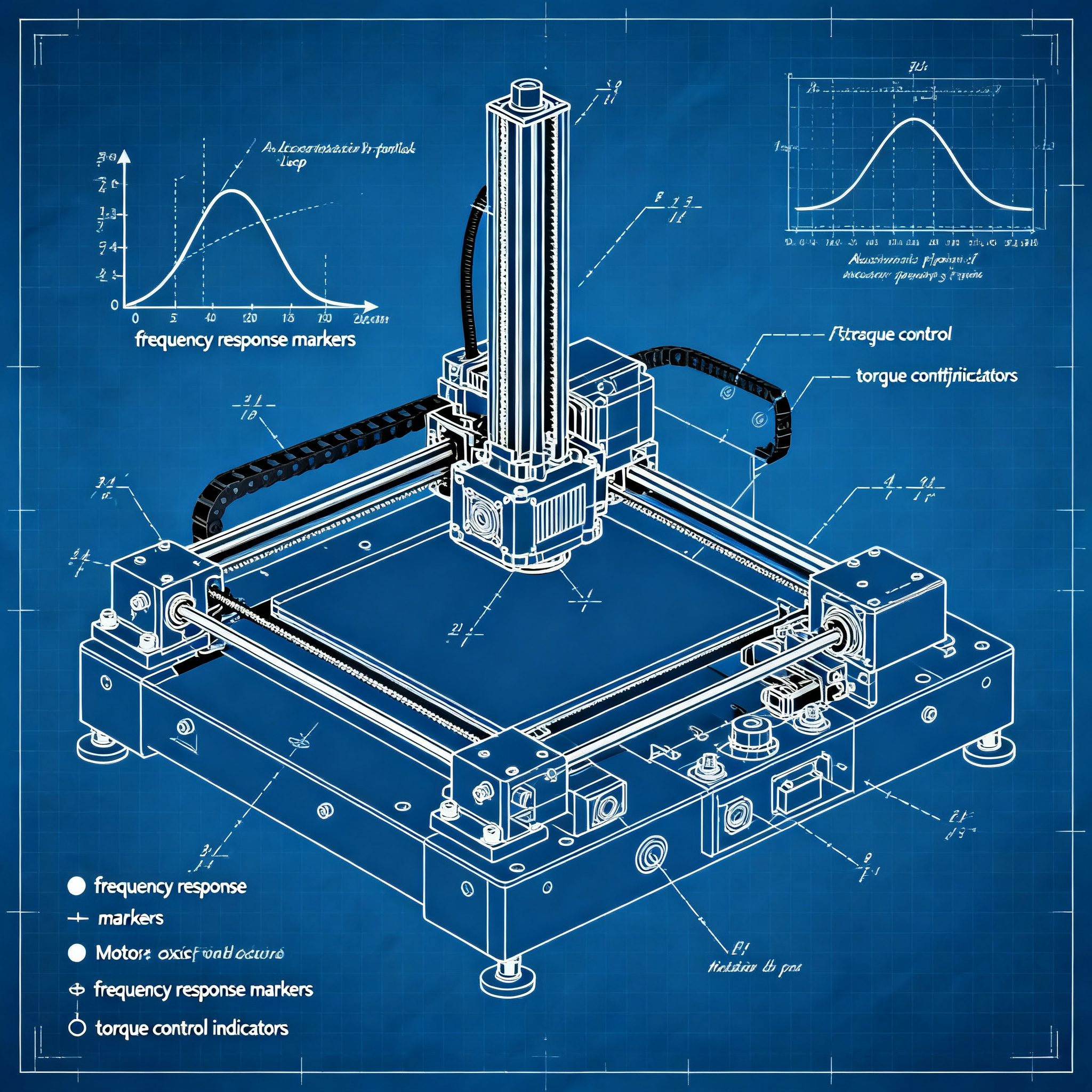
Why is your 3D printer making noise?
Noise reduction in 3D printers does not depend on soundproof panels or acoustic insulation. The problem stems from motor control and vibration management during movement. Understanding this mechanism means grasping how speed, acceleration, and feedback intertwine in determining both noise and print quality.
The noise comes from the motors
Vibrations generated by stepper motors are the main source of noise in modern 3D printers.
Stepper motors produce noise through mechanical vibrations they generate during movement. When the machine accelerates or decelerates, the frame can flex and create resonances that propagate through the structure.
The problem is not uniform. Excessive noise reduction at low speed can compromise precision. Conversely, insufficient reduction at high speed leaves the printer noisy precisely during the most intense phases of movement.
The “active noise reduction” in 3D printers has nothing to do with noise-canceling headphones. Here we are talking about motion control and motor behavior, not environmental acoustic cancellation.
A printer's noise is not a single sound. Fans generate continuous noise, motors produce high-pitched tones, frame vibrations create resonances. The build plate can amplify certain frequencies. An effective strategy must act mainly on the part produced by axis movement.
Input shaping: the intelligent filter
This technique modifies the motion trajectories to cancel structural resonances, reducing noise and mechanical imperfections.
Input shaping is a control technique that generates a command signal capable of canceling its own vibrations. It works after a phase of system measurement and calibration.
When the machine moves rapidly, the frame can bend and then return, transferring vibrations to the workpiece. This causes visible defects on the walls such as ringing or ghosting.
How input shaping works
- Measurement: The system detects the resonance frequencies of the mechanical structure.
- Calibration: A motion profile is generated that anticipates and compensates for vibrations.
- Application: Commands to the motors are modified to cancel oscillations before they manifest.
Input shaping was born to improve surface quality, not to reduce noise. But the two things are linked: less vibration means less noise and cleaner surfaces.
Feedback and tuning: dynamic balance
A closed-loop control system allows real-time corrections, improving precision and quietness.
Motor feedback on the movement axis enables internal calibration based on how the system pilots the motors. The purpose is to find a compromise between noise, stability, and precision.
Closed-loop systems eliminate the non-linearities of microstepping and cumulative errors caused by missed steps. But they cannot push the motor beyond its fundamental physical limits.
Predictive control represents an evolution. By recognizing in advance when high acceleration will be needed, the system can increase the drive voltage before losing position, then reduce it when it is no longer needed. This requires a dynamic model of the system to predict when and how much torque will be required.
- Real-time correction of discrepancies between model and hardware
- Elimination of cumulative positioning errors
- Better management of the trade-off between speed and precision
Acceleration and jerk: hidden enemies
Excessive values cause overshoot and unwanted vibrations; tuning is essential to balance speed and quietness.
Acceleration determines how quickly the head changes speed. Jerk controls how quickly the acceleration itself changes. Both directly affect vibrations and thus noise.
Excessive acceleration values cause overshoot: the system overshoots the target position and must correct, generating oscillations. This applies to both stepper motors and BLDC with feedback.
The calibration of acceleration curves is central to managing the trade-off between quietness and accuracy. With 200 steps per revolution and a 4 mm pitch lead screw, even without microstepping, a resolution of 0.02 mm is achieved. Adding half-stepping brings it to 0.01 mm, while retaining over 70% of the rated torque.
Reducing microstepping may seem counterintuitive, but more decisive movements with fewer intermediate steps can be more stable and less prone to position loss. The motion becomes less fluid but more reliable.
Governing motion to control noise
Managing noise means governing motion. More control over the motors means less noise generated. Modern techniques do not isolate sound; they prevent it at the source through intelligent driving.
Calibrating input shaping on your machine can simultaneously improve sound and print quality. No costly hardware modifications are needed: often it's enough to optimize motion parameters in the firmware.
Try calibrating input shaping on your machine and see how much both sound and print quality improve. The result might surprise you.
article written with the help of artificial intelligence systems
Q&A
What is the main source of noise in 3D printers?
The main source of noise is vibrations generated by stepper motors during movement. These vibrations propagate through the frame and can be amplified in case of structural resonances.
What does 'active noise reduction' mean in 3D printers?
It does not refer to solutions like sound-absorbing panels, but to intelligent control of motors and vibrations. It involves directly acting on the movement to prevent noise at the source.
What is input shaping and what is it used for?
Input shaping is a control technique that modifies movement trajectories to cancel out structural resonances. It serves to reduce both vibrations and visible defects such as ringing or ghosting, improving quality and quietness.
How do acceleration and jerk affect printer noise?
Too high values of acceleration and jerk cause overshoot and unwanted vibrations. These parameters must be calibrated to balance speed, precision, and noise level during movement.
What advantages does a closed-loop control system offer?
It allows real-time corrections, eliminates cumulative positioning errors, and improves precision. It also helps maintain a good compromise between quietness, stability, and movement accuracy.