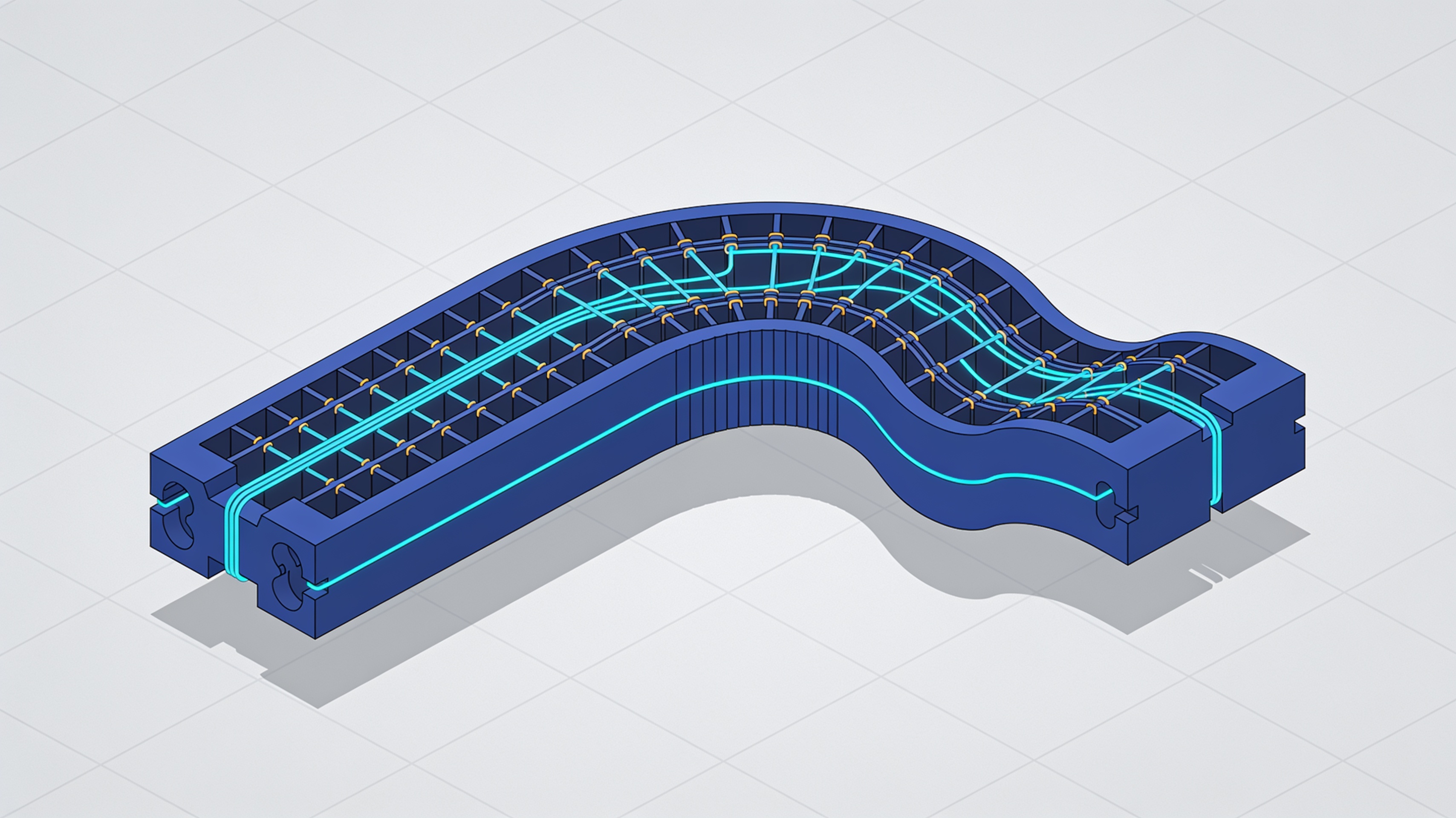
3D-printed artificial muscles: De Montfort University explores piezoelectric metamaterials for soft robotics
De Montfort University in Leicester announced on 20 October 2026 a research project dedicated to developing 3D-printed actuators for soft robotics. Researcher Meisam Abdi will lead the work thanks to a Royal Academy of Engineering/Leverhulme Trust Research Fellowship for 2026–2027.
The goal is not to commercialize a ready-made artificial muscle. The project aims to develop a prototype and establish design and manufacturing methods for piezoelectric metamaterials.
- De Montfort University studies 3D-printed actuators based on piezoelectric metamaterials
- The project is funded by the Royal Academy of Engineering and the Leverhulme Trust for 2026–2027
- The goal is to create prototypes for soft robotics, not commercial products
- Metamaterials combine actuation and sensing functions without bulky external components
Why soft robotics requires different solutions
Traditional industrial robots work well with defined loads and repetitive movements, but become less suitable when interaction with fragile objects or people is required.
Conventional robots use electric motors, reducers, gears and rigid joints. This architecture ensures precision and repeatability in structured environments.
Soft robotics instead seeks solutions capable of deforming and adapting to the context. Soft structures distribute contact over larger surfaces and can reduce force peaks in certain scenarios.
A soft structure is not automatically safe. Even a flexible actuator can exert high forces or move unpredictably.
The potential advantage lies in the possibility of designing different mechanical properties. However, this requires adequate materials, control and sensors.
Many current soft systems depend on pumps, pneumatic circuits or hydraulic components. These elements take up space and complicate miniaturization.
The role of piezoelectric metamaterials
Piezoelectric materials generate an electrical response when mechanically deformed and, conversely, deform when subjected to an electric field.
The reciprocity of the phenomenon makes the same class of materials interesting for both actuation and sensing functions. A single component can therefore move and simultaneously measure its own state.
However, piezoelectricity does not imply that any material can perform large movements. Many efficient piezoelectrics produce relatively small deformations.
To obtain a useful displacement, the geometry of the structure must be considered. Metamaterials are architectures designed to amplify or modify the behavior of the base material through shape.
3D printing as a manufacturing tool
Additive manufacturing makes it possible to create complex geometries that would be difficult or impossible to produce with conventional techniques.
The De Montfort University project will explore the use of 3D printing to create these architected structures. Additive manufacturing enables channels, cavities, and specific geometric patterns to be integrated into a single process.
The approach involves developing parametric design methods. This means defining rules that link geometric parameters to the desired performance.
The combination of smart materials and the geometric freedom offered by 3D printing represents the core of the British project. The goal is to eliminate dependence on bulky external power supplies.
Potential applications beyond artificial muscles
In addition to soft robotics, 3D-printed piezoelectric metamaterials could find use in energy harvesting applications.
Harvesting energy from vibrations or deformations represents another area of interest. Structures capable of converting mechanical movements into electrical signals could power distributed sensors.
Integrated sensing functions would make it possible to monitor the state of the structure without adding separate components. This simplifies the overall system architecture.
The project does not promise immediate results. It is exploratory research intended to establish foundations for future developments.
The 2026–2027 fellowship will provide the time and resources to validate the basic principles. Only afterwards will it be possible to assess the scalability and industrial applicability of the developed solutions.
article written with the help of artificial intelligence systems
Q&A
Who leads the project on 3D-printed artificial muscles at De Montfort University?
The project is led by researcher Meisam Abdi, thanks to a Royal Academy of Engineering/Leverhulme Trust Research Fellowship for 2026–2027. The announcement is dated 20 October 2026.
What is the goal of the De Montfort University project?
The goal is not to commercialize a ready-made artificial muscle, but to develop a prototype and establish design and manufacturing methods for piezoelectric metamaterials intended for soft robotics.
Why are piezoelectric metamaterials interesting for soft robotics?
Piezoelectric materials generate an electrical response when deformed and deform under an electric field. This reciprocity allows a single component to move and simultaneously measure its own state, without bulky external components.
What limitations do current soft systems have according to the project?
Many soft systems depend on pumps, pneumatic circuits or hydraulic components that take up space and complicate miniaturization. Moreover, a soft structure is not automatically safe: it can exert high forces or move unpredictably.
Does piezoelectricity guarantee large movements in actuators?
No. Piezoelectricity does not imply that any material can perform large movements: many efficient piezoelectrics produce relatively limited deformations. This is why the project focuses on metamaterials to achieve engineered mechanical properties.