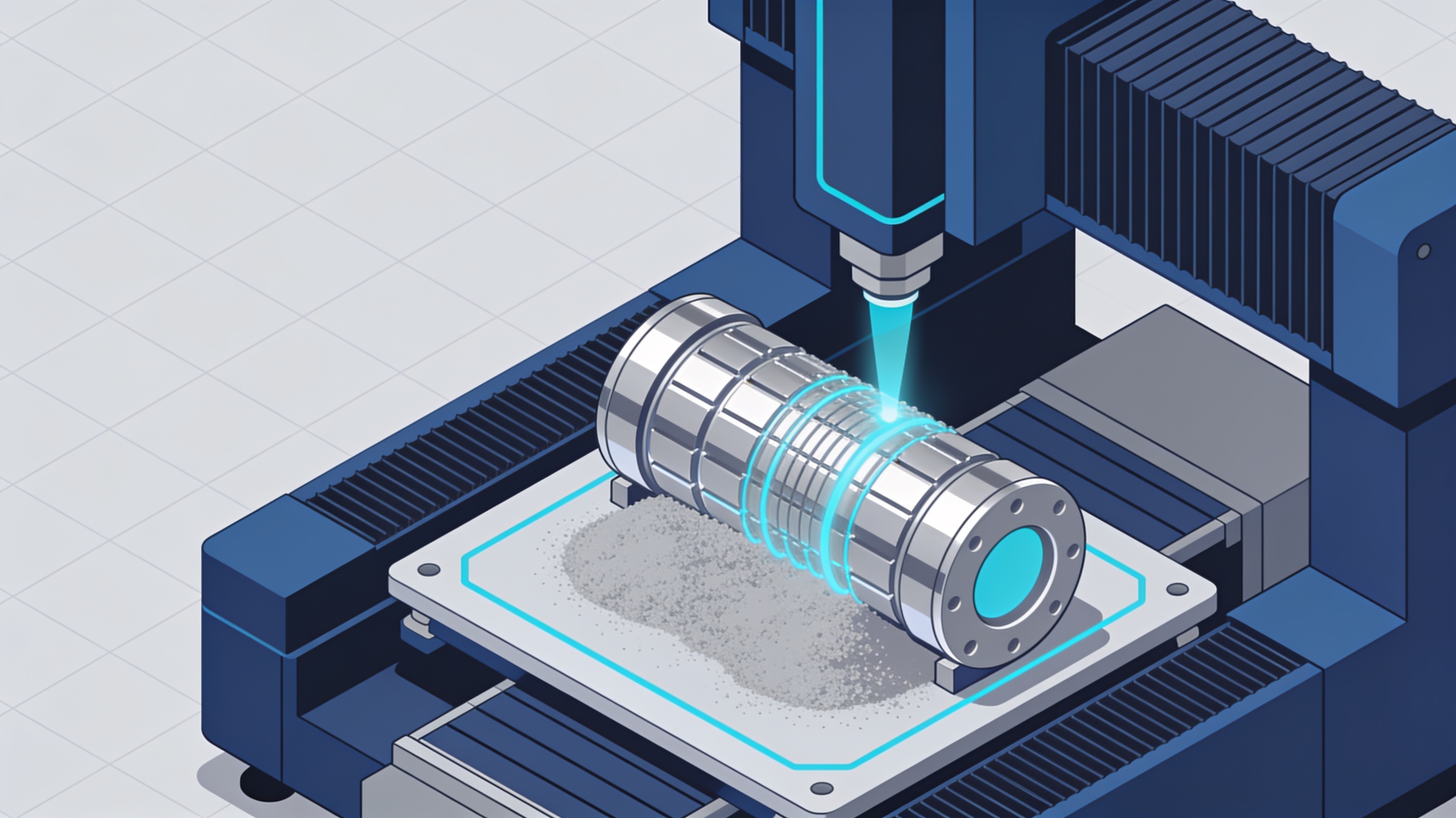
Westinghouse receives $7 million to develop 3D-printed nuclear fuel
Westinghouse Electric Company has received $7 million in funding from the ARPA-E agency for PowerBlock, a research program dedicated to additive manufacturing of metallic nuclear fuel. The project will use LPBF (Laser Powder Bed Fusion) technology to explore new possibilities in the fabrication of fuel elements for advanced reactors.
The announcement dates back to October 29, 2026. The project appears in the official list of the U.S. Department of Energy's HORNIG program.
- $7 million in funding from ARPA-E for the PowerBlock program
- Technology: laser powder bed fusion (LPBF) applied to metallic fuel
- Objective: research and modeling, not immediate commercial production
- Part of the HORNIG program for Generation IV nuclear reactors
Research, not commercial production
The funding covers development and data collection activities, not the final qualification of a fuel ready for use in a power plant.
The PowerBlock project does not announce a fuel already certified for operating reactors. The $7 million funds research, computational modeling and generation of data needed for subsequent assessments.
The distinction is fundamental. In the nuclear sector, the word “fuel” evokes the most critical component of the energy system. The required verifications go beyond the standard checks of industrial additive manufacturing.
The specific challenges of nuclear
3D printing of nuclear fuel requires validations that go beyond the mechanical and dimensional tests typical of additive manufacturing.
In conventional additive manufacturing, the properties of a component are verified with dimensional checks, destructive tests and process monitoring. In nuclear, long-term phenomena are added: irradiation, chemical stability, heat management, compatibility with the reactor environment.
The challenge is not to demonstrate that a metal material can be melted with a laser. A documented path is needed to produce repeatable elements and evaluate their behavior under the expected operating conditions.
Qualifying a material for nuclear applications requires years of testing and documentation. The funding covers the initial phases of this process, not its completion.
The HORNIG program
HORNIG funds several technologies for advanced fuels intended for fourth-generation reactors.
HORNIG is the acronym for High-performance Optimized Recycled Nuclear Isotopes for Gen IV Reactors. The initiative supports the development of advanced fuels and technologies for the nuclear sector.
The funded projects address different families of materials, manufacturing methods, and analysis tools. In the case of Westinghouse, the official description identifies PowerBlock as metallic fuel produced with additive manufacturing by laser powder bed fusion.
Objectives of the PowerBlock project
The activity will combine additive manufacturing and computational simulation to improve design and reproducibility.
The program will combine additive manufacturing and computational modeling. The goal is to improve the design, reproducibility, and industrialization potential of metallic fuel.
The $7 million is the amount indicated in the ARPA-E listing for the project. It does not represent expenditure already incurred, an investment in completed production facilities, or the commercial value of an orderable system.
Implications for additive manufacturing
The entry of 3D printing into the nuclear sector highlights the level of maturity reached by LPBF technology.
The application of laser powder bed fusion to nuclear fuel marks a turning point. Additive manufacturing enters a field where material qualification and process repeatability have particularly significant consequences.
The project will require documentation and traceability standards higher than the already high ones of aerospace and medical. Every process parameter will have to be monitored, recorded, and correlated with the final properties of the material.
The research conducted by Westinghouse could generate protocols and methodologies applicable to other high-criticality sectors as well. The qualification path developed for nuclear fuel could become a reference for applications requiring extreme guarantees of reliability and long-term performance.
article written with the help of artificial intelligence systems
Q&A
How much funding did Westinghouse receive and from which agency?
Westinghouse Electric Company received $7 million from the ARPA-E agency for the PowerBlock program, dedicated to additive manufacturing of metallic nuclear fuel.
Which 3D printing technology will be used in the PowerBlock project?
The project will use LPBF (Laser Powder Bed Fusion) technology, i.e., laser fusion on a powder bed, applied to metallic nuclear fuel.
Will the PowerBlock project produce commercial nuclear fuel?
No, the funding covers research activities, computational modeling, and data collection. It is not about final qualification of a fuel ready for use in a power plant.
Which U.S. Department of Energy program does the project fall under?
The project appears in the official list of the HORNIG program (High-performance Optimized Recycled Nuclear Isotopes for Gen IV Reactors), dedicated to fourth-generation nuclear reactors.
What additional challenges does 3D printing of nuclear fuel present?
In addition to dimensional checks and destructive testing typical of additive manufacturing, validations are needed on long-term phenomena such as irradiation, chemical stability, heat management, and compatibility with the reactor environment.