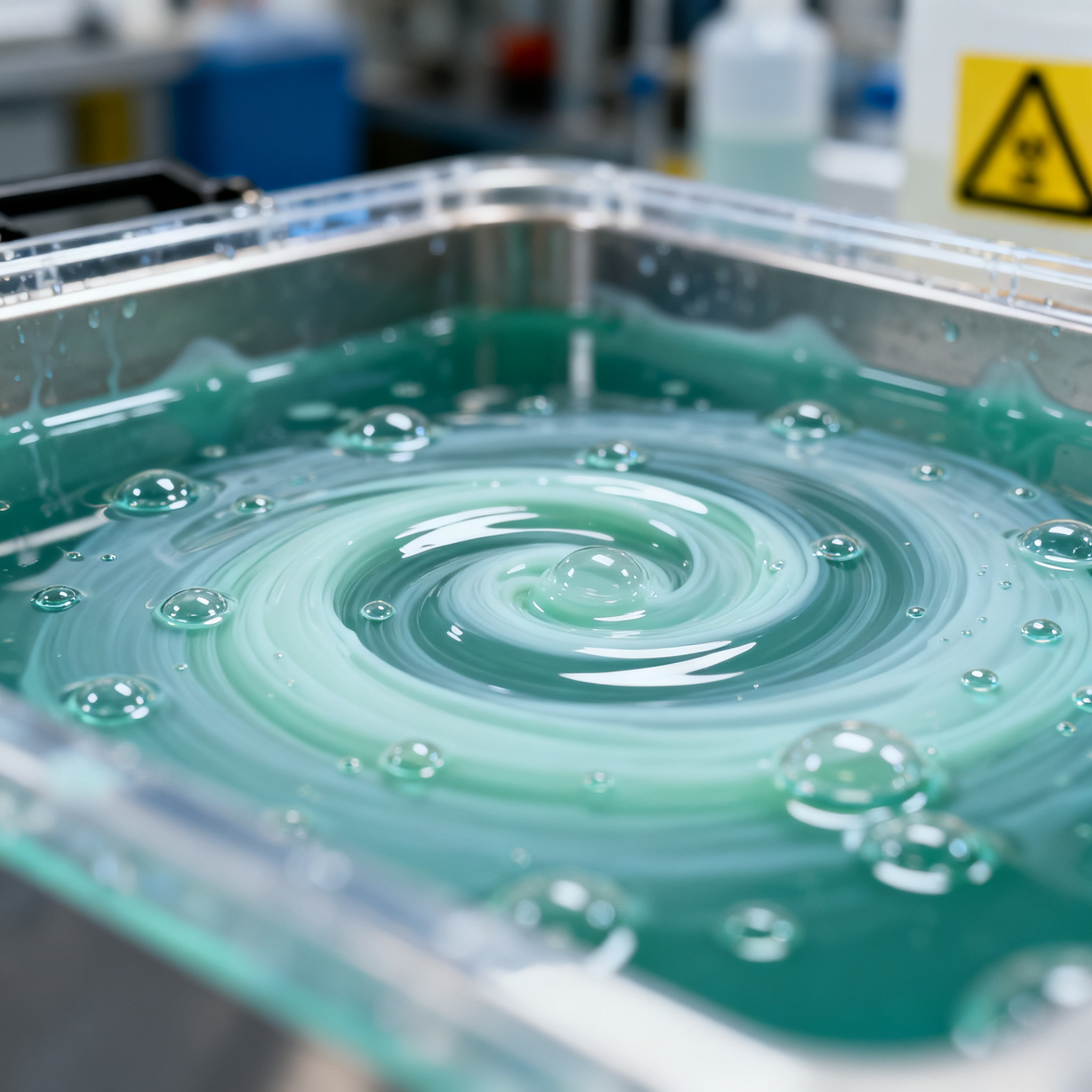
Washable in water does not mean safe: here's why
Water-washable resins simplify post-processing, but they do not eliminate the risks associated with unpolymerized photopolymers. The term “water-washable” creates dangerous misconceptions about the material's actual safety.
Water-washable resins promise to remove isopropyl alcohol from the 3D printing workflow. The idea is simple: print, wash with water instead of IPA, dry, and cure. But “water-washable” only means that the surface resin can be removed with water as a washing liquid. It does not mean it is safe, eco-friendly, or drain-safe.
Marketing has oversimplified the message, focusing on convenience and the absence of “aggressive chemicals”. The reality is different: the chemistry of the resin remains that of a liquid photopolymer that must be handled with rigorous care.
Water-washable does not mean green
The “water-washable” label creates false myths about environmental safety. The problem is not the solvent used for cleaning, but the liquid resin that ends up in the wash water.
The true risk in resin 3D printing does not come from the solvent. When a model is washed with IPA, the surface resin dissolves in the solvent. When washed with water, the resin ends up in the water. The liquid used for cleaning changes, but the fact that this liquid becomes contaminated waste does not.
- Water-washable resins contain the same reactive monomers and toxic photoinitiators as traditional resins
- The water used for washing becomes water contaminated with unpolymerized resin
- Water solubility can make pieces more sensitive to humidity and promote cracking over time
Liqcreate explains that water used to wash water-soluble resins must not be poured down the drain because it contains resin and many raw materials can be harmful to aquatic life. Washing the piece under the tap is a practice to avoid: washing should be done in a dedicated container, never in the sink.
Exposed photopolymer: the invisible enemy
Even when using water for washing, unpolymerized resin retains all its toxicological risks and requires rigorous management. Safety data sheets tell a different story from marketing.
The safety data sheet for Anycubic Water-Wash Resin 2.0 classifies the product with hazard indications such as skin irritation, serious eye injury, skin sensitization, and reproductive toxicity category 1B. The Elegoo data sheet indicates risks to eyes and skin, possibility of allergic skin reactions, and harmful effects on aquatic organisms with long-lasting consequences.
Sensitization is an immune response that develops after repeated exposures. The immune system “learns” to recognize the compound as hostile. The process does not produce evident symptoms in the initial stages: the operator works for months without noticing consequences, then suddenly even a minimal exposure triggers severe allergic reactions. This condition is irreversible.
Many formulations contain between 30% and 60% methoxyethyl acrylamide (ACMO), a compound classified by the EPA with special regulation due to health risks. This is often not clearly indicated in the safety data sheet.
Regulations and obligations: there is no escape
Rules for disposal and safety remain stringent, regardless of how easy the cleaning process is. Avoiding IPA does not eliminate the disposal problem.
Anycubic indicates in the SDS not to release the product into the environment and to dispose of containers and waste safely. Material and container must be disposed of as hazardous waste. Waste codes must be assigned by the user, preferably with competent authorities.
For the hobbyist user, this is the most critical point: avoiding IPA does not eliminate the disposal problem. It shifts it from contaminated alcohol to contaminated water.
3D Store Monza also specifies that “washable in water” does not mean washable under running water: pieces must be washed in a container and the dirty water must be disposed of in an environmentally responsible manner. Wastewater contaminated with photopolymer resin cannot be poured into household drains without treatment, on penalty of serious environmental damage.
Everything contaminated by liquid resin and detergent—including water, cloths, and gloves—must be treated as toxic waste and must not end up in general waste.
Good operating practices
Adopt standardized procedures to reduce exposure and ensure compliance, even with resins that are easier to handle. The workbench should be organized as for any other resin-based 3D printing.
Anyone using a water-washable resin should set up the workflow as if handling a sensitive chemical material. Washing should be done in a dedicated tank, preferably enclosed, avoiding running water. After washing, the part must be dried carefully before UV curing.
Safe procedure
- Protection: wear nitrile gloves, protective goggles, and work in a ventilated area.
- Washing: Use a dedicated closed basin, never running water or a domestic sink.
- Decantation: Let the contaminated water settle and treat it according to local regulations.
- Disposal: Consider gloves, paper, filters, and contaminated instruments as special waste.
Contaminated water should be allowed to settle and be treated according to the manufacturer's instructions and local regulations. Polymerized solid residues should not be confused with liquid resin: the liquid or partially polymerized part remains the most problematic.
Gloves, absorbent paper, filters, removed supports, dirty trays, and contaminated instruments must be considered part of the waste management flow. Even if the bottle says “water washable”, the workbench must be organized as for any other 3D resin printing.
Conclusion: Water-washable resins simplify the workflow by eliminating IPA, but they do not eliminate safety duties. Awareness of the real risks is the first step toward responsible use. The term “water washable” describes only the cleaning process, not the material's safety profile.
Check the safety data sheets of the materials you use and update your emergency procedures based on current data. Do not confuse the convenience of the process with intrinsic safety: the main risk is always the unpolymerized resin, not the solvent chosen to remove it.
article written with the help of artificial intelligence systems
Q&A
Why can the term "water-washable" generate dangerous misunderstandings?
Because it mistakenly suggests that the material is safe, eco-friendly, or disposable down the sink, whereas it only describes the cleaning method. In reality, the resin retains the same reactive monomers and toxic photoinitiators as traditional resins, so the risk profile remains unchanged.
What is the real risk in 3D printing with water-washable resins?
The main danger is not the washing solvent, but the unpolymerized resin that contaminates the water. This contains chemicals harmful to human health and aquatic organisms, turning the washing liquid into hazardous waste that cannot be poured down drains.
What is meant by skin sensitization and why is it particularly insidious?
It is an irreversible immune response that develops after repeated exposures to resin. It is insidious because in the first months it presents no obvious symptoms, but once developed the immune system reacts even to minimal future exposures, triggering severe allergic reactions.
How must the water used to wash parts printed with these resins be managed?
It must never be poured down the sink or household drains. It should be collected in a dedicated tank, left to settle, and then treated as special waste according to local regulations and the manufacturer's instructions, as it is contaminated with toxic resin.
What safety precautions are essential when using water-washable resins?
It is necessary to wear nitrile gloves and protective goggles, work in a ventilated environment, and use a closed, dedicated washing tank. Furthermore, all contaminated materials, including gloves, cloths, and filters, must be disposed of as hazardous waste and not in general waste.