80 hours of therapy in 10 hours of production: how to create a custom pediatric prosthesis
Building a custom pediatric prosthesis is not just a design matter: it is a structured process involving specific materials, precise timelines, and a network of collaboration between clinic and production. SLS 3D printing in Nylon 12 now enables the transition from CAD file to functional component in 8-10 hours, opening unprecedented scenarios for rapid adaptation to the needs of growing patients.
Materials and precision: the foundation of pediatric design
Material selection directly influences the durability, precision, and mechanical compatibility of the prosthesis. Nylon 12 SLS represents today's standard for functional pediatric prosthetic components.
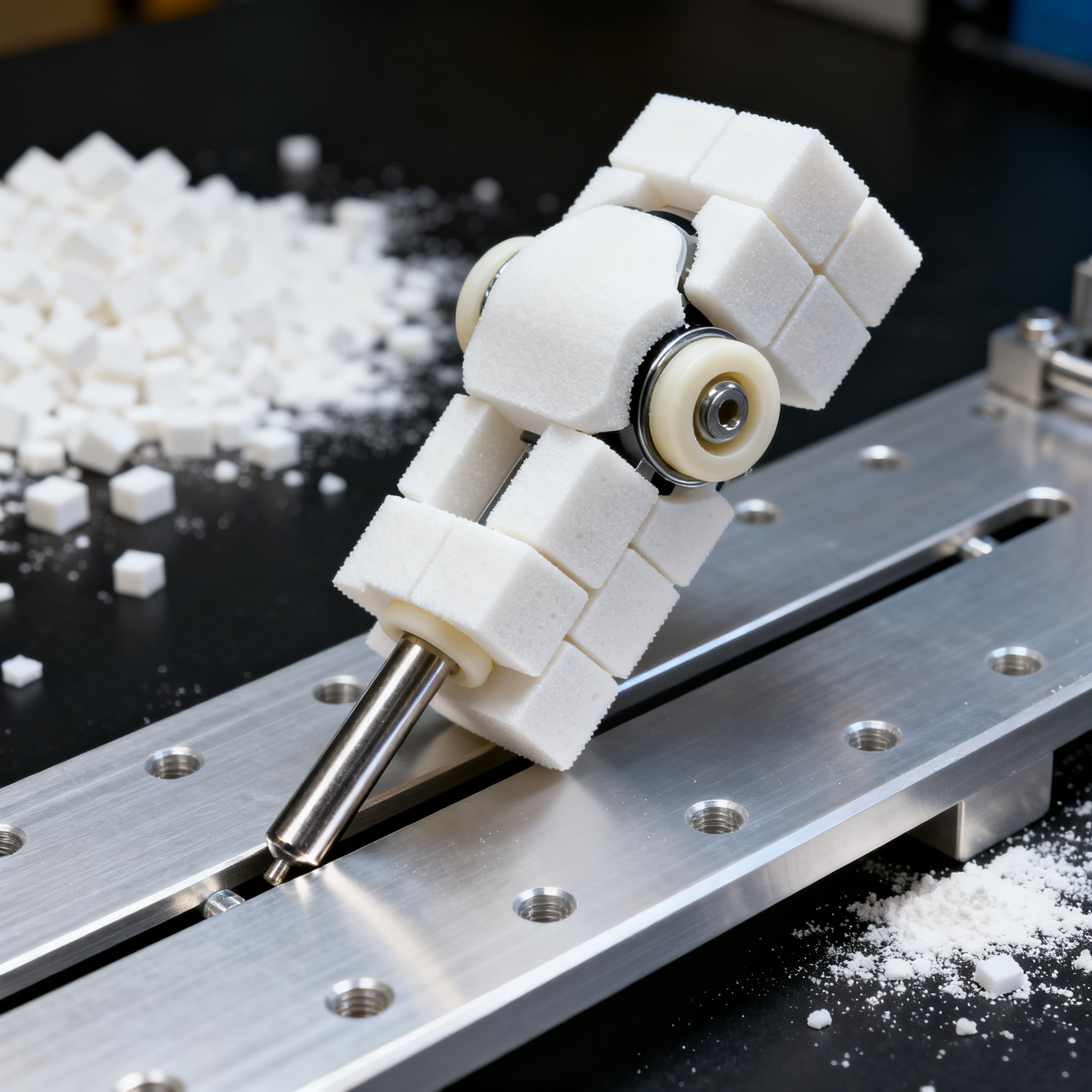
The Pedi-Knee prototype, developed by the Indian Spinal Injuries Centre and ALIMCO, uses PA12 (Nylon 12) produced with SLS technology. This material guarantees robustness, dimensional precision, and integration with standard hardware such as modular pyramid connectors.
The final weight of the prototype is approximately 240 grams, with controlled flexion from 0 to 120 degrees. This range covers basic daily activities: walking, sitting, and transitioning between positions.
- Weight: 240 grams
- Flexion: 0-120 degrees
- Material: PA12 (Nylon 12) via SLS
- Components: interlocking blocks, stainless steel pin, nylon bushings
The choice of Nylon 12 is not random. Formlabs, in the SLS material documentation, defines Nylon 12 Powder as suitable for robust, precise parts integrable with standard hardware. SLS technology allows for complex geometries without supports, as unsintered powder naturally supports the part during construction.
Critical timing: from file to patient in less than 24 hours
Every minute counts: the production workflow must integrate slicing, printing, and post-processing in times compatible with clinical needs. Additive manufacturing drastically shortens the prototyping phase.
Printing and cooling of the Pedi-Knee components require approximately 8-10 hours. After printing, post-processing operations follow: powder recovery, blasting, cleaning of holes and sliding surfaces, insertion of the stainless steel pin, assembly of the bushings, and alignment on a prosthetic bench.
This does not mean producing a complete prosthesis during a visit, but reducing dependence on dedicated equipment for small batches or devices adapted to the individual patient.
Production workflow
- CAD modeling: parametric design in SolidWorks with modular connectors.
- SLS Printing: 8-10 hours with Formlabs Fuse 1+ and powder recovery with Fuse Sift.
- Post-processing: sandblasting, cleaning, assembly of metal components, and alignment.
- Validation: biomechanical tests and fitting on a prosthetic bench.
Iteration speed is crucial for pediatric patients. A child grows, changes weight, changes posture. The ability to quickly modify the design and reproduce the component in less than 24 total hours represents a significant operational advantage over traditional production.
Clinical-industrial collaboration: scaling innovation
Involving expert manufacturing partners enables maintaining high quality and speed in distribution and maintenance. The ALIMCO model shows how to integrate clinical research and national-scale production.
Two complementary Indian realities appear in the Pedi-Knee project: the Indian Spinal Injuries Centre – Institute of Rehabilitation Sciences (a clinical and training facility) and ALIMCO, P&O Centre (an entity linked to the production and distribution of aids). ALIMCO is involved in Indian government programs for the supply of assistive devices to people with disabilities and the elderly.
This context is important because a pediatric prosthesis must be replaced or adjusted over time. A component that is too expensive, too complex, or too difficult to repair risks being unsuitable precisely in contexts where the need is greatest.
A pediatric prosthesis is not a “one-time” device. It requires maintenance, adjustments, and frequent replacements during growth. Partners like ALIMCO guarantee territorial distribution, technical assistance, and sustainable costs for public programs.
Materialise, in the cranio-maxillofacial implant sector, also demonstrates the importance of validated workflows and certified production partners. The Belgian company produces approximately 280,000 custom devices per year, with delivery times of 72 hours for PEEK implants in Europe, thanks to collaboration with Ad Mirabiles under EN ISO 13485 certification.
Practical cases: when theory meets the operating room
Real examples show how parametric design and additive production integrate into hospital contexts to respond to growing pediatric patients. The FDA expansion for VSP Orthopedics opens new scenarios.
3D Systems recently obtained FDA 510(k) approval to extend the VSP Orthopedics platform to adolescents with skeletal maturity. This eliminates case-by-case approvals and previously required hospital IRB reviews for adolescent patients.
The expansion covers over 1,200 new annual cases in the USA of osteosarcoma and Ewing's sarcoma in patients under 20 years old, plus 2,600 cases of primary bone tumors in young adults (20-39 years old). It also includes thousands of complex osteotomies and reconstructive procedures for congenital, developmental, and post-trauma deformities.
| Parameter | Pedi-Knee (prototype) | Ottobock 3R38 (commercial) |
|---|---|---|
| Weight | 240 g | 160 g |
| Maximum flexion | 120° | 145° |
| Maximum load | Not declared | 45 kg |
| Main material | PA12 (SLS) | Aluminum |
| Production time | 8-10 hours + post-treatment | Series production |
Boston Children's Hospital uses PolyJet models for pediatric surgical planning, demonstrating how different AM technologies find specific application based on the clinical case. The key is to choose technology and material based on the objective: anatomical model, surgical guide, or functional component.
From prototyping to clinical practice
Custom pediatric prosthetics are no longer a technological dream, but a scalable operational reality. The Pedi-Knee case demonstrates that with validated materials (PA12 SLS), compatible production times (8-10 hours), and structured clinical-industrial partnerships, it is possible to meet the needs of growing patients.
The path to clinical use requires rigorous biomechanical validation. A prosthetic knee must withstand thousands of cycles, impacts, misalignments, and load variations. 3D printing accelerates prototyping but does not replace clinical testing.
Do you want to replicate this model in your facility? Start by mapping locally available certified materials and identify production partners with ISO 13485 certification. The technology is ready: now it is necessary to build the operational network.
article written with the help of artificial intelligence systems
Q&A
What are the advantages of Nylon 12 SLS for the Pedi-Knee pediatric prosthesis?
Nylon 12 (PA12) ensures robustness, dimensional accuracy, and integration with standard hardware such as modular pyramid connectors. SLS technology also allows complex geometries to be produced without supports, as the unsintered powder naturally supports the part during construction.
What are the main technical specifications of the Pedi-Knee prototype?
The prototype weighs 240 grams and offers controlled flexion from 0 to 120 degrees. It consists of interconnected PA12 blocks printed in SLS, a stainless steel pin, and nylon bushings.
Why are rapid production times crucial for pediatric patients?
Children grow rapidly, changing weight and posture, so the prosthesis requires frequent adjustments or replacements. The ability to go from CAD file to functional component in 8-10 hours allows the device to be adapted in less than 24 hours total, reducing waiting times compared to traditional production.
What does the complete production workflow of the Pedi-Knee prosthesis consist of?
The process begins with parametric CAD modeling in SolidWorks, followed by SLS printing in 8-10 hours with powder recovery. Subsequently, sandblasting, surface cleaning, assembly of metal components, and alignment on a prosthetic bench are performed, concluding with biomechanical testing and validation.
Why is collaboration between clinical facilities and manufacturing partners important in the development of pediatric prostheses?
A pediatric prosthesis is not a definitive device but requires maintenance, adjustments, and frequent replacements during growth. Manufacturing partners such as ALIMCO ensure territorial distribution, technical assistance, and sustainable costs, essential for public programs and contexts with high need.