Custom 3D in series: how to do it without failing?
Mass customization is no longer a luxury, but a competitive necessity in wearable devices. Designing the implementation without losing efficiency requires precise choices on architecture, technology, and data.
Modular architectures for customized production
A modular infrastructure allows for scaling variability without sacrificing production efficiency.
Customized production of wearable devices requires an architecture that separates fixed elements from variable ones. Parametric design allows for the automatic generation of geometric variants starting from specific body measurements.
DI Labs has demonstrated how this logic also works for medium-high volumes. The key is to design standardized base components and connection interfaces compatible with custom variants, thus maintaining the efficiency of serial production where possible.
- Clear separation between standardized and customizable components
- Parametric design for automatic variant generation
- Compatible connection interfaces between fixed and custom modules
- Unique identification system for each part (integrated QR, RFID)
Integrated traceability systems in the product during manufacturing ensure correct management throughout the supply chain. Recent patents show informative labels printed contextually with the main body of the device.
AI and user data: the engine of the perfect variant
Artificial intelligence, powered by demographic and behavioral data, allows for the automatic generation of ergonomic and functional variants.
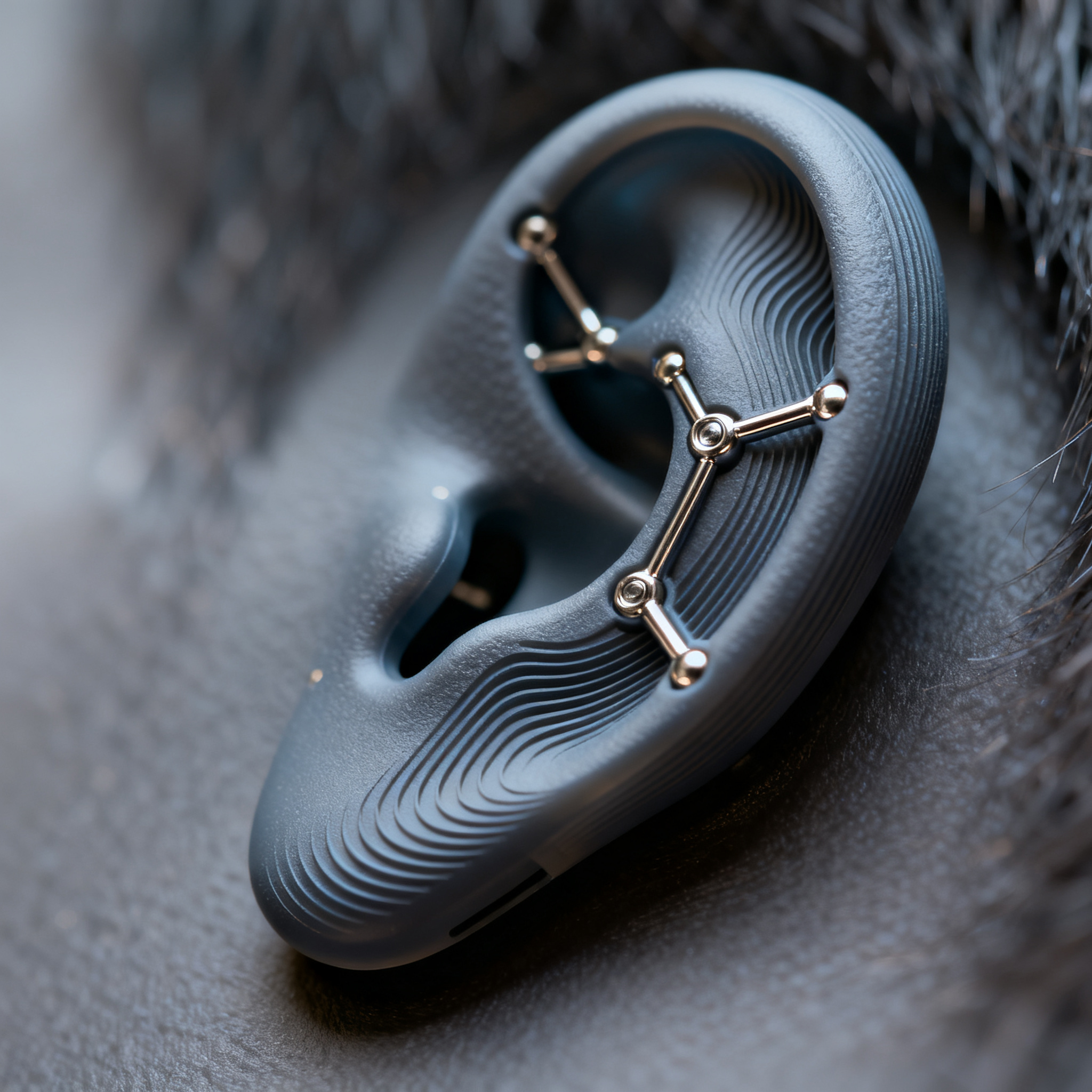
3D biometric scanning captures the exact geometry of the user's hand or ear. These data feed algorithms that automatically adapt dimensions, curvature, and component positioning.
The process takes a few hours: an advanced Face ID scan detects measurements, the system generates the production file, 3D printing produces the device in 2-4 hours. All with delivery within 24 hours.
AI-driven customization workflow
- Data acquisition: in-store or remote biometric scanning via smartphone to capture body geometry.
- Parametric generation: AI processes the measurements and automatically generates the customized 3D model.
- Production: The file is sent to 3D printing systems for immediate manufacturing.
- Quality verification: automatic control via a unique identifier integrated into the part.
Designer Brigitte Kock has demonstrated how mathematical formulas replace traditional manual steps. What required hours of manual work now happens in seconds through parametric software.
Materials and processes: who chooses what and when
The choice between 3D printing, injection molding, or hybrid technologies determines the economic sustainability of customization.
For rigid wearable devices, polycarbonate printed with 0.6 mm nozzles offers the right balance of flexibility and strength. PLA is only used for initial geometric checks: too fragile for real use.
Metal 3D printing (titanium) via Multi Jet Fusion guarantees precision and strength for structural components. Post-processing with Vapour Smoothing eliminates the typical surface roughness of additive manufacturing.
| Technology | Material | Time/part | Ideal application |
|---|---|---|---|
| FDM desktop | PC, TPU | 2-4 hours | Ergonomic inserts, accessories |
| Multi Jet Fusion | PA12, Titanium | 4-6 hours | Support structures, cases |
| Injection molding | Various polymers | 30-60 sec | High-volume standardized components |
The hybrid approach works best: 3D printing for custom parts, traditional production for common components. This optimizes costs and times without compromising customization.
Technology integration: from design to supply chain
Customization requires end-to-end alignment between configuration software, production systems, and logistics.
Parametric software (OnShape, Grasshopper) must communicate directly with production systems. No manual steps between configuration and fabrication: every human intervention slows down and introduces errors.
Digital traceability accompanies each piece from design to delivery. Identification codes integrated into the product during printing allow for managing orders, quality, and post-sales assistance.
Each customized device generates sensitive data (body measurements, preferences). A management system compliant with privacy regulations is needed to ensure security without slowing down the production flow.
Atlantic Clinic has demonstrated that 3D-printed prostheses are “better in every aspect” compared to traditional ones. The secret lies in complete integration: from patient scanning to delivery, the entire process is digital and automated.
Conclusion
Mass customization in wearable devices is feasible, but requires a holistic design. It's not enough to buy a 3D printer: the entire value chain must be rethought.
Modular architecture, AI for automatic generation, careful choice of production processes, and full digital integration are the four pillars. If even one of these elements is missing, the system collapses.
Evaluate your current production workflow: where can you introduce modularity without compromising efficiency? Start with a secondary component, test the end-to-end process, then scale up gradually.
article written with the help of artificial intelligence systems
Q&A
Why is modular architecture fundamental to mass customization of wearable devices?
It enables a clear separation between standardized and customizable components, maintaining serial production efficiency wherever possible. Parametric design automatically generates geometric variants from specific body measurements, while compatible connection interfaces guarantee assembly between fixed and customized modules without sacrificing productivity.
How does the AI-based customization flow work and what are the production times?
3D biometric scanning captures the user's exact geometry and feeds algorithms that automatically adapt dimensions, curvature, and component placement. The system generates the production file without manual steps and sends it directly to 3D printing, which takes 2 to 4 hours. The result is final delivery of the customized device within 24 hours.
Which production approach is most suitable for balancing customization and costs?
The hybrid approach is the most sustainable: 3D printing produces the customized parts, while injection molding manufactures high-volume standardized components in 30-60 seconds. This optimizes time and costs without compromising customization, avoiding the use of inappropriate materials such as PLA for final parts.
Why is it crucial to eliminate manual steps between configuration and manufacturing?
Every human intervention slows down the process and introduces errors, compromising the efficiency of mass customization. Parametric software must communicate directly with production systems, while identification codes integrated into the piece ensure end-to-end digital traceability for quality and after-sales support.
What are the four indispensable pillars for successfully implementing mass customization?
They are modular architecture, AI for automatic generation of variants, careful selection of production processes, and complete digital integration of the supply chain. If even just one of these elements is missing, the entire system collapses, making the isolated purchase of a 3D printer insufficient without a holistic rethink of the value chain.