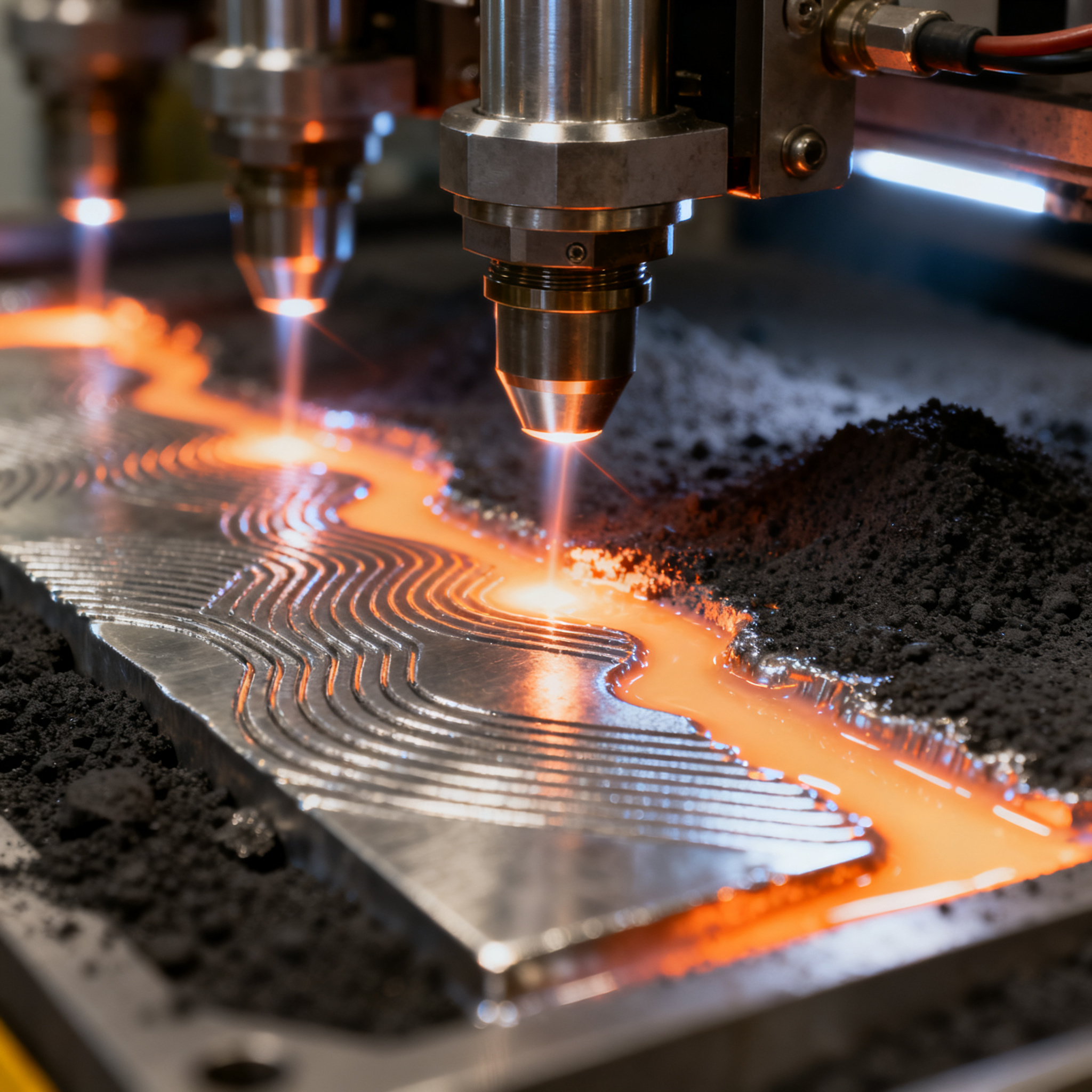
Additive manufacturing in the APAC: from laboratory to production line
At TCT Asia 2026, additive manufacturing is no longer just technological innovation but an integral part of the Chinese industrial production chain. The Asian market has surpassed the experimental phase and now competes on workflows, reliability, and integration.
The additive manufacturing market in the Asia-Pacific region has reached a decisive turning point. With over 55,000 square meters of exhibition space, 550 exhibitors, and 44,519 visitors (+421% year over year), TCT Asia 2026 has demonstrated that industrial 3D printing is no longer an emerging technology but a consolidated production infrastructure.
The density of the event reflects a market that is moving rapidly. Chinese industrial policies in recent years have transformed sectors such as electric vehicles and artificial intelligence. Additive manufacturing represents the next chapter of this evolution.
- 44,519 visitors at TCT Asia 2026, with growth of 421% compared to the previous year
- Over 55,000 m² of exhibition space distributed between Hall 7.1 (metal) and Hall 8.1 (polymers and consumer)
- The competition shifts from technical specifications to workflows, uptime, and industrial integration
From prototype to production: the evolution of AM in the APAC
Additive manufacturing in the Asian market has surpassed the experimentation phase and is entering a steady state in industrial supply chains, with a growing focus on concrete applications and scalability.
The most significant change does not concern the technical capabilities of Chinese machines. This is now an established fact. The real transformation is the shift from a competition centered on machines to a competition centered on applications.
Exhibitors no longer sell speed, laser, or print volumes in isolation. They sell complete workflows, guaranteed uptime, integration into existing systems, cost reduction, and productive throughput. The national manufacturing system has learned to absorb, implement, test, and commercialize new tools with speed.
This represents a much more mature stage of market development. The Asia-Pacific region has become one of the most dynamic markets for 3D printing, thanks to government support, growing industrial adoption, and robust domestic demand.
Scalable workflows and uptime as a competitive advantage
Companies now invest in reliable and integrable processes, no longer just in isolated technical performance. The competition is based on the ability to guarantee continuous production and predictable costs.
The maturity of the APAC market is measured by the language used by exhibitors. Pre-fair messages focus on scalable production, cost efficiency, sustainability, and automation. This is no longer the language of a market stuck at prototyping.
A strategic report published by Guojin Securities and cited by Nanjixiong identifies a “triple push for efficiency”: three converging cost reductions (collapse in raw material prices, multiplication of laser efficiency, and scalability of print capacity) that are opening up entirely new application categories.
The qualitative infrastructure has developed in parallel. The gap between what can be printed and what can be certified is closing, not as an aspiration but as an operational reality in sectors such as aerospace, nuclear, and automotive. ASTM International organized a comprehensive certified course on AM quality the day before the opening of TCT Asia, covering ISO/ASTM standards and IQ/OQ/PQ qualification processes.
Hall 7.1: the heart of the industrialization of metal AM
The exhibition space dedicated to metal reflects a maturity of the sector, with solutions oriented toward continuous, automated, and high-throughput production.
Hall 7.1 concentrated the entire value chain of metal additive manufacturing. The main exhibitors no longer positioned their systems based on technical specifications or research capabilities. The focus was on scalable production, economic efficiency, and industrial integration.
The competition on multi-laser continues to accelerate. Farsoon presented the FS1311M-U with 16 lasers and a build volume of 1310×1310×1650 mm, together with the updated FS812M-U with 8-10 lasers. Eplus3D announced the EP-M3050, configurable up to 256 lasers with a build volume of 3058×3058×1200 mm.
The transition from 8-16 laser configurations to systems with 64-256 lasers is not just a race for numbers. It represents the ability to produce complex metal parts with industrial throughput, reducing production times from days to hours.
LEAP 71 and HBD exhibited a one-meter aerospike cryogenic rocket engine, printed in Inconel, capable of generating 200 kN of thrust. Designed with Noyron, LEAP 71's computational model represents the largest aerospike ever printed and attracted continuous streams of visitors.
Additive manufacturing in the APAC region is being redefined as a production infrastructure, no longer as an emerging technology. The market competes on reliability, integration, and operating costs. The region is no longer just a market outlet for technologies developed elsewhere, but a place where AM is funded, produced, tested, and integrated on an industrial scale.
Discover how local companies are redefining the boundaries between innovation and mass production.
article written with the help of artificial intelligence systems
Q&A
What are the key numbers for TCT Asia 2026 and what do they indicate about the additive manufacturing market?
TCT Asia 2026 recorded 44,519 visitors with 42% year-on-year growth, over 55,000 square meters of exhibition space, and 550 exhibitors. These figures demonstrate that additive manufacturing in the Asia-Pacific region has become an established production infrastructure, definitively moving beyond the experimental phase.
How has competition changed in the APAC additive manufacturing market?
Competition has shifted from mere machine technical specifications to factors such as complete workflows, guaranteed uptime, integration into existing systems, and cost reduction. Companies now sell concrete applications and reliable processes rather than isolated print speeds or volumes.
What characterizes the evolution of the metal 3D printing systems presented in Hall 7.1?
The exhibited systems, such as the Farsoon FS1311M-U with 16 lasers and the Eplus3D EP-M3050 with up to 256 lasers, aim for scalable, high-throughput production. This shift to advanced multi-laser configurations allows production times to be reduced from days to hours, competing on economic efficiency and industrial integration.
What is the meaning of the 'triple efficiency push' mentioned in the article?
According to a Guojin Securities report, the 'triple efficiency push' stems from the convergence of three factors: the collapse of raw material prices, the multiplication of laser efficiency, and the scalability of printing capacity. These cost reductions are opening new application categories for additive manufacturing.
How is the quality infrastructure developing in APAC additive manufacturing?
The gap between what is printable and what is certifiable is closing in sectors such as aerospace, nuclear, and automotive. As evidence of this, ASTM International organized a certified course on ISO/ASTM standards and IQ/OQ/PQ qualification processes on the occasion of TCT Asia 2026.
What was the most relevant application example showcased at TCT Asia 2026 and why?
LEAP 71 and HBD presented a one-meter cryogenic aerospike rocket engine, printed in Inconel, capable of generating 200 kN of thrust. It is the largest aerospike ever printed and demonstrates how additive manufacturing in APAC is successfully tackling advanced applications in the aerospace sector.