VulcanForms appoints Jeff Hemenway Chief Revenue Officer to accelerate the transition to series production
VulcanForms appointed Jeff Hemenway Chief Revenue Officer on September 18, 2026. The move marks a phase change for the U.S. company: no longer proving that high-productivity metal 3D printing works, but transforming the production capacity built in recent years into long-term industrial programs.
Hemenway will lead commercial strategy, development of existing customers, and acquisition of new programs in the aerospace, defense, medical, and industrial sectors. The appointment comes a few months after a $220 million financing announced on January 30, 2026.
- Jeff Hemenway appointed Chief Revenue Officer on September 18, 2026
- Goal: transform production capacity into long-term industrial programs
- Follows $220 million financing (January 2026)
- VulcanForms prepares further expansion in Massachusetts
An industrial model different from traditional manufacturers
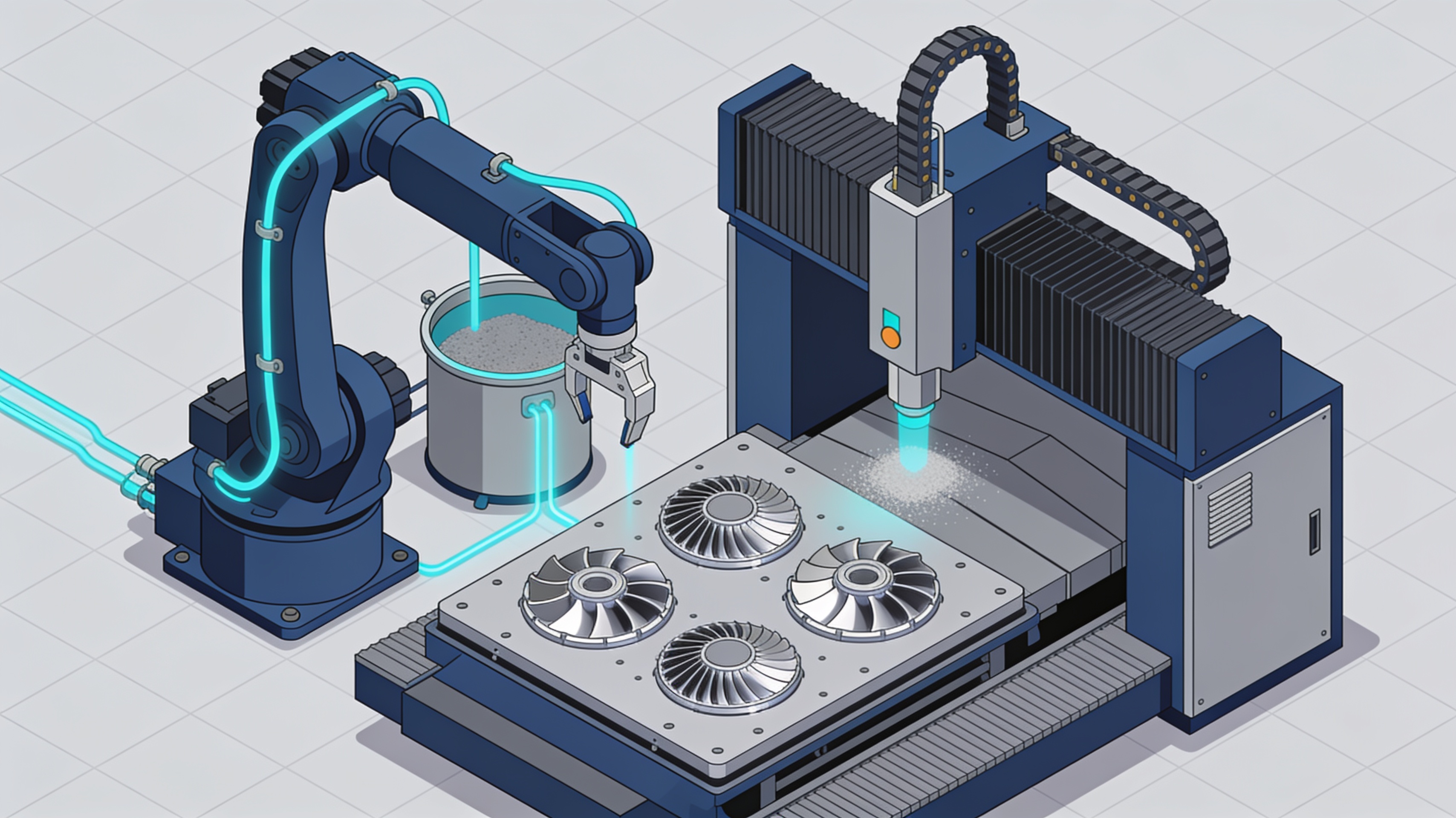
VulcanForms does not sell printers but finished components, integrating its own factories into customers' supply chains.
The company designs and builds Laser Powder Bed Fusion systems in-house. It installs them in its own factories and sells finished components and production capacity to customers. It does not sell the machines on the market.
This model radically changes the commercial challenge. VulcanForms must convince OEMs and prime contractors to entrust it with complete production programs. It must qualify processes and components, integrate the factories into the customer's supply chain, and maintain performance, quality, and costs at volumes much higher than typical prototype runs.
From MIT origins to industrial production
Founded in 2015 out of MIT, VulcanForms tackled the main limitation of Laser Powder Bed Fusion: productivity.
VulcanForms was founded in 2015 by Martin Feldmann and Professor John Hart of the Massachusetts Institute of Technology. The initial idea was to address one of the main economic limitations of Laser Powder Bed Fusion: productivity.
In conventional LPBF, one or more lasers selectively melt thin layers of metal powder. Once a layer is completed, the build plate is lowered, new material is spread, and the process starts again. The technology enables complex geometries and near-net-shape components, but productivity is historically much lower than casting, forging, or stamping when quantities increase.
VulcanForms' response was to drastically increase the number of laser sources, accompanying this increase with digital control, automation, and advanced monitoring.
Expansion of production capacity in Massachusetts
The company is preparing a further expansion of production capacity while consolidating its commercial structure.
VulcanForms is preparing a further expansion of production capacity in Massachusetts. The expansion follows the January 2026 financing and is part of the company's strategy to consolidate its industrial position.
Hemenway's appointment as Chief Revenue Officer represents recognition that the technology phase has been surpassed. Now the priority is to build stable business relationships and repeatable production programs in high-value sectors.
article written with the help of artificial intelligence systems
Q&A
Who was appointed Chief Revenue Officer of VulcanForms and when?
Jeff Hemenway was appointed Chief Revenue Officer of VulcanForms on September 18, 2026. The appointment marks the company's transition from technology demonstration to building long-term industrial programs.
Which sectors will Hemenway focus on in his commercial strategy?
Hemenway will lead commercial strategy, development of existing customers, and acquisition of new programs in the aerospace, defense, medical, and industrial sectors. These are the markets where VulcanForms intends to consolidate its production capacity.
What is VulcanForms' business model compared to traditional manufacturers?
VulcanForms does not sell printers but finished components and production capacity, integrating its factories into customers' supply chains. The company designs and builds Laser Powder Bed Fusion systems in-house and installs them in its own facilities.
When was VulcanForms founded and by whom?
VulcanForms was founded in 2015 by Martin Feldmann and Professor John Hart of the Massachusetts Institute of Technology. The initial goal was to overcome the productivity limit of Laser Powder Bed Fusion.
What funding preceded Hemenway's appointment?
The appointment comes a few months after a $220 million funding round announced on January 30, 2026. This capital supports the transition to series production and preparation for further expansion in Massachusetts.