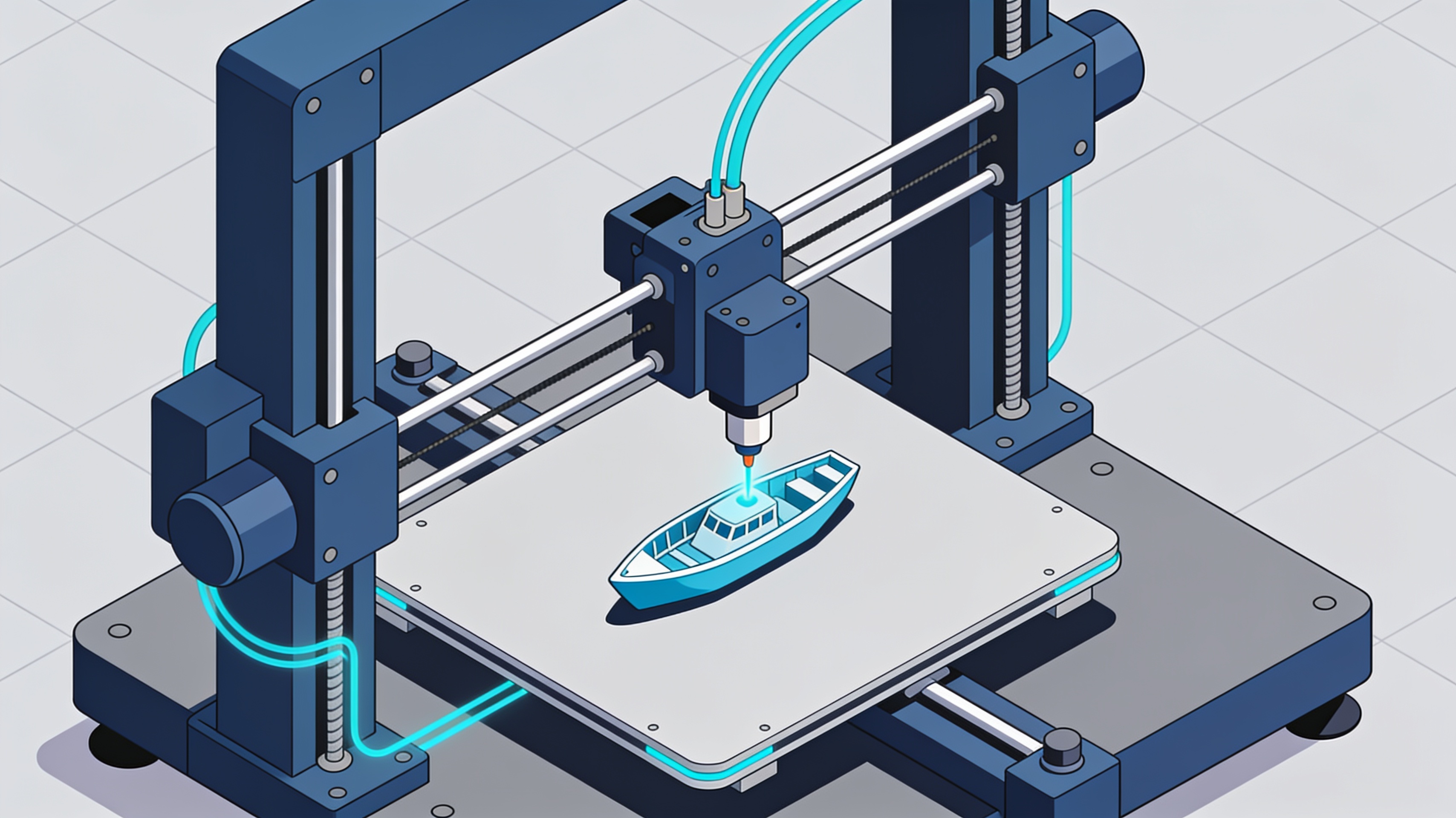
RepRap Micron prints the world's smallest 3DBenchy: 0.650 mm in 13 hours
The open-source RepRap project has achieved a microscopic milestone: printing a 3DBenchy just 0.650 mm long. The model, used as a benchmark in 3D printing, was produced on the RepRap Micron printer, still under development.
The print took 13 hours of work. This is the first attempt to produce this model on a microscopic scale.
A printer for the micron scale
RepRap Micron represents the evolution of the project that gave rise to desktop 3D printing. The goal is to produce structures down to one micron or less.
The RepRap project made history in additive manufacturing. Years ago it developed the first designs for affordable desktop FFF systems, giving rise to the entire consumer 3D printing industry.
Now RepRap is aiming for the microscopic frontier. The Micron printer is designed to produce structures as small as a single micron (0.001 mm) or even less.
Vik Olliver, the project leader, confirmed that this tiny 3DBenchy represents the first test of its kind on the platform.
- 3DBenchy printed at 0.650 mm in length
- First print of this kind on RepRap Micron
- Production time: 13 hours
- Goal: resolution down to 0.001 mm
Applications beyond silicon
Microscopic printing could revolutionize fields such as microelectronics and biological sciences, just as RepRap did with traditional manufacturing.
The RepRap team sees enormous potential for this technology. The biological sciences could benefit from inexpensive and rapidly evolving equipment.
Microelectronics represents another promising field. The technology could enable independent communities to develop micron-scale solutions, overcoming dependence on silicon as the primary platform.
The project envisions that micron-scale manufacturing could advance the same fields that RepRap transformed with desktop 3D printing. Developments could emerge in sectors that do not even currently exist.
One micron equals 0.001 millimeters. The printed 3DBenchy measures 0.650 mm, about 650 times larger than the system's final target resolution.
Technology has not reached a plateau
While some believe that 3D printing has reached a technological plateau, projects like RepRap Micron prove otherwise.
The tiny 3DBenchy is not perfect. The source itself admits that “it is not the best 3DBenchy ever seen”. But that is not the point.
The value lies in the proof of feasibility. Open-source 3D printing is pushing toward sizes that until recently were the exclusive domain of expensive industrial technologies.
RepRap Micron is still in development. The project maintains the open-source philosophy that has characterized RepRap from the beginning, when it introduced the concept of devices capable of self-replicating.
The road to reliable micron-scale production is still long. But this first microscopic 3DBenchy marks a concrete starting point for a new frontier in additive manufacturing.
article written with the help of artificial intelligence systems
Q&A
How small is the smallest 3DBenchy printed by RepRap Micron?
The 3DBenchy printed by RepRap Micron measures just 0.650 mm in length. This is the first attempt to produce this model on a microscopic scale.
How long did it take to print the microscopic 3DBenchy?
The print took 13 hours of work. It was made on the RepRap Micron, a printer still under development.
What is the target resolution of the RepRap Micron printer?
The RepRap Micron is designed to produce structures as small as a single micron (0.001 mm) or even less. The 0.650 mm 3DBenchy is about 650 times larger than the final target resolution.
Who leads the RepRap Micron project?
The project leader is Vik Olliver. He confirmed that this tiny 3DBenchy represents the first test of its kind on the RepRap Micron platform.
Which applications could benefit from RepRap Micron's microscopic printing?
The RepRap team sees potential in the biological sciences, which could obtain inexpensive and rapidly evolving equipment, and in microelectronics, overcoming the dependence on silicon as the main platform.