Turmeric in 3D printing: the kitchen spice that reduces light scattering in ceramics
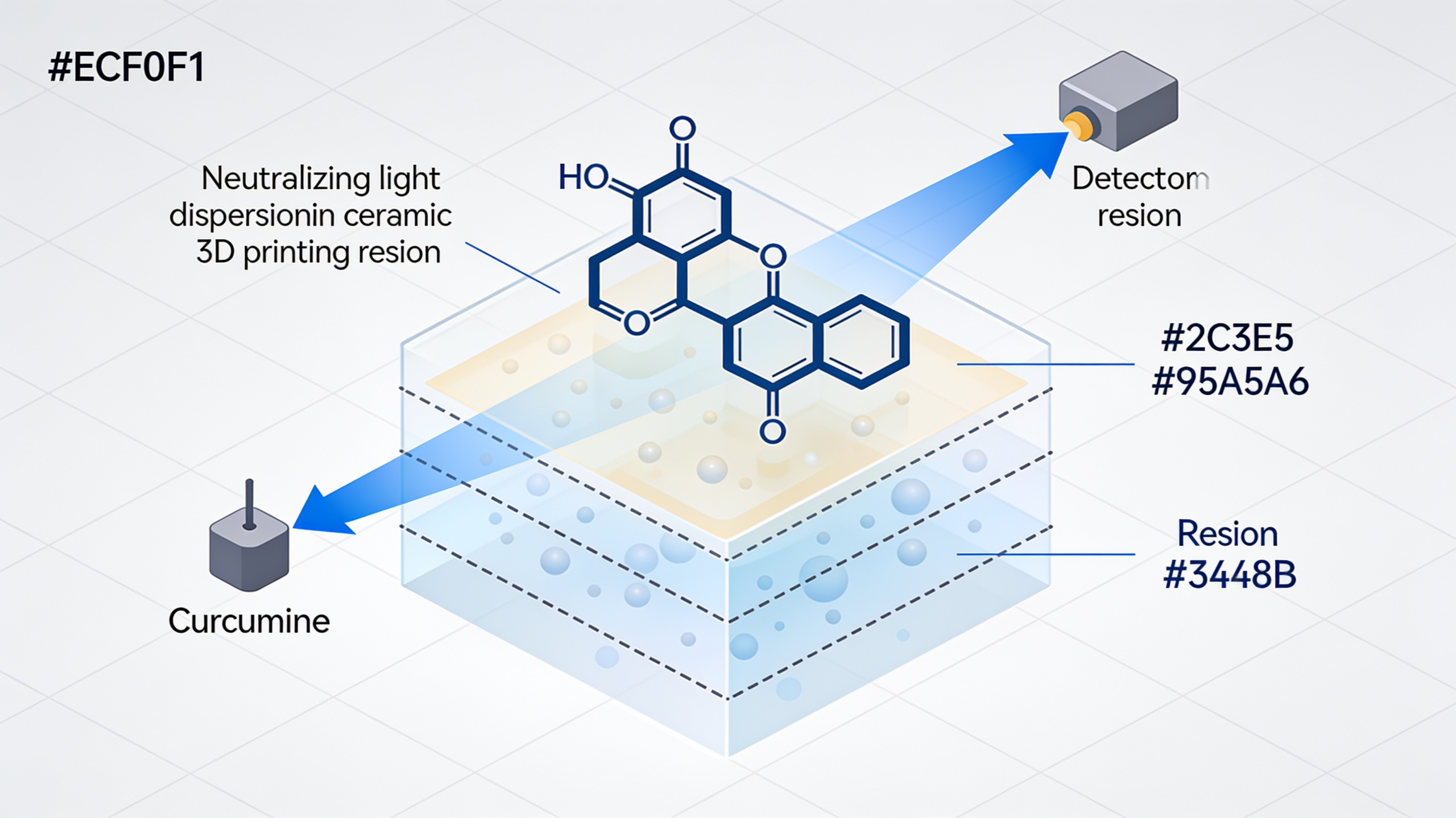
Researchers from Hunan University have discovered that curcumin, the active compound in turmeric, solves one of the most critical problems of ceramic 3D printing: uncontrolled light scattering during photopolymerization. Concentrations as low as 0.01% are enough to drastically improve resolution without compromising mechanical properties.
Curcumin is the chemical compound that gives turmeric its characteristic bright yellow color. Extracted from the plant Turmeric, it is used in supplements, cosmetics, and food colorings. Now it finds application in ceramic additive manufacturing.
The problem of light scattering
Ceramic 3D printing with DLP technology has always faced a technical challenge: ceramic particles scatter light randomly, compromising precision.
DLP (Digital Light Processing) technology for ceramics works by projecting light patterns onto resins loaded with microscopic ceramic powder. Each layer polymerizes when hit by light.
Solid ceramic particles act like tiny mirrors. They scatter light in random directions, causing the hardening of unwanted areas of the resin.
This phenomenon generates printing defects and loss of detail. The final components are less precise than required by critical applications.
- Industrial dyes block scattered light but degrade mechanical properties
- Users must choose between fine detail and structural strength
- Curcumin eliminates this compromise
How curcumin works
Curcumin does not just passively block light: it actively neutralizes the chemical reactions that cause printing errors.
Traditional dyes absorb excess light but compromise the thermal and mechanical stability of the final part. Curcumin takes a different approach.
The team at Hunan University demonstrated that curcumin neutralizes the free radicals responsible for irregular reactions. This active mechanism prevents errors at the source.
The required concentration is minimal: only 0.01% by weight. This amount prevents fine details from blurring together without slowing down production.
| Feature | Traditional dyes | Curcumin |
|---|---|---|
| Light management | Passive block | Active absorption + radical neutralization |
| Concentration | Variable | 0.01% by weight |
| Mechanical properties | Compromised | Preserved |
Implications for the industry
This discovery opens new possibilities for sectors that require ceramic components with high precision and simultaneous resistance.
The aerospace sector uses ceramic components for high-temperature applications. Curcumin allows producing more precise parts while maintaining structural performance.
Medical devices benefit from biocompatible ceramics with complex geometries. The higher resolution enables more sophisticated designs.
Vat photopolymerization is the basic process: a liquid resin loaded with ceramic powder is hardened layer by layer via precisely projected UV or visible light.
Future perspectives
The research was conducted by Hunan University and represents a paradigm shift in the approach to light scattering problems. The use of natural compounds instead of industrial chemical additives could extend to other materials.
Curcumin demonstrates that effective solutions can come from unexpected sources. A kitchen spice solves a technical problem that has limited ceramic additive manufacturing for years.
The integration of this natural additive into existing production processes will require further validation. However, preliminary results indicate significant potential for large-scale industrial applications.
article written with the help of artificial intelligence systems
Q&A
What problem of ceramic 3D printing does curcumin solve?
Curcumin solves the problem of uncontrolled light scattering during photopolymerization, which causes hardening of unwanted areas and reduces the precision of the parts.
How does curcumin act differently from traditional dyes?
While traditional dyes passively block light but compromise mechanical properties, curcumin actively neutralizes free radicals responsible for irregular reactions, preserving the material's strength.
What concentration of curcumin is sufficient to improve ceramic 3D printing?
A concentration of 0.01% by weight is sufficient to dramatically improve resolution without slowing down production.
What mechanical properties are preserved thanks to the use of curcumin?
Curcumin preserves the mechanical properties of the final part, unlike traditional dyes that compromise them.
Which industrial sectors could benefit from this discovery?
The aerospace and medical device sectors can benefit from high-precision and high-strength ceramic components, thanks to the greater resolution achievable with curcumin.