32 pieces/hour or 1.920? The true limit of AM
Industrial 3D printing reaches a maximum of 32 parts per’hour in continuous production with advanced Binder Jetting. Injection’ molding produces 1.920. This 60x gap defines the true application limits of additive manufacturing in high-volume production contexts.
Real productivity of industrial AM technologies
MEX, VPP, and BJ technologies show measurable production limits when compared to traditional processes. Benchmark data reveal significant gaps even in continuous flow scenarios.
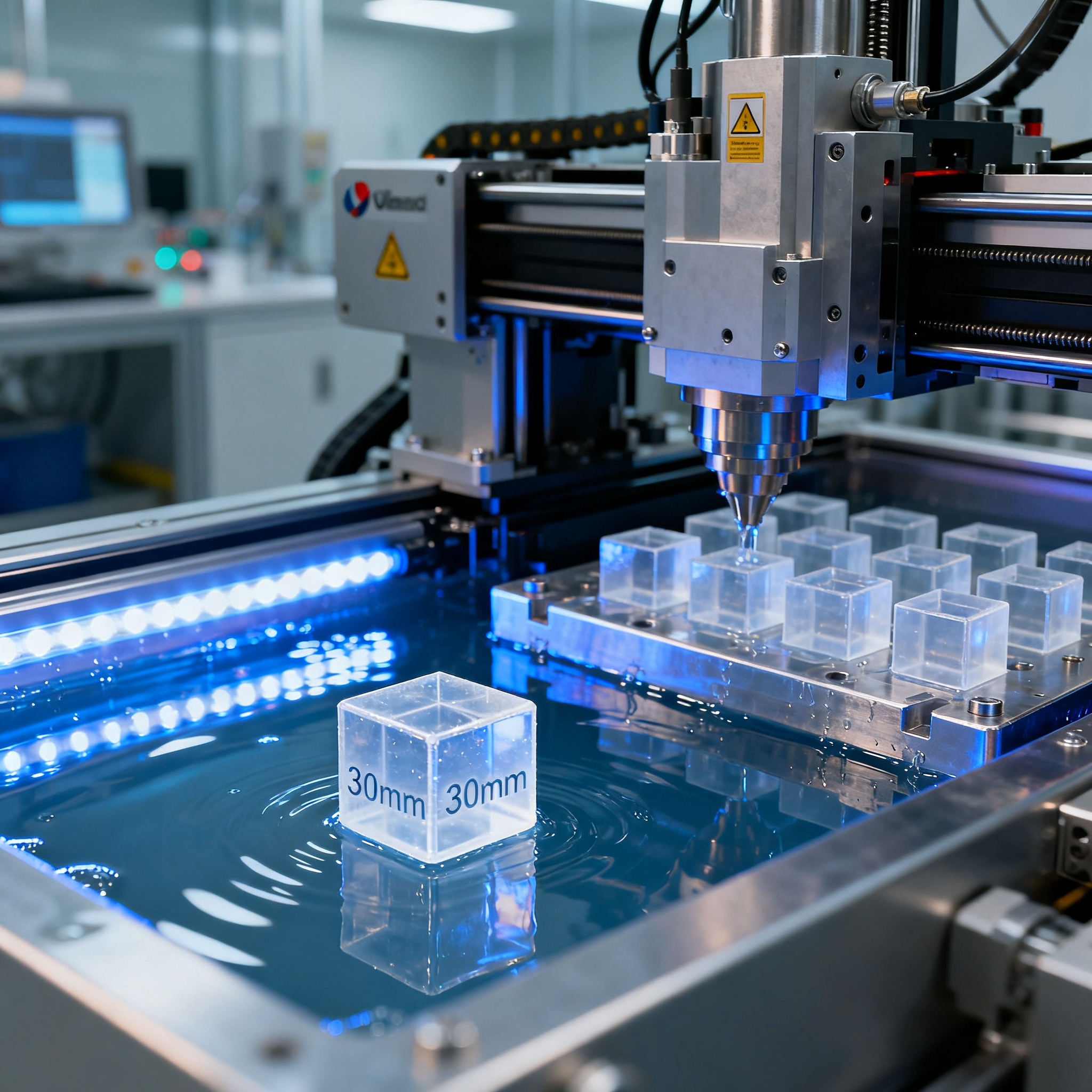
A study from Sungkyunkwan’University tested five categories of additive processes according to the ISO/ASTM 52900 standard. The benchmark used a solid cube of 30 mm per side to compare actual productivity.
Material Extrusion (MEX) produced 7.43 parts per hour in a single batch and 7.23 parts/hour in a 120-hour continuous scenario. Vat Photopolymerization (VPP) reached 7.62 parts/hour per batch, rising to 14.00 parts/hour in continuous production.
| Technology | Parts/hour (single batch) | Parts/hour (continuous) |
|---|---|---|
| Material Extrusion | 7,43 | 7,23 |
| Vat Photopolymerization | 7,62 | 14,00 |
| Binder Jetting | 5,30 | 32,25 |
| Powder Bed Fusion | 4,42 | 9,47 |
Binder Jetting showed the most significant growth: from 5.30 parts/hour per batch to 32.25 parts/hour in continuous flow, assuming adequate post-processing infrastructure. Powder Bed Fusion stopped at 9.47 parts/hour in continuous.
Plastic injection: the industrial benchmark
Plastic injection sets production standards that 3D printing cannot approach. A 60-fold gap separates the best-performing technologies from traditional manufacturing.
The same study compared additive results with plastic injection. Assuming an eight-cavity mold with a 15-second cycle, injection reaches 1,920 parts per hour.
The gap is structural. Even the best-performing Binder Jetting (32.25 parts/hour) produces 98.3% less than injection. Material Extrusion and Vat Photopolymerization stop below 15 parts/hour in continuous.
- Plastic injection: 1,920 parts/hour (8-cavity mold, 15-second cycle)
- Continuous Binder Jetting: 32.25 parts/hour (best AM performance)
- Gap: 59.6 times less productive
Researchers have introduced the Effective Parts Per Hour (EPPH) metric, which includes preprocessing, printing, and mandatory post-processing. For metal systems like the Desktop Metal P-50, printing takes about four hours, but sintering, cooling, and depowdering add up to 36 hours. Polymer systems like the Figure 4 Modular require washing and UV curing, which can be completed in a few hours.
When flexibility is not enough: the limits of time-to-market
Quick setup and lack of tooling reduce time-to-market, but do not compensate for limited throughput. 3D printing remains constrained to low volumes and high variability.
Additive manufacturing eliminates the typical tooling times of plastic injection. The same CAD file can be used for validation, modifications, and repeated production without retooling. This continuity reduces decision cycles from design to production.
The advantage becomes irrelevant in mass production scenarios. When volumes exceed a few hundred parts, limited throughput cancels out the benefits of quick setup. Plastic injection recovers the cost of the mold in a few hours of continuous production.
3D printing maintains economic competitiveness only in low-volume, high-variability productions. The study from Sungkyunkwan University confirms that additive can compete with injection exclusively in low-volume, high-mix contexts.
Each transfer between isolated processes introduces latency and variation. Factories that shorten this distance consolidate steps and simplify the movement of matter and energy, reducing costs and times.
Strategic exceptions: who approaches industrial productivity
Advanced Binder Jetting and integrated architectures show superior production potential. The trade-offs involve resolution, materials, and infrastructure complexity.
Binder Jetting reaches 32.25 parts/hour in continuous production, six times more than Material Extrusion. This result requires post-processing infrastructure sized to handle continuous flows: depowdering, sintering, heat treatments.
Software-defined platforms are unifying printers, robots, post-processing, inspection, and enterprise IT systems. These architectures orchestrate multi-stage workflows with AI-based closed-loop control, reducing downtime between processes.
Arridex has inaugurated the Omnifactory in Lagos, the first multi-technology industrial 3D printing plant in West Africa. The facility integrates Laser Powder Bed Fusion, Cold Spray, Fused Filament Fabrication, Selective Laser Sintering, and large-format printing. The goal is to produce components and spare parts locally for oil & gas, maritime, aerospace, and defense, reducing import dependence and lead times.
The company has announced a Mega Omnifactory for the first quarter of 2027, which should rank among the largest single-site industrial additive manufacturing plants. The actual scalability will need to be verified with concrete operational data.
Conclusion
Industrial 3D printing does not compete with plastic injection in high-volume scenarios. The 60x production gap defines precise application boundaries: low volume, high variability, complex geometries, customization. Scalability remains the structural limit of the technology.
Integrated architectures and advanced Binder Jetting reduce the gap, but do not eliminate it. Additive manufacturing remains strategic in production niches where flexibility and time-to-market outweigh throughput as operational priorities.
Want to understand if your production can truly benefit from 3D printing? Download our checklist for production benchmarking.
article written with the help of artificial intelligence systems
Q&A
What is the productivity gap between the highest-performing industrial 3D printing and plastic injection molding?
Plastic injection molding with an eight-cavity mold and a 15-second cycle produces 1,920 parts per hour, while continuous-flow Binder Jetting reaches a maximum of 32.25 parts per hour. This means that the fastest additive technology is approximately 60 times less productive than traditional manufacturing.
Which AM technologies were benchmarked and what results did they achieve in continuous production?
The Sungkyunkwan University study tested Material Extrusion (7.23 parts/hour), Vat Photopolymerization (14.00), Binder Jetting (32.25), and Powder Bed Fusion (9.47) in continuous-flow scenarios. Binder Jetting showed the most significant growth compared to single batch processing, but all remain well below plastic injection molding.
What is EPPH and why is it important for evaluating the real productivity of 3D printing?
Effective Parts Per Hour (EPPH) is a metric that includes mandatory preprocessing, printing, and post-processing. It is essential because it highlights how operations such as sintering, cooling, and depowdering can add up to 36 hours to the production cycle, drastically reducing effective throughput.
In which production contexts does 3D printing remain competitive compared to plastic injection molding?
Additive manufacturing maintains economic and strategic advantages exclusively in low-volume, high-mix productions, where setup speed, the absence of tooling, and the possibility of customization outweigh the importance of massive throughput.
What are the strategic exceptions that reduce the productivity gap of 3D printing?
Advanced continuous-flow Binder Jetting and integrated software-defined architectures, which orchestrate printing, robotics, post-processing, and inspection with AI, show superior potential. Examples such as Arridex's Omnifactory in Nigeria indicate how the integration of multiple technologies can improve operational scalability.