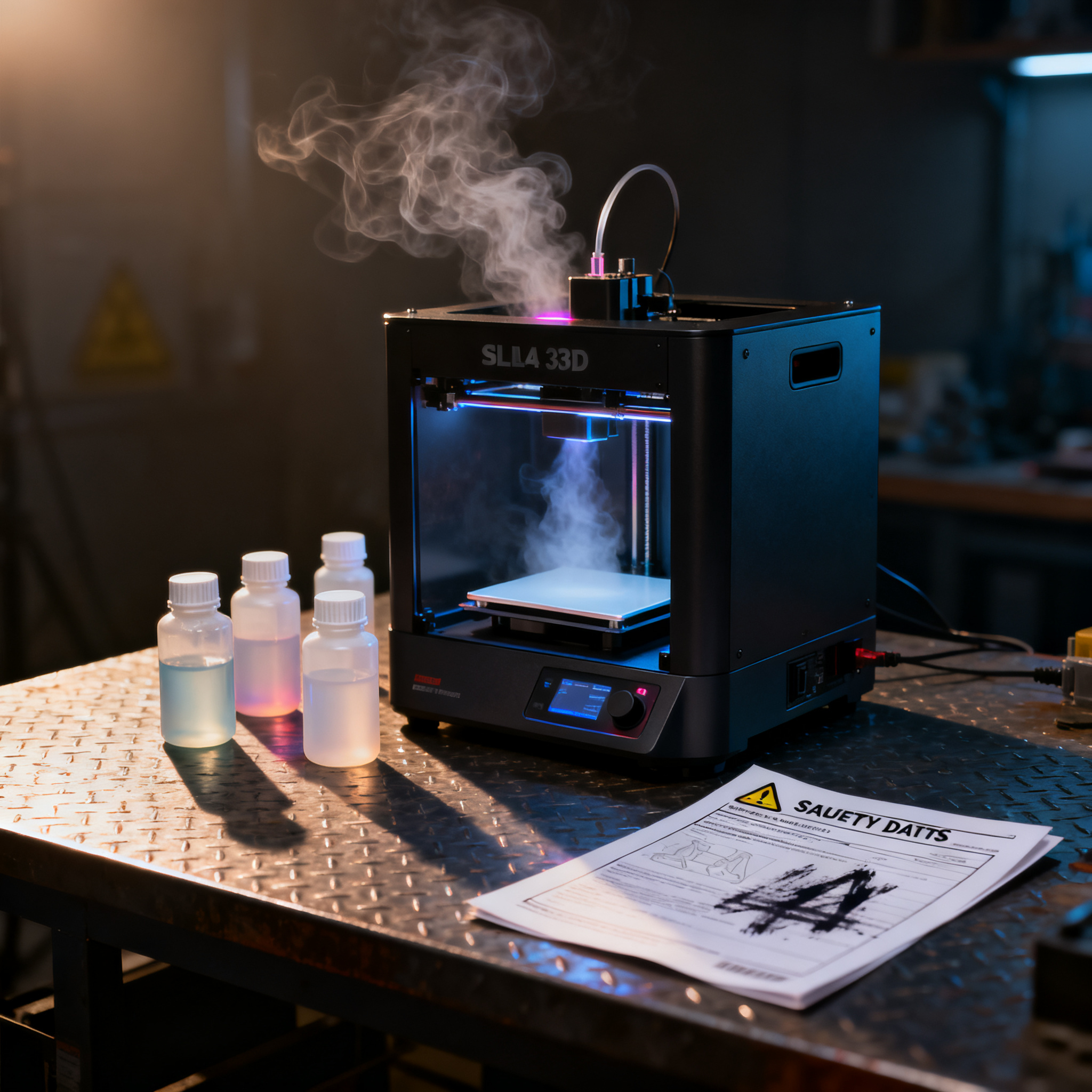
Toxic fumes from your SLA?
Resin 3D printers have become accessible to everyone, but few really know what they breathe or touch during use. Many consumer resins contain dangerous reactive monomers, often not declared in safety data sheets. The absence of strict regulations in the hobbyist sector exposes users to real and underestimated chemical risks.
The dark side of consumer resins
Resins marketed to hobbyist users hide critical chemical compounds, often not declared in safety data sheets.
An analysis conducted by Formlabs on over 70 resins from 17 different manufacturers revealed an alarming fact: the vast majority of general-purpose resins contain between 30% and 60% methoxyethyl acrylamide (ACMO) in the formulation. This compound is classified by the US EPA with a SNUR (Significant New Use Regulation) due to health risks.
The problem is that this data often does not appear in the safety data sheet. The most common resins on the consumer market — including those from Elegoo, Anycubic, Phrozen, and Creality — contain reactive monomers, oligomers, and photoinitiators. The chemistry of liquid photopolymer resin represents a concrete risk for those who handle it without adequate protection.
- 30-60% ACMO (methoxyethyl acrylamide) in most formulations
- Reactive monomers and oligomers not always declared
- Photoinitiators with variable toxicological profiles
- Safety data sheets often incomplete or generic
Why regulations do not protect you
The consumer market lacks stringent requirements, creating a regulatory gap that exposes users to invisible risks.
The cost of resin printers has dropped dramatically. Today it is possible to buy a desktop machine for less than 100 euros. However, economic accessibility has not been accompanied by parallel education on the risks of the material used.
In online stores and promotional campaigns, attention is focused on resolution, speed, and price. The effort required to set up a safe workstation remains in the background. Elegoo, Anycubic, and other companies provide safety data sheets, but this information often arrives after purchase.
The difference with the professional sector is clear. Industrial machines integrate containment systems, closed cartridges, and automatic dispensing. Budget printers, on the other hand, require more manual interventions: pouring the resin, recovering unused resin, removing the platform, detaching the model.
ACMO and other monomers: the hidden enemies
Chloromethoxyethyl acrylate (ACMO) is just one of the many reactive monomers present in many resins, with known but poorly communicated toxic effects.
The most insidious mechanism is immunological sensitization. Andrius Darulis, co-founder of AmeraLabs, describes it as the element of greatest concern in the current landscape.
Sensitization is an immune response that develops after repeated exposures. The immune system “learns” to recognize the compound as a hostile element. The fundamental characteristic is that the process does not produce evident symptoms in the initial stages.
The operator continues to work with resin for months or years without experiencing consequences. Then, suddenly, even minimal exposure triggers severe allergic reactions: contact dermatitis, urticaria, respiratory crises, occupational asthma. This condition is irreversible: once sensitized, the individual can no longer be near uncured resin.
Those who work with resin for a long time without symptoms tend to spread online the belief that the risks are exaggerated. This dynamic is documented in forums and YouTube channels dedicated to resin printing, where images of people handling resin with bare hands are common.
Chemical Transparency: The AmeraLabs Model
Initiatives like those of AmeraLabs demonstrate how safety can be achieved through clear communication and verifiable data.
AmeraLabs, a Lithuanian company specializing in photopolymer resins, has published a structured 23-point guide on the risks of resins for 3D printing. It is not a promotional document about a single product, but an evaluation grid applicable to any resin on the market.
The guide covers GHS classification of hazards, the presence of warnings about skin irritation and sensitization, exposure limits for individual components. It also includes instructions on ventilation, personal protective equipment, first aid procedures, and waste management.
The document invites to distinguish between generic claims such as “biocompatible” or “safe” and statements supported by tests according to recognized standards. AmeraLabs asks that manufacturers clearly indicate not only the nominal properties of the material, but also the process conditions necessary to ensure safety.
| Safety Element | What to Check |
|---|---|
| Safety Data Sheet (SDS) | Completeness of GHS pictograms and risk phrases |
| Chemical composition | Indication of reactive monomers and exposure limits |
| Required PPE | Nitrile gloves, respirator with VOC filters, goggles |
| Ventilation | Ricambio d’aria continuo verso l’esterno |
| Disposal | Instructions for liquid resin, solvents, and contaminated waste |
AmeraLabs’ approach aligns with recommendations already disseminated by various entities. Formlabs uses closed cartridges and automatic dispensing on its professional platforms. Prusa Research publishes documentation dedicated to the risks of resins and has worked on formulations with improved safety profiles.
Conclusion
Safety in SLA resins is not just a matter of ventilation: it requires chemical awareness and informed choices. The regulatory gap in the consumer sector leaves users with the responsibility of assessing the real risks.
Resins labeled as “water-washable” or “eco” contain the same reactive monomers as traditional formulations. The surgical masks included in the packaging of many printers are inadequate to retain VOCs. Only a respirator with specific filters for organic vapors offers effective protection.
Check the chemical specifications of the resins you use: transparency is the first step towards a safe printing environment. Always read the safety data sheet before using a new resin and set up a dedicated workstation, separate from living areas.
article written with the help of artificial intelligence systems
Q&A
What is the main chemical risk of consumer resins for SLA 3D printing?
Most general-purpose resins contain between 30% and 60% of 2-methoxyethyl acrylamide (ACMO), a reactive monomer classified by the EPA as a health risk. This data often does not appear in safety data sheets, exposing users to real and underestimated chemical hazards.
What is meant by immunological sensitization and why is it particularly dangerous?
It is an immune response that develops after repeated exposures to monomers without producing evident symptoms in the initial stages. Once it occurs, the condition is irreversible: even minimal future exposure can trigger severe allergic reactions such as dermatitis, urticaria, and occupational asthma.
Why do current regulations not sufficiently protect hobbyist users?
The consumer market lacks stringent requirements and safety data sheets are often incomplete or generic. The economic accessibility of printers has not been accompanied by adequate education on risks, leaving users with the responsibility of evaluating the real dangers.
Are 'eco' or 'water-washable' resins safer than traditional formulations?
No, they contain the same reactive monomers as traditional resins. Terms such as 'biocompatible' or 'safe' do not guarantee lower chemical hazard, so it is always necessary to adopt the same protective precautions.
What personal protective equipment is essential for printing safely with resins?
Nitrile gloves, safety goggles, and a respirator with specific filters for organic vapors (VOC) are required, as surgical masks are inadequate. It is also essential to ensure continuous ventilation to the outside in a workstation separate from living areas.
What does AmeraLabs propose to improve safety in the resin sector?
AmeraLabs has published a 23-point guide to evaluate the risks of any resin on the market. The document requires transparency on chemical composition, GHS classification, and exposure limits, inviting a distinction between generic claims and statements supported by testing.