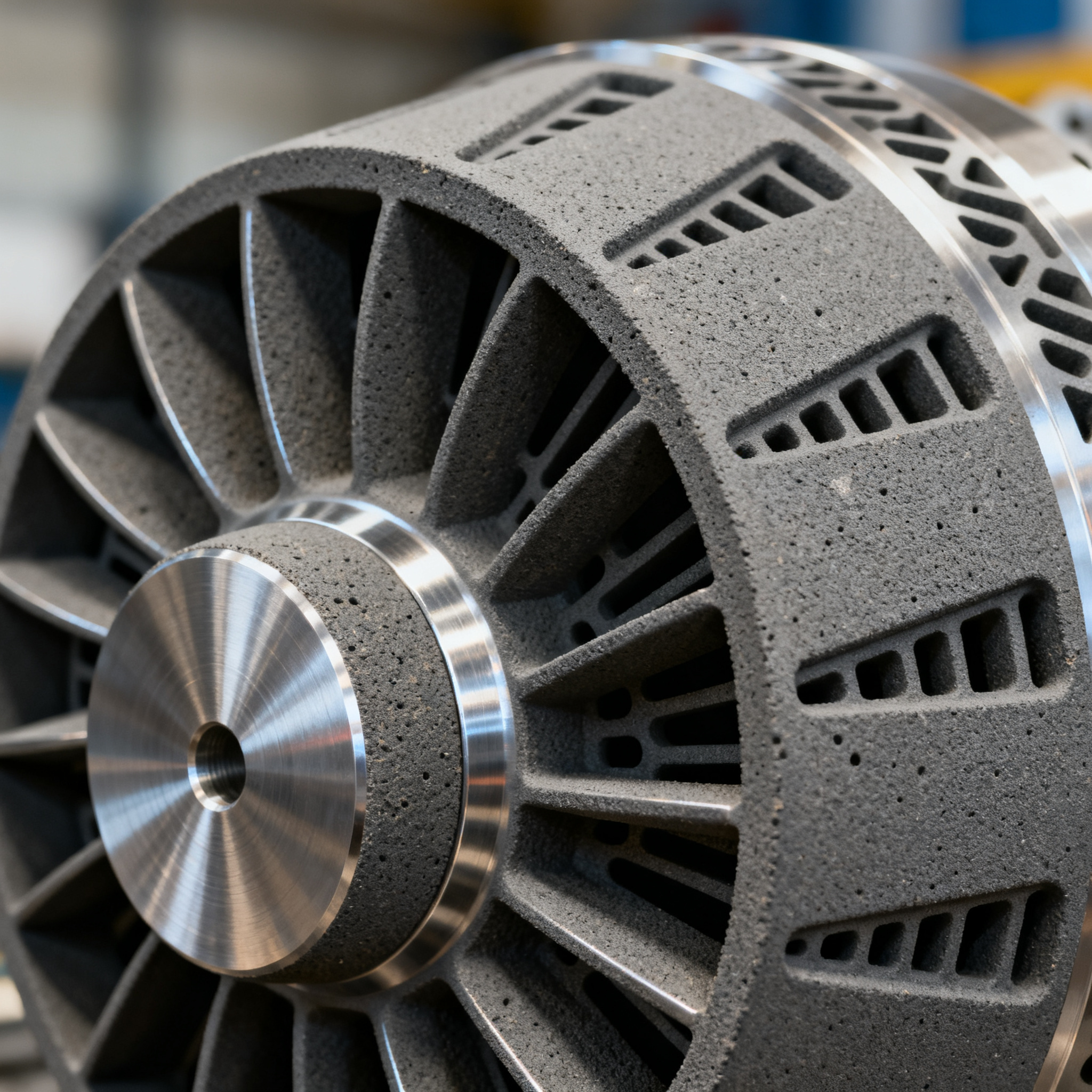
3 moves that are revolutionizing industrial AM
The convergence between metals and ceramics in 3D printing is redefining the boundaries of the industry, but only those who adopt a clear action plan are reaping the competitive benefits.
Leading companies are integrating 3D printing of metals and ceramics into their production processes with measurable results. The key to success is not the technology itself, but how it is implemented. Those who treat these technologies as complementary elements gain concrete competitive advantages.
- Structured workflows that integrate AM without stopping production
- Replicable case studies from aerospace and semiconductors
- Process standardization and targeted team training
Integration strategies: when metal meets ceramic
A clear action plan is essential to fuse metals and ceramics into existing production processes without operational interruptions.
Integration requires industry-specific approaches. Sinto Advanced Ceramics, former Bosch division, focuses on serial production of technical ceramics. Their CTO Nikolai Sauer emphasizes that the transition from prototyping to serial production requires repeatable processes.
The British center AMRICC offers an end-to-end model for ceramics. It uses robocasting and bath polymerization to help manufacturers with paste formulation, sintering, and debinding. This comprehensive approach eliminates the typical bottlenecks of adoption.
Ceramics integration process
- Formulation: development of optimized ceramic pastes for the specific AM process.
- Printing and debinding: production of the green component and controlled removal of organic binders.
- Sintering: final consolidation with precise control of shrinkage and density.
On the metals front, technologies like LabAM24's InertOn are changing the game. This wire DED system creates an inert environment around the melt pool, reducing oxygen below 20 ppm in one minute. It eliminates the need for printing chambers for large components.
Winning workflows from the aerospace sector
Real-world cases demonstrate how space companies have redefined complex production chains thanks to hybrid AM.
Starlab Space is developing a LEO space station to replace the ISS. Their director Jonathan Volk highlights a crucial point: «Volume is precious in space. Save weight and space with an on-board printer, producing what is needed on-demand instead of sending many different components.».
Redwire has already demonstrated feasibility by 3D printing monolithic ceramic blisks for turbines in space. This application shows how ceramics and metals complement each other: ceramics for high-temperature components, metals for load-bearing structures.
| Application | Material | Key advantage |
|---|---|---|
| Turbine blisk | Ceramic | Extreme thermal resistance |
| Combustion chambers | Refractory alloys (RCCA) | Creep and temperature resistance |
| AI cold plates | Pure copper | Optimal thermal conductivity |
Safran uses Lithoz to print ceramic cores for the casting of monocrystalline nickel alloy turbine blades. This hybrid workflow combines ceramic AM with traditional casting, achieving geometries impossible with conventional methods.
Operational scalability: standardize to grow
Repeatable processes and specifically trained teams accelerate the adoption of advanced AM.
Serial production requires standardization. Lithoz has demonstrated volumes of 2,000 units per month for semiconductor gas injectors produced by Bosch Advanced Ceramics. This level of output requires validated processes and systematic quality control.
Free Form Fibers has obtained government funding for the production of semiconductors with ceramic matrix composites via chemical vapor deposition. Their researcher Seth Shuster notes: «I am impressed by the form tolerance that can be achieved in short times with non-oxide ceramic 3D printing.».
The metal-ceramic convergence requires cross-disciplinary expertise. Teams must understand both metallurgy and ceramic materials science, in addition to specific AM process parameters.
The C1000 FLEXMATIC system by 3DCeram Sinto integrates artificial intelligence to automatically generate optimized print parameters. This approach reduces downtime and ensures repeatable quality, essential elements for mass production.
Advanced materials such as aluminum nitride (AlN) and silicon nitride (Si₃N₄) are now compatible with industrial systems. AlN offers thermal conductivity of 180 W/m·K with excellent electrical insulation. Si₃N₄ achieves 750 MPa in flexural strength, ideal for aerospace structural components.
Conclusion
Those who treat metals and ceramics as complementary, not alternative, elements are redefining their production capacity. Cases from aerospace and semiconductors show that structured integration generates measurable results.
Scalability passes through three pillars: validated workflows, process standardization, and targeted training. The technologies exist and are mature. Implementation makes the difference.
Start today mapping your processes toward a structured integration of AM: the first steps count more than you think. Identify where metals and ceramics can collaborate in your products, not compete.
article written with the help of artificial intelligence systems
Q&A
What are the three winning moves to successfully integrate industrial AM of metals and ceramics?
The three winning moves are: structured workflows that integrate 3D printing without stopping existing production; replicable case studies from the aerospace and semiconductor sectors; process standardization combined with targeted training of the technical team.
Why is LabAM24's InertOn system considered a paradigm shift in metal 3D printing?
InertOn is a wire-fed DED system that creates an inert environment around the melt pool, reducing oxygen below 20 ppm in one minute. This feature eliminates the need for sealed build chambers for large components, greatly simplifying the production process.
How does the Safran case demonstrate the integration between ceramic additive manufacturing and traditional processes?
Safran uses Lithoz technology to 3D print ceramic cores intended for the casting of single-crystal nickel alloy turbine blades. This hybrid workflow combines ceramic AM and traditional foundry to achieve complex geometries that would be impossible with conventional methods.
What specific advantages does the convergence between ceramics and metals offer in the aerospace applications mentioned in the article?
In space, ceramics are used for high-temperature components, such as monolithic blisks for turbines, thanks to their extreme thermal resistance, while metals provide the necessary structural robustness. This synergy saves weight and volume by producing what is needed on-demand, rather than transporting countless components from Earth.
Which advanced ceramic materials are mentioned and what properties make them suitable for industry?
The article cites aluminum nitride (AlN), which offers a thermal conductivity of 180 W/m·K with excellent electrical insulation, and silicon nitride (Si₃N₄), which reaches 750 MPa of flexural strength. Both are now compatible with industrial systems and are respectively suited to electronic and aerospace structural components.