3 G-Code moves that double strength without extra weight
Optimizing the internal structure of 3D prints requires more than just adding walls: here's how to use advanced slicing techniques to maximize strength with intelligent infill.
Infill 2.0: smart structure instead of blind filling
Replacing uniform infill with structures like gyroid allows for directional strength without excess weight.
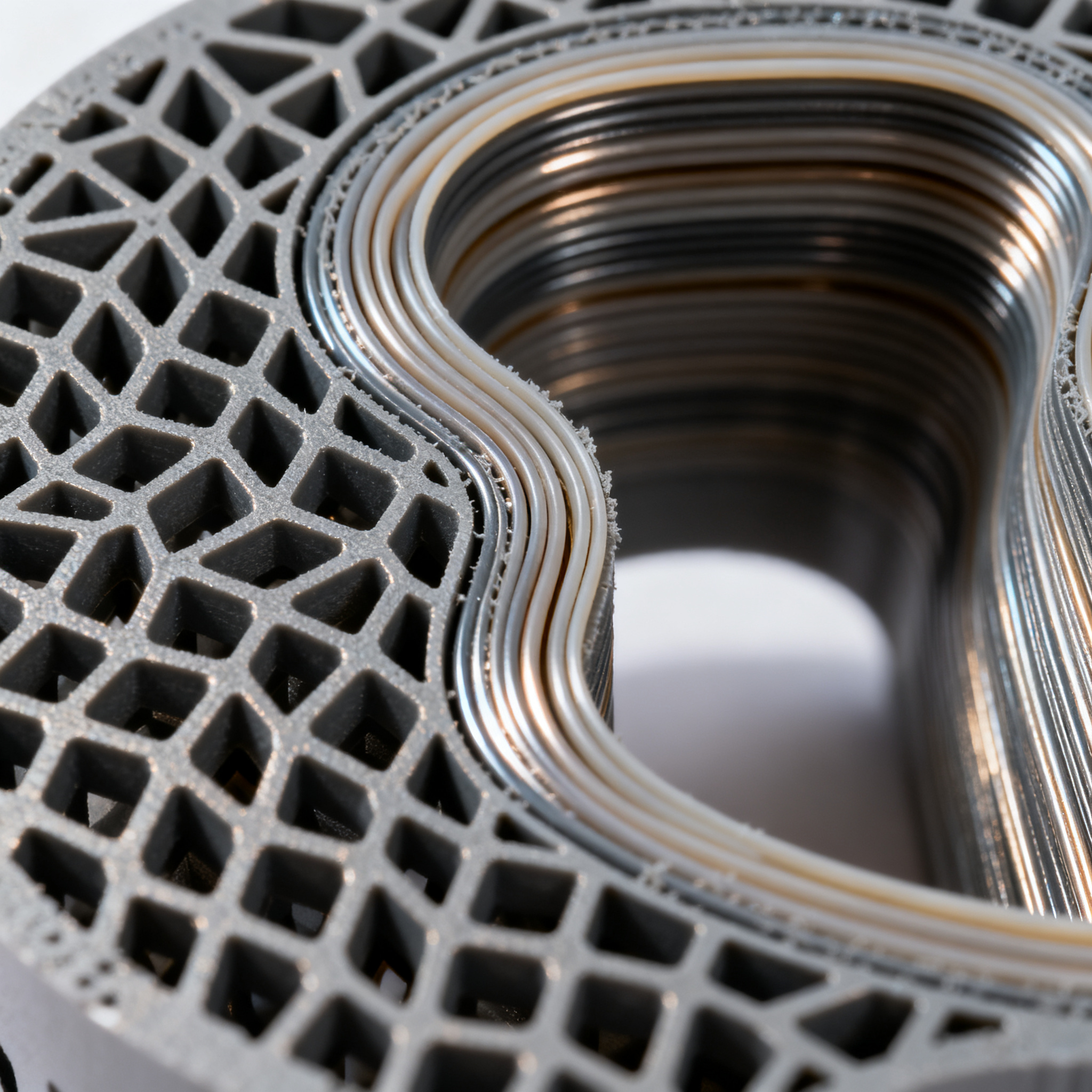
Traditional infill fills the internal space uniformly, wasting material where it's not needed. Gyroid represents a mathematically optimized alternative: this three-dimensional structure distributes the load isotropically, offering equivalent strength in all directions.
The geometry of the gyroid creates interconnected cells that absorb mechanical stresses better than classic linear grids. It does not require internal supports and maintains structural continuity even at low infill densities.
- Multidirectional strength equivalent to linear infill with 15-20% less material
- No weak points along preferred axes
- Compatible with all modern slicers (PrusaSlicer, OrcaSlicer, Cura)
Some developers are working on dynamic infill that allocates material only in critical areas. This feature is not yet automated in mainstream slicers, but many already allow the manual placement of geometric primitives for localized reinforcements.
Curved Pathing and Arachne: when the nozzle path makes the difference
Advanced slicing techniques like Arachne allow continuous trajectories that improve layer cohesion and stress distribution.
The path followed by the nozzle is not just an aesthetic issue. Arachne, the variable-width engine integrated into PrusaSlicer and other slicers, dynamically adapts the extrusion width to follow curved paths even in tight corners.
This eliminates points of discontinuity where tensions normally accumulate. Curved internal perimeters create a more cohesive structure compared to the broken trajectories of traditional slicing engines.
Path continuity matters as much as the material itself. Prints with optimized pathing show measurable improvements in tensile and flexural strength, without adding a gram of plastic.
Arachne calculates paths that adapt to the actual geometry of the part, reducing microscopic voids between extrusion lines that weaken the final structure.
Localized reinforcements without CAD: how to add key structures in the G-Code
Manually inserting reinforcement primitives into the G-Code allows you to optimize critical zones without altering the original model.
Modifying the G-Code after slicing opens up possibilities that no CAD software can easily offer. Many slicers support the placement of geometric primitives (cylinders, spheres, blocks) directly within the slicing environment.
These primitives merge with the main model during path generation. You can add internal ribs, corner reinforcements, or localized thickening only where mechanical loads require them.
Basic procedure
- Identify critical zones: analyze where the part will undergo the greatest stresses (corners, mounting points, thin sections).
- Add primitives in the slicer: use the geometric placement function to insert cylinders or blocks in the identified zones.
- Verify the path: check the layer-by-layer preview to ensure the primitives integrate correctly with the model.
For more advanced modifications, Python scripts can post-process the G-Code by adding specific commands. PrusaSlicer natively integrates support for post-processing scripts that modify the machine file before printing.
Tools like FullControl GCode Designer allow you to define parametric paths without going through CAD or traditional slicing. The approach requires understanding G-Code commands but offers total control over the internal structure.
Conclusion
Knowing advanced slicing and manipulating G-Code at a structural level allows you to obtain stronger and lighter prints without resorting to complex CAD modifications. The three techniques described—smart infill, optimized pathing, and localized reinforcements—are accessible with tools already available in most modern slicers.
Try applying these techniques to your next structural print and verify the increase in strength with a mechanical test. Start with gyroid, experiment with Arachne if your slicer supports it, and consider adding primitives for critical points.
article written with the help of artificial intelligence systems
Q&A
What is gyroid infill and what advantages does it offer over traditional infill?
Gyroid infill is a mathematically optimized three-dimensional structure that replaces traditional uniform infill. It distributes loads isotropically, offering equivalent strength in all directions with 15-20% less material. Furthermore, it does not require internal supports and maintains structural continuity even at low infill densities.
How does the Arachne engine improve the strength of 3D prints?
Arachne uses a variable-width engine that dynamically adapts extrusion to follow continuous curved paths, even in tight corners. This eliminates discontinuity points where stresses accumulate and reduces microscopic voids between extrusion lines. Consequently, it improves layer cohesion and tensile and flexural strength without adding weight.
How is it possible to add localized reinforcements without modifying the original CAD model?
It is possible to manually insert geometric primitives such as cylinders, spheres, or blocks directly into the slicing environment, where they merge with the main model during path generation. These primitives allow the creation of internal ribs, corner reinforcements, or thickenings only in critical areas. For advanced modifications, Python scripts or tools like FullControl GCode Designer can be used to post-process the G-Code.
What are the three advanced slicing techniques described in the article to increase strength without extra weight?
The three techniques are: using smart infill such as gyroid structures, optimizing pathing with engines like Arachne for continuous paths, and inserting localized reinforcements via geometric primitives or G-Code modification. These methods allow for stronger and lighter prints without resorting to complex CAD modifications.
Is dynamic infill that allocates material only to critical areas already an automated feature in mainstream slicers?
No, dynamic infill is not yet automated in mainstream slicers. However, many software packages already allow the manual placement of geometric primitives to achieve localized reinforcements in a similar way.