30 printers, 1 historic environment: how they did it
A museum replicated a historical environment using 30 desktop 3D printers in parallel: here's how they did it.
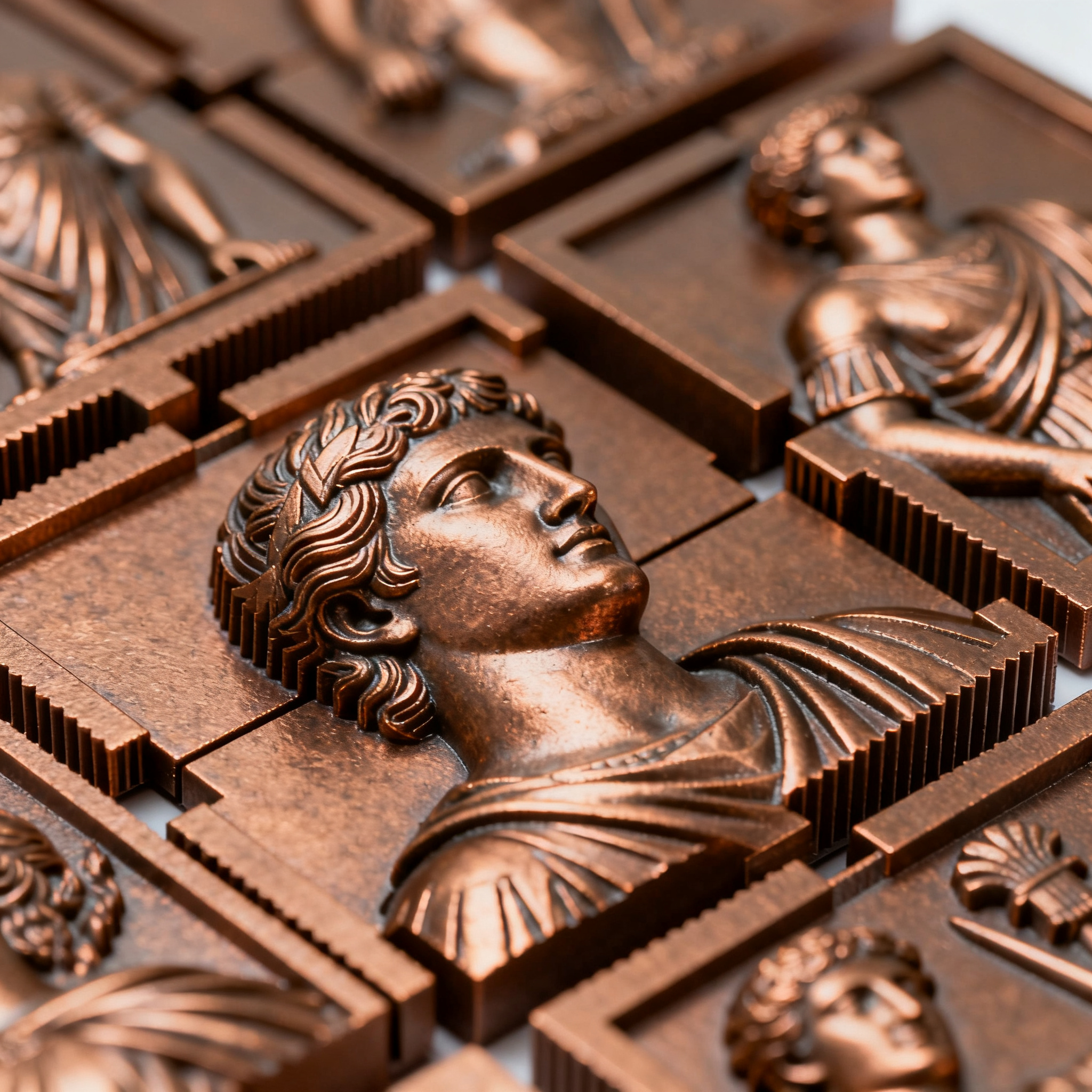
Distributed production on desktop printers allows for scalability and flexibility compared to industrial machines. The Saint Louis Art Museum replicated a section of the Trajan's Column using a farm of 30 Bambu Lab H2S printers coordinated by Printerior. The result is a life-size, tactile, and accessible replica, integrated into the exhibition “Ancient Splendor: Roman Art in the Time of Trajan”.
Success depends on the coordinated management of modeling, slicing, printing, quality control, and final assembly. A large-format machine is not necessary if the workflow is designed to divide, produce, and finish in a modular way.
Modeling: from survey to ready mesh
The accuracy of the replica starts with an accurate survey and a repeatable modeling pipeline.
The transition from the 3D model to the displayed replica is not automatic. An ancient survey contains undercuts, worn surfaces, overlapping figures, and minute details that can create problems in FDM printing. The model's subdivision must respect both the geometry and the scene's readability.
In the Trajan's Column project, digital data was provided by Flyover Zone. Printerior then managed the division into printable segments. Print orientation affects surface quality: each part must be designed to reduce supports, minimize visible layer lines, and facilitate subsequent assembly.
- The digital survey must include internal geometries, undercuts, and minute details
- The model's subdivision respects the scene's readability and FDM printing constraints
- The orientation of each segment reduces supports and improves surface quality
Choosing the scene to replicate is equally important. The Saint Louis Art Museum selected a section showing soldiers loading goods onto ships, a warship, and Trajan in travel attire. The scene also includes an amphitheater, a temple, and triumphal arches in the background.
This choice showcases Roman logistics, engineering, and infrastructure, not just combat. 3D printing serves to make a complex surface readable, which on the original Roman artifact develops vertically and cannot be fully viewed up close.
Slicing and work distribution
Optimizing files for a network of printers requires standardized criteria for slicing and naming.
A farm of 30 Bambu Lab H2S units allows treating machine time as a scalable resource. More printers working on the same project shortens the schedule. However, precision in file division, quality control, and assembly is required.
The Bambu Lab H2S is a large-format printer for the desktop category, with a declared volume of 340 × 320 × 340 mm and an active heated chamber. Using 30 units in parallel allows producing dozens of segments simultaneously, reducing overall times.
Distribution procedure
- Model division: each segment is named with a unique code indicating position and assembly sequence.
- Standardized slicing: The parameters for layer height, speed, and temperature are defined once and applied to all files to ensure uniformity.
- Assignment to printers: Files are distributed based on estimated print time, balancing the load among available machines.
This approach is interesting for museums, exhibition studios, restorers, and companies working on stage sets or cultural replicas. Not always is it necessary to produce a piece in a single block. Division into modules allows the use of more accessible machines, reduces the risk of failure of a huge print, and parallelizes operations.
Quality control during production
A checkpoint system minimizes print errors and reduces post-production work.
Quality control cannot be postponed to the end. Each printed segment must be verified before moving to the next phase. Defects such as warping, layer shift, or poorly removed supports compromise the final assembly.
In the Saint Louis Art Museum project, segments were checked immediately after printing. Defective parts were reprinted immediately, without blocking overall progress. This system reduces waste and maintains a constant workflow.
A checkpoint system during production allows for identifying recurring problems (for example, a printer that produces warping) and correcting them before they compromise dozens of pieces.
Surface finishing was handled after printing. Segments were hand-finished and treated with a bronze finish. The choice is not purely aesthetic: the museum explains that the reproduction is colored bronze to help visitors imagine how the column originally appeared.
The modern image of ancient art is often linked to white marble, but many sculptures and architectures from the Roman world were colored. 3D printing also becomes a tool for interpretation, allowing the museum to present a visual and tactile hypothesis.
Assembly and finishing: manual scalability
The final assembly requires simple and documented procedures for non-specialized teams.
The assembly of dozens of 3D-printed segments must be designed to be performed by non-specialized staff. Each piece must have clear joint points, with tolerances that allow for fitting without excessive force.
In the case of the Trajan's Column, the segments were assembled following a sequence defined during modeling. The joints were reinforced and the contact surfaces were leveled to ensure visual continuity. The final result is a life-size, tactile, and accessible replica.
| Phase | Tools | Estimated time |
|---|---|---|
| Parallel printing | 30 × Bambu Lab H2S | Variable (days) |
| Quality control | Visual and dimensional verification | 1-2 hours per batch |
| Surface finishing | Sanding and painting | Weeks |
| Final assembly | Adhesives, mechanical reinforcements | Days |
One of the most interesting aspects of the project is the possibility of touching the replica. In museum rooms, the relationship with ancient objects is almost always mediated by display cases and safety distances. A 3D-printed reproduction changes the type of experience: the visitor can perceive depth, relief, proportions, and rhythm of the figures.
The replica does not claim to replace the original, but allows the museum to present a visual and tactile hypothesis, useful both for the general public and for those studying the relationship between archaeology, color, restoration, and museum communication.
Replicating cultural heritage with desktop printers is possible
Replicating cultural heritage with desktop printers is possible if scalable and operational processes are adopted. The Saint Louis Art Museum project shows a mature use of 3D printing in cultural heritage. Printerior transformed digital resources into a full-scale physical replica, using a Bambu Lab H2S printer farm and a manual finishing process.
The result is not a simple copy of the Trajan's Column, but a tool to better read a complex monument, bring the public closer to the Roman relief, and show how additive production can help museums tell stories about works that, due to size, fragility, or position, cannot be brought into the gallery.
The use of accessible materials and technologies makes the process replicable for museums and scenic design studios without an industrial budget. Distributed production on desktop printers allows scalability and flexibility compared to industrial machines.
Try replicating an object from your museum using the described workflow and share the results.
article written with the help of artificial intelligence systems
Q&A
Which museum created the replica and which monument did it reproduce?
The Saint Louis Art Museum replicated a section of Trajan's Column for the exhibition Ancient Splendor: Roman Art in the Time of Trajan. The project produced a full-scale, tactile, and accessible replica. Digital data was provided by Flyover Zone and managed by Printerior.
Which printers were used and what is the main advantage of using a farm of desktop machines?
30 Bambu Lab H2S desktop printers were used, coordinated in parallel by Printerior. This distributed approach offers scalability and flexibility compared to industrial machines, allowing dozens of segments to be produced simultaneously and reducing overall times. In addition, it makes it possible to use more economically accessible equipment.
How was the modeling and subdivision process of the relief managed for 3D printing?
The 3D model was divided into printable segments respecting the readability of the scene and the constraints of FDM printing. Each piece was oriented to reduce supports, minimize visible layer lines, and facilitate assembly. The subdivision included the management of undercuts, worn surfaces, and minute details present in the ancient relief.
Why was the replica finished with a bronze color rather than white?
The bronze-colored finish helps visitors imagine the original appearance of the column, since many Roman works were polychrome and not white as is often assumed. The choice is not purely aesthetic, but represents a historical interpretive hypothesis. 3D printing thus becomes a tool for communicating the original color of antiquity.
How is quality ensured during the production of the numerous segments?
A checkpoint system was implemented to verify each segment immediately after printing, checking for defects such as warping or layer shift. Defective pieces were reprinted immediately without blocking the overall workflow. This method also makes it possible to identify recurring problems on specific printers and correct them promptly.
How does the tactile replica change the experience of museum visitors?
The tactile replica allows visitors to touch and directly perceive depth, relief, and proportions, overcoming the barrier of display cases. This radically changes the experience compared to the original, which due to its size and position cannot be observed up close. The object becomes an accessible educational tool for both the general public and scholars.