Binder jetting in production? Here's how to scale it
Binder jetting is moving out of laboratories and into industrial production lines, but its adoption requires a well-defined implementation plan. Scalability depends not only on the machine, but on less visible parameters: nozzle control, material management and integration into existing production workflows.
From idea to line: planning integration
Implementing binder jetting requires a preliminary assessment of existing infrastructure and a targeted technology roadmap.
The transition to industrial binder jetting starts with hardware, but success is built on the ecosystem. Control electronics for the print heads, workflow software and material management are as critical as the printer itself.
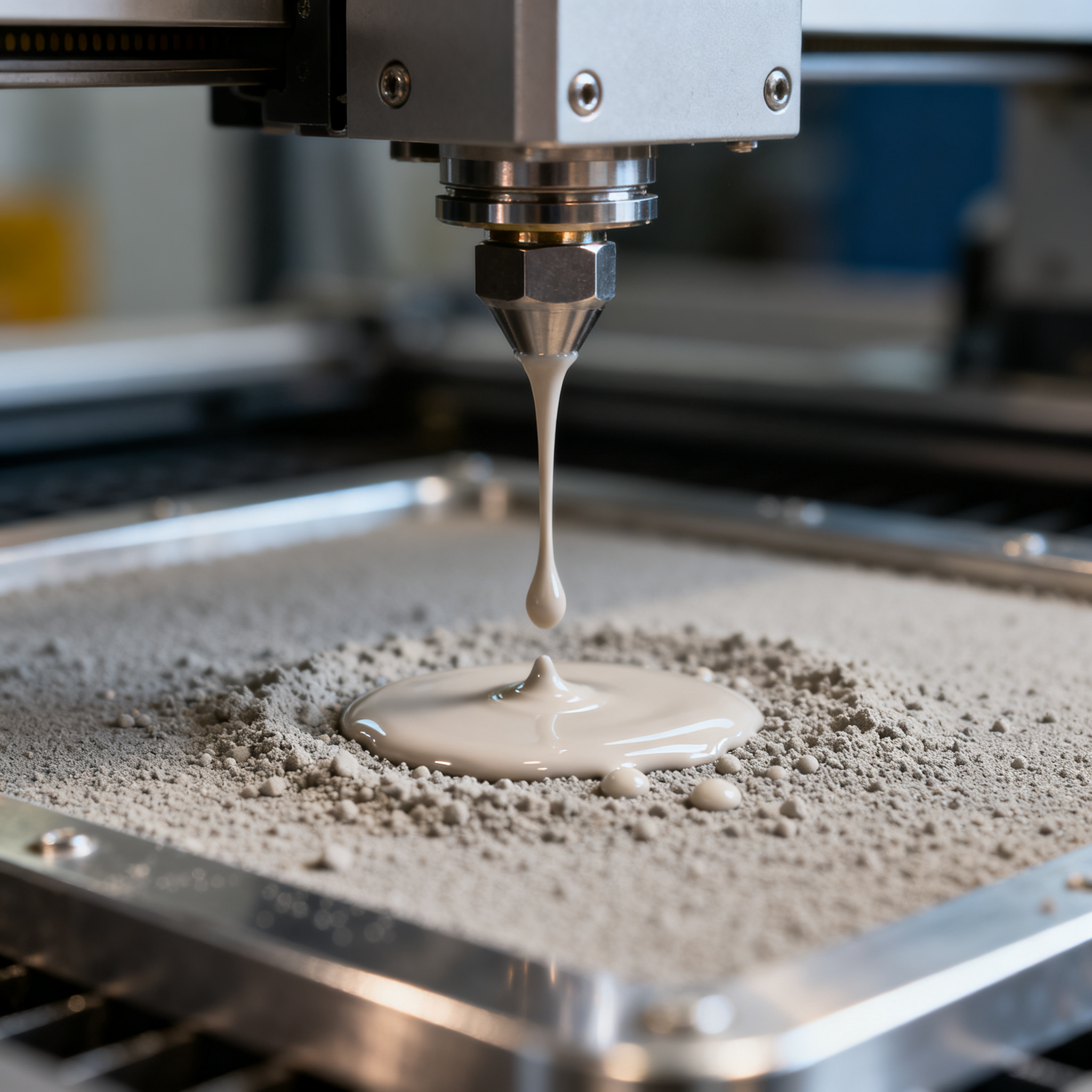
Nozzle control is the heart of the system. The heads must deposit binder onto a powder bed with ultra-high precision, managing often complex fluids with high viscosity or difficult chemistries. Without this control, issues with uniformity, clogged nozzles and deposition defects emerge.
- Control electronics with multi-impulse waveforms to manage droplet volume and timing
- Fluid recirculation systems to prevent sedimentation and clogging
- Integration between digital front-end and printhead control to reduce development complexity
In the foundry sector, hardware is only one part of adoption. Installation, material tuning, maintenance, and spare parts availability become crucial. The ability to ensure operational continuity impacts ROI as much as the nominal speed of the printer.
Advanced materials: when slurries change everything
The use of ceramic slurries imposes new process dynamics, from preparation to sintering, with direct implications on the quality of the final part.
The transition from dry powder to high-solid-concentration ceramic slurries introduces additional variables related to rheology, sedimentation, and suspension stability. However, slurries enable higher green density and more controlled material distribution.
From a rheological perspective, the slurry must maintain a viscosity compatible with uniform deposition. The process window depends on particle size, particle size distribution, type of dispersing additives, and solid content.
Slurry management in production
- Preparation: Stirring systems and in-line viscosity monitoring to ensure stability.
- Quality control: Verify that each batch meets defined requirements before entering the machine.
- Maintenance: Feedstock renewal procedures and particle management to avoid defects.
Inkjet technology for high-viscosity materials is evolving. Industrial printheads now declare the capacity to handle viscosities up to 80 mPa·s, extending the available material window for ceramic and metal binder jetting.
Stability and repeatability: the heart of industrialization
The scalability of binder jetting depends on often underestimated parameters: nozzle control, material flow, and standardized environments.
Industrial production requires absolute repeatability. Printheads must deposit binder with increasing precision, managing functional materials, coatings, resins, and particles with ultra-precise placement control.
The future of jetting will not depend only on new machines, but on the quality of electronics, nozzle control, and the ability to integrate everything into sustainable production workflows. The digitization of production passes through less visible components, without which industrial 3D printing could not function continuously.
Modern printheads adopt a native resolution of 1200 dpi with nozzle redundancy, allowing repeatable production of small details and complex geometries suitable for medium-large batches.
For research applications, binder jetting offers a cold process environment where the printer acts as a precision tool for ceramic and metal powders. This approach allows experimental flexibility and the development of new powder systems.
Case study: serial production of ceramic components
A real-world example shows how production cycle optimization has led to concrete results in terms of costs and volumes.
In the foundry sector, binder jetting on sand eliminates patterns and core boxes, compressing development times. The immediate benefit is the ability to produce cores and molds without traditional tooling, moving from CAD files to mold fabrication.
This approach unlocks internal channels and complex geometries, accelerating design iterations. In an industrial scenario, the value shifts toward design and simulation, reducing dependencies on dedicated tooling operations.
| Parameter | Traditional process | Binder jetting |
|---|---|---|
| Tooling time | Weeks | Hours |
| Complex geometries | Limited | Unlimited |
| Design iterations | Lens | Rapid |
| Tooling dependency | High | None |
Manufacturer-declared numbers speak of efficiency up to 360 L/h in peak configurations. These values must be interpreted in light of real parameters: geometries, percentage of filled useful volume, thicknesses, filling strategy, and job box handling times.
Binder jetting as a production asset
Binder jetting can become a solid production asset, provided that the implementation is designed with industrial rigor. The technology is mature for applications that require high volumes, repetitive cycles, and competitive per-part costs when the flow is stabilized.
Integration requires attention to factors beyond the machine: control electronics, material management, scheduled maintenance, and local support. Anyone building a machine must handle 3D files, nesting, slicing, head control, synchronization, and interface with MES systems.
Evaluate your current process: where could a binder jetting cell scale? The answer depends on the ability to standardize the workflow, control material quality, and ensure operational continuity over time.
article written with the help of artificial intelligence systems
Q&A
What are the key factors for scaling binder jetting in industrial production beyond the printer itself?
Scalability depends on less visible parameters such as printhead control electronics, material management (in particular slurries and powders), integration into existing production flows, workflow software, and scheduled maintenance. These elements ensure operational continuity and impact ROI as much as the machine's rated speed.
Why is nozzle control considered the heart of the binder jetting system?
The printheads must deposit binder onto a powder bed with ultra-high precision, managing complex fluids with high viscosity or difficult chemistries. Without accurate control, issues of uniformity, clogged nozzles, and deposition defects arise that compromise the quality of the final part.
What challenges do ceramic slurries introduce compared to dry powders, and what advantages do they offer?
Slurries introduce variables related to rheology, sedimentation, and suspension stability, requiring in-line viscosity monitoring and rigorous quality control on every batch. However, they allow achieving higher green densities and a more controlled material distribution, improving the quality of the sintered part.
How does binder jetting modify the traditional foundry production flow for cores and molds?
Sand binder jetting eliminates the need for traditional patterns and core boxes, reducing tooling times from weeks to hours. It enables producing cores and molds directly from CAD files, unlocking complex geometries and accelerating design iterations without depending on dedicated tooling.
What does the industrialization of binder jetting require in terms of repeatability and production environment?
Industrial production requires absolute repeatability, which relies on ultra-precise printhead positioning, standardized environments, and stable material flows. Modern printheads with native 1200 dpi resolution and nozzle redundancy make it possible to guarantee repeatable production of small details and complex geometries for medium-large batches.
What should companies evaluate before integrating a binder jetting cell into their current process?
Companies must evaluate existing infrastructure, define a targeted technology roadmap, and verify the ability to standardize the flow, control material quality, and ensure operational continuity over time. It is also necessary to manage the integration between digital front-end, nesting, slicing, and interface with MES systems.