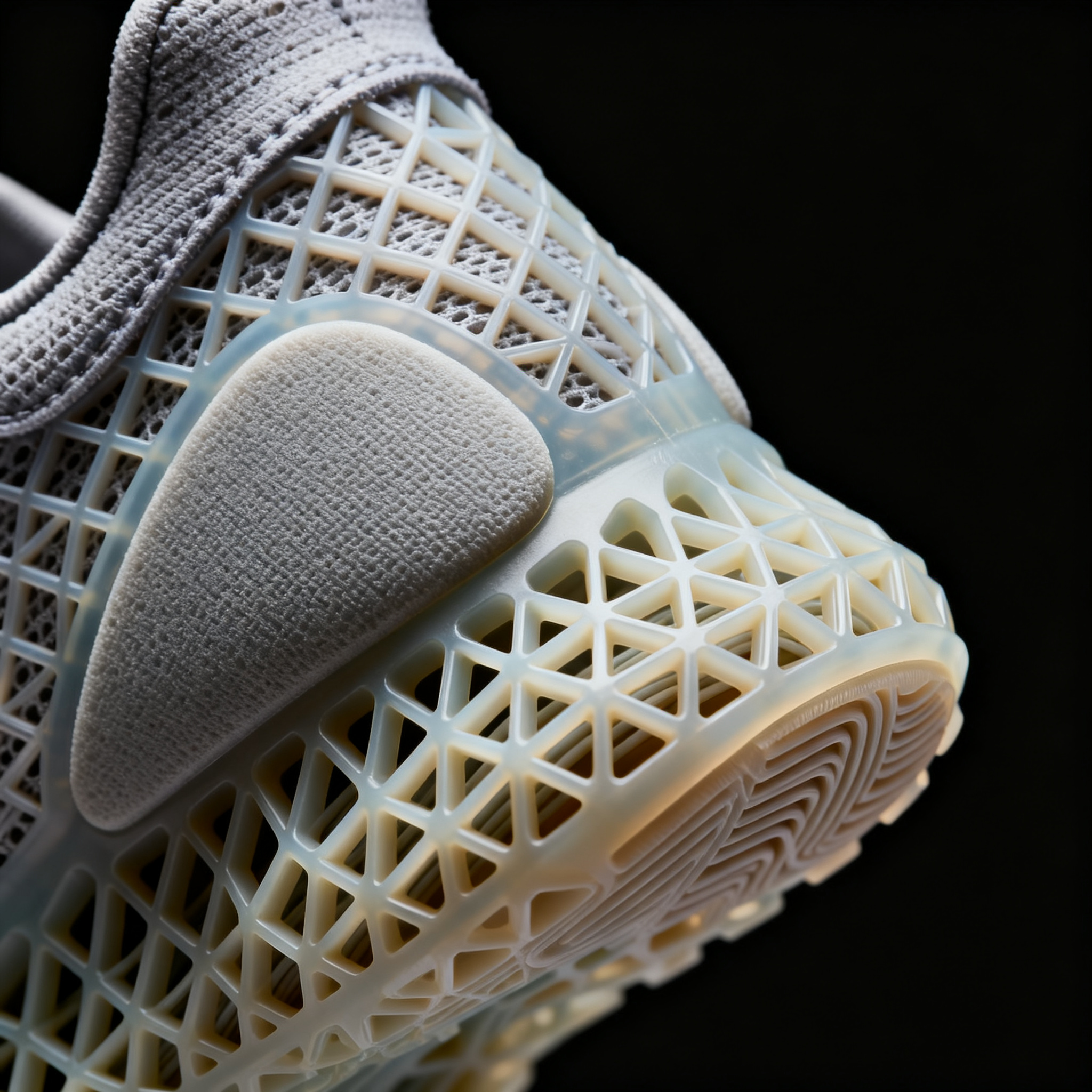
3D printed shoes? Here's who's already making money from them
After years of experimentation, the 3D-printed shoe industry is finally taking shape thanks to a rapidly expanding ecosystem. This is no longer about trade show prototypes, but specialized companies, dedicated technologies and business models generating real revenue in 2026.
The new industrial players
Companies like Zellerfeld, PollyFab and Syntilay are redefining the footwear market with production models dedicated to 3D printing, each with a distinct commercial strategy.
Zellerfeld has developed high-performance 3D printers optimized for footwear production. The German company's strategy aims to become the App Store for printed shoes: designers upload models to their online store and shoes are produced only when someone orders a pair. The company recently opened a production hub in Texas and hired a CFO with experience in billion-dollar platforms and a COO from the global footwear industry.
PollyFab represents a different approach. Born as a spin-off from a materials company, it directly produces 3D-printed consumer products. Its first market is precisely footwear, with unusual designs available to order immediately.
- Zellerfeld: production platform and marketplace for designers
- PollyFab: vertical producer from materials to finished product
- Syntilay: AI-assisted design and productive partnership with Zellerfeld
Syntilay uses AI tools to create functional designs and relies on Zellerfeld for production. Carbon, on the other hand, works with major brands to produce 3D-printed midsoles, a hybrid approach that does not involve the entire shoe but maintains the partnership with the traditional industry.
Custom technologies for footwear
From specialized printers to AI-assisted design software, technologies are adapting to the specific needs of the footwear industry.
Zellerfeld's printers are designed exclusively for producing shoes; they are not generic adapted machines. This level of specialization reduces production times and improves the quality of the finished product.
On the software front, Ergono3D offers a foot-to-STL service to generate custom insoles. The system does not require 3D scanners: through a guided measurement process, it generates models that include arch height, midfoot support, and heel control. The insoles include complex lattice sections for flexibility and support.
Custom insoles are not simple templates: they require complex geometries with differentiated density zones and optimized lattices. This explains why dedicated software is needed and simply scaling a generic model is not enough.
Bambu Lab and MakerWorld have launched the Persona Footwear package as a digital product with defined FDM compatibility criteria and mechanical performance. The system allows for customization of size, colors, and internal structures. In parallel, they have started with Presq an open-source project called Fig. (0), a modifiable platform to create a standardized common base.
Dedicated materials and supply chains
New polymers and strategic partnerships are reducing costs and improving the scalability of 3D-printed footwear production.
BIQU has developed MorPhlex, a specific filament for printing shoes. The material is flexible but maintains an adequate level of hardness, ideal for the footwear industry. This specialization of materials is a clear signal: the market is moving beyond the experimental phase.
| Company | Specialization | Model |
|---|---|---|
| BIQU | Materials (TPU filaments) | Direct sales to manufacturers |
| PollyFab | Materials and production | Vertical integration |
| Ergono3D | Customization software | Subscription (from $49 per month) |
Creality has tested and released breathable non-slip shoes, selling the Aerorise sneakers for $159. The company has a download platform and tools such as the Sermoon P1 3D scanner, creating a complete toolkit for production.
In the orthopedic sector, tens of thousands of insoles are already being printed worldwide. This segment is gravitating towards industrial units designed for orthotics, desktop systems optimized for TPU, and dedicated workflow software.
Who wins and who loses in this new ecosystem
The market is polarizing between those who own production technology and those who control brands: boundaries are rapidly being redefined in 2026.
Zellerfeld is hiring people with experience in global supply chains and structured finance. This indicates preparation for important funding rounds and real production volumes, no longer pilot projects.
FITASY Inc has enabled the purchase of single shoes, not pairs, directly on its own site, sold at half price. The system uses spatial AI and advanced imaging to create 360-degree biometric profiles via smartphone. The company claims to be the first brand of custom 3D-printed footwear to make the sale of single shoes commercially sustainable.
Major traditional brands, such as Adidas, Nike, and Puma, have partially 3D-printed shoes, but collaborate with specialized manufacturers like Carbon for midsoles. Hugo Boss, Mallet London, and Sean Wotherspoon have launched designs produced by Zellerfeld.
The orthopedic sector represents a parallel but consolidated market, with real volumes and tailored logic already in place. Here the competition is between specialized industrial systems and economical desktop printers like Bambu A1, both supported by workflow software.
The future of 3D shoes is no longer just about technology
The ecosystem of 3D printed shoes in 2026 no longer depends solely on the quality of printers. The game is won with synergies between specialized materials, customization software, digital distribution platforms, and scalable business models.
The emerging players have clear strategies: open production platforms for designers, vertical integration from materials to finished product, or partnerships with established brands. The orthopedic market demonstrates that volumes exist when customization solves real problems.
Follow the evolution of this ecosystem: it could redefine made-in in a digital sense. On-demand production, customization via smartphone, and the elimination of traditional molds are creating a new industry, not just an alternative to the existing one.
article written with the help of artificial intelligence systems
Q&A
What is Zellerfeld's business model and how does it differ from PollyFab's?
Zellerfeld operates as a manufacturing platform and marketplace for designers: designers upload models and shoes are produced on demand, with the goal of becoming the App Store for 3D printed footwear. PollyFab, on the other hand, adopts a vertically integrated model, directly producing consumer footwear with unusual designs from material development to finished product.
How does Ergono3D allow the creation of customized midsoles without the use of 3D scanners?
Ergono3D offers an end-to-end service that generates STL files from a guided measurement process, eliminating the need for 3D scanners. The software produces models with complex geometries that include plantar arch height, midfoot support and rearfoot control, integrating lattice sections to ensure optimal flexibility and support.
What makes FITASY's business model innovative in the 3D shoe sector?
FITASY has made the sale of single shoes rather than in pairs commercially sustainable, offering them at half price on its website. The system leverages spatial artificial intelligence and advanced smartphone imaging to create 360-degree biometric profiles, enabling made-to-measure customization without dedicated equipment.
What are the main differences between Carbon's approach and Zellerfeld's in the footwear market?
Carbon collaborates with large traditional brands such as Adidas and Nike to produce 3D printed midsoles, maintaining a hybrid approach that integrates technology into the existing industry without involving the entire shoe. Zellerfeld, instead, aims at an open manufacturing platform that produces complete footwear on demand, hosting third-party designs in its marketplace.
Why is the orthopedic sector considered an established parallel market for 3D printing?
In the orthopedic sector, tens of thousands of insoles are already printed worldwide, with real volumes and long-established customization logics. Competition takes place between specialized industrial systems for orthotics and affordable desktop printers such as the Bambu A1, both supported by dedicated workflow software.
What synergies are necessary for the future success of the 3D printed shoe ecosystem?
According to the article, success no longer depends solely on printer quality, but on the combination of specialized materials, customization software, and digital distribution platforms. To these are added scalable business models such as on-demand production, smartphone-based customization, and the elimination of traditional molds.