Mobile production in containers? Here's how to scale it
Mobile production solutions are redefining the boundaries of modern industry, bringing manufacturing capabilities directly to the field. Real-world cases show how to integrate advanced additive technologies in remote, defense, and complex logistics contexts.
Containerized production is no longer a laboratory experiment. It is a concrete response to industrial needs that require flexibility, speed, and operational autonomy in contexts where traditional supply chains show their limits.
Demonstration hubs: the first step toward mobile production
Containerized demonstration centers are becoming the testing ground for the adoption of advanced additive technologies in remote or emerging contexts.
The partnership model between Farsoon and Addimax in South Africa represents a strategic approach to implementing mobile production. The demonstration hub provides hands-on experience through live machine demonstrations, benchmarking, and real-scale production, all supported by technical services and training.
- Live machine demonstrations and benchmarking tests
- Real-scale production to validate processes
- Technical services and on-site training
- Focus on aerospace, mining, and automotive sectors
This configuration combines 25 years of technological excellence with local presence. The goal is to enable local businesses to unlock efficiency, customization, and supply chain resilience through serial production solutions and tailored support.
SAMM Tech: hybrid manufacturing in defense contexts
A real-world case of integrating additive and subtractive technologies in a modular, highly mobile environment.
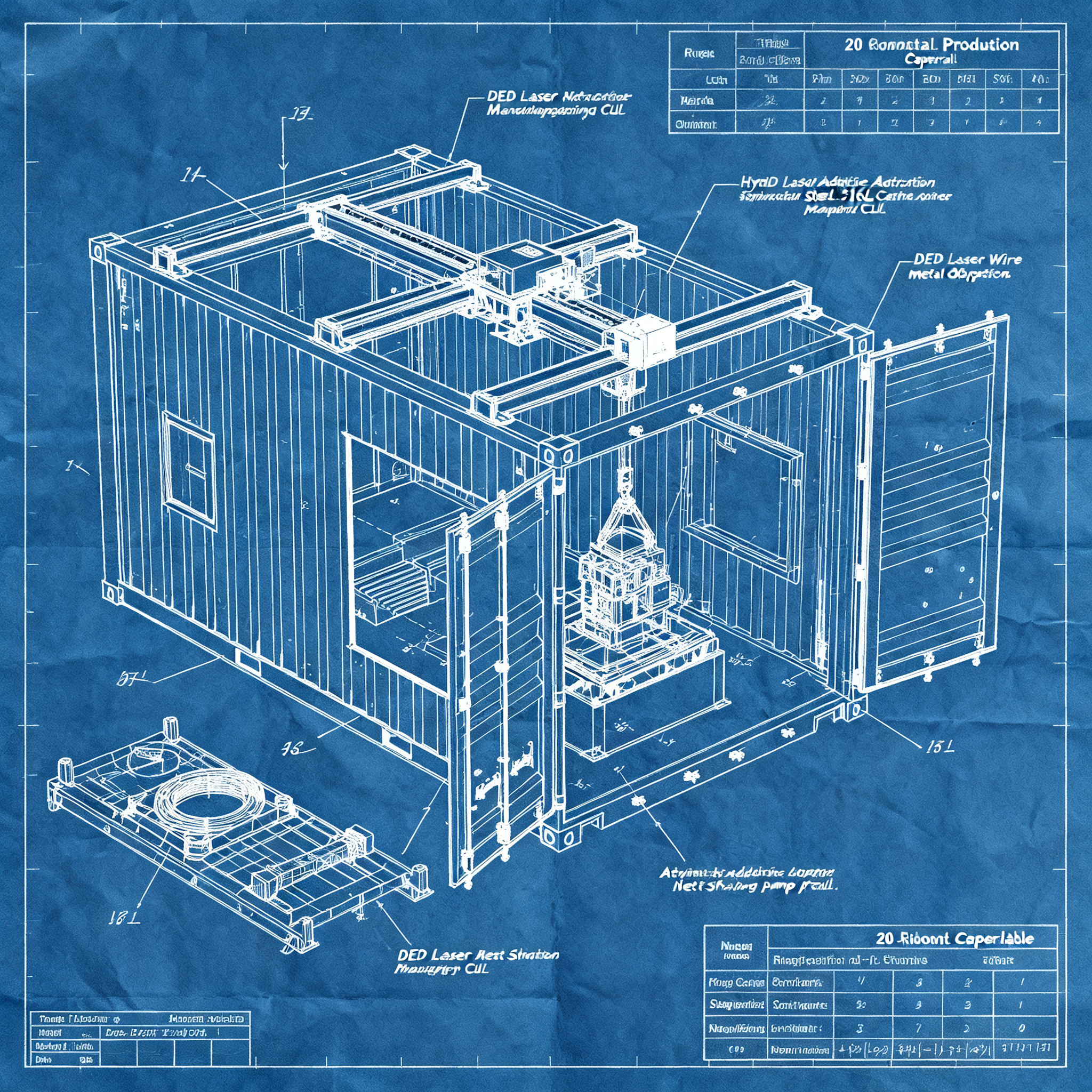
Snowbird Technologies' SAMM Tech platform, integrated with Meltio Engine Blue, is a forward-deployable hybrid manufacturing system for defense applications. The system is housed in a ruggedized container and combines additive and subtractive capabilities through a hybrid production cell mounted on a patented gantry.
DED laser-wire technology makes it possible to work with numerous industrial metals. The modular system is designed for global mobility and rapid deployment, capable of operating in extreme maritime and land conditions.
During at-sea operations, SAMM Tech produced a 316L stainless steel component for a reverse osmosis pump in 34 hours, demonstrating the ability to manufacture critical spare parts while the ship was operational.
This approach increases operational readiness and reduces dependence on centralized supply chains. Defense forces can repair, manufacture, and sustain mission-critical components much closer to the operational field.
Key logistical and architectural choices
The success of a mobile system depends on precise choices in terms of ruggedization, technology integration, and local support.
The integration of DED laser-wire technologies into containerized platforms requires specific architectural decisions. The ruggedization of the container must ensure operability under extreme conditions, while the integration of industrial controls (such as FANUC) and scanning capabilities (Creaform) creates an autonomous production ecosystem.
| Appearance | Requirement | Benefit |
|---|---|---|
| Containerization | 20-foot standard | Global logistics compatibility |
| Reinstallation | 1-2 days | Rapid reorganization vs 2-3 weeks for fixed systems |
| Hybrid technology | Additive + subtractive | From near-net-shape to finishing without repositioning |
| Local support | Local technical services | Reduced dependence on remote centers |
Local technical support is essential. The presence of local expertise, as demonstrated by the Farsoon-Addimax model, makes it possible to extend the reach of serial production solutions with customized assistance for specific sectors.
The choice of compatible materials and the ability to process standard industrial metals (such as 316L stainless steel) ensure immediate applicability to existing critical components, without the need for complete redesign.
Containerized production is no longer an experiment, but a concrete response to increasingly dynamic logistical and industrial needs. The Farsoon-Addimax and Snowbird-Meltio cases demonstrate that the integration of advanced additive technologies into mobile platforms is technically mature and operationally validated.
Explore the case studies and assess how a modular approach can transform your production chain. The key to success lies in the balance between advanced technology, adequate ruggedization, and competent local support.
article written with the help of artificial intelligence systems
Q&A
What is container-based mobile production and what industrial needs does it solve?
Container-based mobile production consists of transportable manufacturing units that bring production capabilities directly to the field. It solves needs for flexibility, speed, and operational autonomy in remote or logistically complex contexts, where traditional supply chains prove inefficient or inadequate.
What is the objective of the containerized demonstration hub built by Farsoon and Addimax in South Africa?
The demonstration hub serves as a testbed for the adoption of advanced additive technologies in remote contexts, offering live demonstrations, benchmarking, and real-scale production. The objective is to enable local businesses to improve efficiency, customization, and supply chain resilience through serial production and targeted technical support in the aerospace, mining, and automotive sectors.
What does the SAMM Tech platform consist of and what technologies does it integrate?
SAMM Tech by Snowbird Technologies is a forward-deployable hybrid manufacturing platform housed in a ruggedized container, designed for defense applications and global mobility. It integrates a hybrid additive and subtractive production cell on a patented gantry with laser-wire DED technology, FANUC industrial controls, and Creaform scanning systems for an autonomous production ecosystem.
What is the naval use case demonstrated by SAMM Tech and what advantage did it bring?
During operations at sea, SAMM Tech produced a 316L stainless steel component for a reverse osmosis pump in just 34 hours while the vessel was operational. This demonstrated the ability to manufacture critical spare parts in real time, increasing operational readiness and reducing dependence on centralized supply chains.
What are the key elements for the success of a mobile production system?
Success depends on adequate container ruggedization to operate in extreme conditions, the integration of hybrid additive and subtractive technologies, and the presence of competent local technical support. Furthermore, the use of standard industrial materials such as 316L stainless steel ensures immediate applicability without the need for complex redesign.