Sensors that sense without electronics: the revolution of smart materials
Bio-inspired soft sensors represent an engineering revolution in which the material structure itself becomes the true sensor, eliminating the need for additional electronic components. The microarchitecture of the material converts mechanical stimuli into electrical signals, opening up unprecedented scenarios for intelligent infrastructures and soft robotics.
A structure that senses: the bio-inspired principle
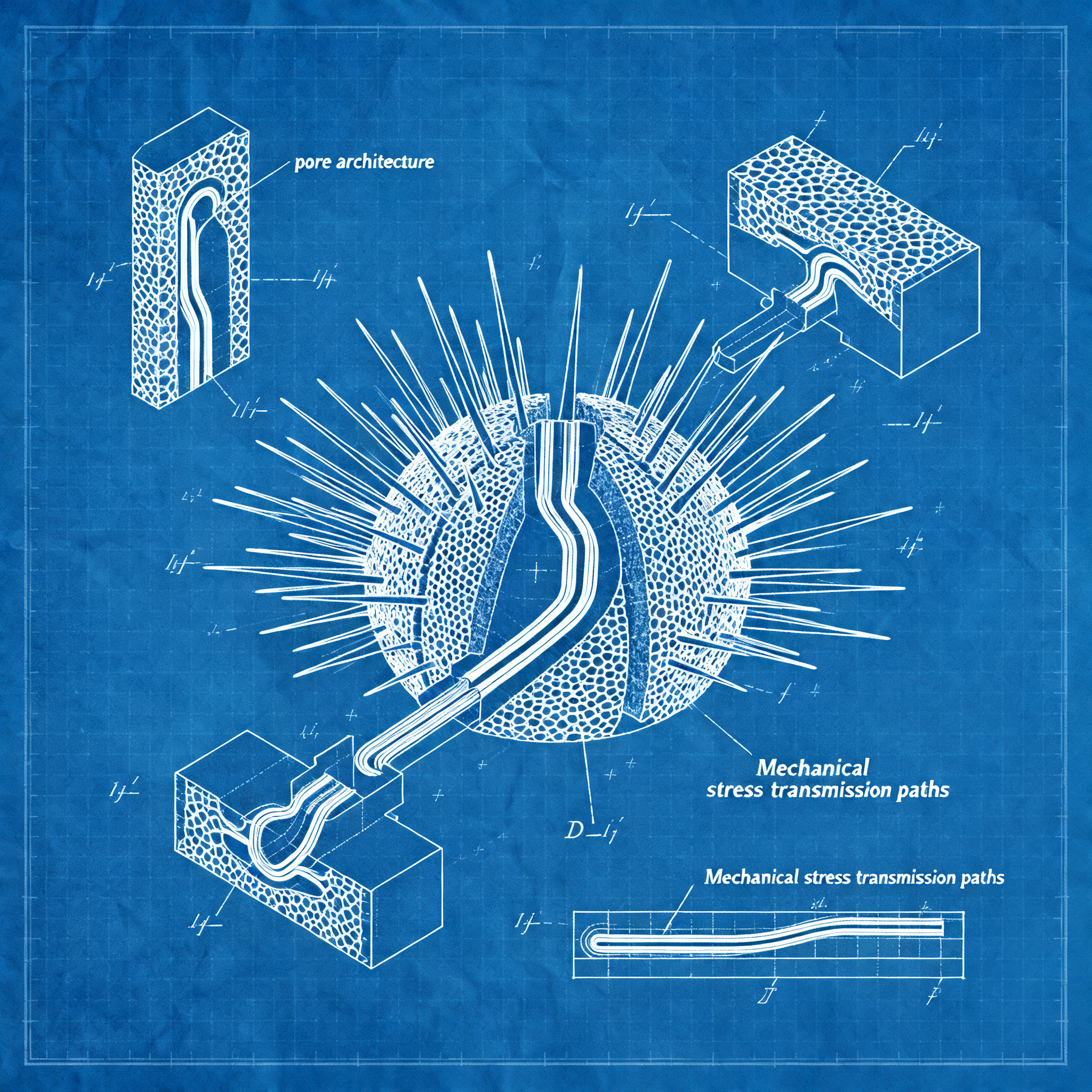
The porous and anisotropic microarchitecture transforms pressure and deformation into an electrical signal, leveraging physical phenomena that occur directly within the material.
The spines of sea urchins Diadema setosum generate measurable electrical impulses when water flows over their surface. This occurs without vital nervous tissue: the porous ceramic structure itself functions as the sensor.
The mechanism is based on the streaming potential. When the fluid passes through the porous channels, opposite charges accumulate at the solid-liquid interfaces. The porosity gradient from the base to the tip creates ideal conditions for charge separation.
- Voltage pulses up to 100 millivolts generated by the microstructure alone
- Pore size gradient: decreases towards the tip, increases the specific surface area
- Faster electrical response of the animal's visual processing
- No need for separate functional materials or external power supply
Researchers from the City University of Hong Kong have replicated this principle through vat 3D printing. The anisotropic porous topology is designed digitally and realized with photopolymerization, transferring the “wisdom of nature” into engineering components.
Chip-free smart materials
Polymers, smart foams, and architected metamaterials enable structure-function integration through microstructure design, not through electronics.
Multifunctional materials exploit internal geometry to control mechanical and electrical properties simultaneously. Programmable hydrogels developed at Penn State University change shape, texture, and appearance in response to external stimuli such as heat or solvents.
The technique halftone-encoded printing converts image or texture data into binary patterns on the material surface. Each region of the hydrogel responds differently to stimuli, following “instructions” printed directly into the structure.
The optical and structural approach reduces electrical hysteresis, electromagnetic interference, and fatigue in flexible conductive traces. The signal travels as light or ionic charge to the conversion point.
Sulfur-based polymers developed by the Korea Research Institute of Chemical Technology demonstrate another direction. These materials contain bonds that break and reform with heat, enabling 4D printing and full recycling without loss of functionality.
Operational cases: from structural monitoring to soft robotics
Practical examples where soft sensors replace complex systems with scalable and autonomous solutions, from marine sensing to industrial self-sensing components.
The biomimetic mechanoreceptor developed at CityUHK detects underwater water flows in real time without external power. A structural component with gradient porosity becomes both a sensor and a load-bearing part.
Potential applications include monitoring currents and impacts in offshore structures, flow management in water plants, and self-sensing structural components in civil and industrial settings. The structure itself provides feedback on operational conditions.
| Application | Sensor function | Structural advantage |
|---|---|---|
| Marine infrastructure | Current and vortex detection | No separate wiring or electronics |
| Water plants | Flow monitoring | Direct integration into pipelines |
| Soft robotics | Deformation perception | Beams and joints act as sensors |
The optical SOLen sensor developed with DLP printing integrates waveguides and lenses directly into the flexible body. During deformation, the focus shifts between two photoreceptors, producing a robust differential signal without conductive tracks.
The microrobots from Leiden University demonstrate the extreme concept: flexible self-propelling chains that perceive obstacles and adapt behavior without traditional sensors. Functionality arises from the interaction between geometry, mechanical properties of the joints, and fluid hydrodynamics.
Producibility and limit: the challenge of multi-material 3D printing
Additive manufacturing is opening new possibilities through microstructure control, but still presents technological obstacles in scalability and multi-material precision.
Vat 3D printing (vat photopolymerization) allows the fabrication of bio-inspired porous topologies with micrometric resolution. Nanoscribe systems achieve details below 100 nanometers, essential for replicating effective porosity gradients.
The printing embedded in gel support, as demonstrated by Nottingham Trent University and Chinese University of Hong Kong, allows for the production of silicone structures with conformal geometries. The use of six-axis robotic arms enables toolpath non-planar and better surface quality.
Current technological challenges
- Deposition volume control: The shape of the extruded section changes from oval to round depending on the speed, complicating calibration.
- Multi-material integration: Combining piezoelectric materials or technical ceramics with polymers requires hybrid processes that are still under development.
- Production scalability: Print times for structures with complex gradients limit large-scale industrial application.
Generative design can automatically explore optimized porous topologies. Integration with piezoelectric materials or data processing networks could lead to distributed monitoring platforms where each element self-quantifies the stresses it undergoes.
Conclusion
Bio-inspired soft sensors are redefining the boundary between material and device. The stated goal of researchers is to use the natural concept of structure-function integration to generate a new generation of self-sensitive materials, where internal geometry enables the capability of perception.
Prospects include porous technical ceramics for industry, more sensitive hybrid devices, and structural components that provide continuous operational feedback. 3D printing serves as an enabling platform to transfer complex topologies inspired by biological systems into real-world applications.
Explore open source projects and development toolkits to experiment with soft sensors in your prototypes. Microfabrication platforms are becoming more accessible, opening up opportunities for rapid prototyping in industrial and robotic contexts.
article written with the help of artificial intelligence systems
Q&A
What is the bioinspired principle underlying structural soft sensors?
The principle takes inspiration from sea urchin spines, which generate electrical impulses when fluid flows over their porous surface. The anisotropic microarchitecture of the material converts mechanical stimuli into electrical signals without electronic components.
How does the streaming potential phenomenon work in porous materials?
When fluid flows through porous channels, a streaming potential is generated: opposite charges accumulate at solid-liquid interfaces. A porosity gradient favors charge separation, producing a measurable electrical signal.
What advantages do soft sensors offer compared to traditional sensors?
Structural soft sensors reduce hysteresis, electromagnetic interference, and conductor fatigue. They require no external power supply or additional electronics, integrating sensing functionality directly into the load-bearing structure.
What are the main manufacturing techniques used to produce these materials?
3D printing via vat photopolymerization enables the creation of bioinspired porous microstructures. Advanced techniques such as embedded printing in gel and Nanoscribe systems allow for complex geometries and controlled porosity gradients.
In which sectors do structural soft sensors find application?
They are employed in monitoring marine and water infrastructure, soft robotics, and self-sensing structural components. They can detect currents, deformations, and impacts in real time without external electronics.