Shimizu and JAXA build one-meter rocket tank with robotic WAAM and real-time geometric control
The Japanese company Shimizu Corporation announced on November 18, 2026 the creation of an experimental space propellant tank about one meter in diameter, produced in a single piece using Wire Arc Additive Manufacturing (WAAM). The component was subjected to a burst test for internal pressure up to 1.7 MPa.
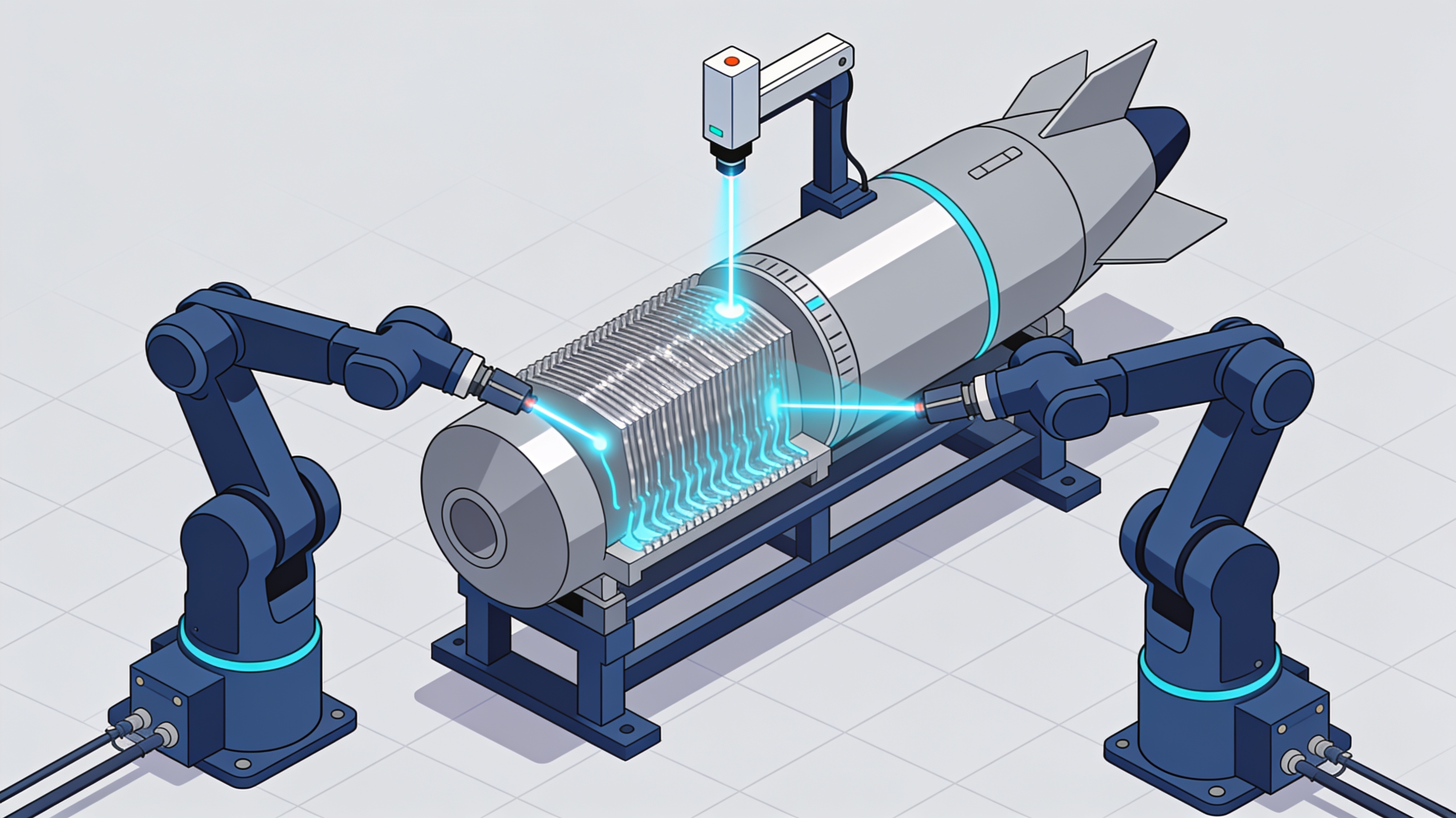
The distinctive element of the project, developed in collaboration with the Japanese space agency JAXA, is the use of a hybrid cell that integrates metal deposition, geometric verification, and in-process correction.
- Experimental ~1-meter tank produced in a single piece with WAAM
- Robotic system with two units: deposition and measurement/correction
- Geometric control with a laser profilometer during component growth
- Pressure test up to 1.7 MPa on the demonstrator
- Goal: tanks of 2.5 meters by 2028 for small and medium launch vehicles
A dual-arm robotic cell
The Shimizu system integrates deposition and quality control in the same production cycle, with two robots operating in coordinated sequence.
The configuration includes two distinct robots. The first performs deposition of the metallic material by electric arc. The second carries out measurements and geometric corrections.
A laser profilometer checks the geometry while the component grows. The measurements feed the compensation of paths and layer heights. When a deviation exceeds the acceptable threshold, processing stops and the area is corrected before continuing.
Intermediate subtractive machining improves dimensional control. This approach distinguishes the system from a simple wire printer.
WAAM for large metal volumes
Wire Arc Additive Manufacturing technology makes it possible to deposit large quantities of metal, with characteristics different from powder-bed processes.
The WAAM technique feeds metallic material in wire form and melts it with an arc source. Compared with laser melting of a powder bed, it makes it possible to deposit larger volumes of metal.
The technical trade-off entails wider beads, greater heat input and the need for machining. For large components such as space tanks, this balance can be advantageous.
The value of 1.7 MPa describes a test on the demonstrator and does not equate to flight qualification. The latter requires material characteristics, design margins, fatigue strength, propellant compatibility, thermal behavior and non-destructive testing defined by the space program.
The challenges of propellant tanks
Containers for space applications must meet much stricter mechanical, thermal, and sealing requirements than ordinary industrial components.
A propellant tank is subjected to mechanical loads, pressure cycles, vibrations, and thermal conditions different from those of an ordinary industrial container. The geometry of the domes, thickness transitions, and attachment zones are critical points.
WAAM makes it possible to integrate structural portions and reduce some welding operations. However, it requires particular attention to porosity, residual stresses, microstructural anisotropy, and distortions.
Intermediate subtractive machining does not replace volumetric inspections, metallographic tests, or leak-tightness assessments. Process control in the production cycle does not guarantee that every possible internal defect is eliminated.
Objectives for 2028
The project is part of Japan's Space Strategy Fund and aims for 2.5-meter-class tanks for small and medium-capacity launch vehicles.
Work on propellant structures is included in the Space Strategy Fund, Japan's strategic space fund. The stated goal is to achieve 2.5-meter-class tanks by fiscal year 2028.
These components are intended for small and medium-capacity launch vehicles. The transition from the one-meter demonstrator to flight-qualified components will require further development in terms of materials, processes, and validation.
The collaboration between Shimizu Corporation and JAXA is an example of integration between industrial expertise and space-sector requirements. The hybrid deposition-control-correction approach could become a reference for additive manufacturing of large metal structures.
article written with the help of artificial intelligence systems
Q&A
What are the dimensions of the tank produced by Shimizu and JAXA?
The experimental tank has a diameter of about one meter and was produced in a single piece using WAAM. It was subjected to a burst test for internal pressure up to 1.7 MPa.
How does Shimizu's dual-arm robotic cell work?
The cell integrates two robots: the first deposits the metal material via electric arc, the second performs measurements and geometric corrections. A laser profilometer monitors the geometry during component growth and, if a deviation exceeds the threshold, the process stops to correct the area.
What is the difference between WAAM and powder bed processes?
WAAM melts a metal wire with an arc source, allowing higher volumes of metal to be deposited compared to laser powder bed fusion. The trade-off involves wider beads, greater heat input and the need for machining.
Does the 1.7 MPa test equate to flight qualification?
No, the 1.7 MPa value describes a test on the demonstrator and does not equate to flight qualification. The latter requires material characteristics, design margins and strength.
What are the future goals of the Shimizu-JAXA project?
The goal is to produce 2.5-meter tanks by 2028 for small and medium launch vehicles. The project aims to scale WAAM technology with real-time geometric control.