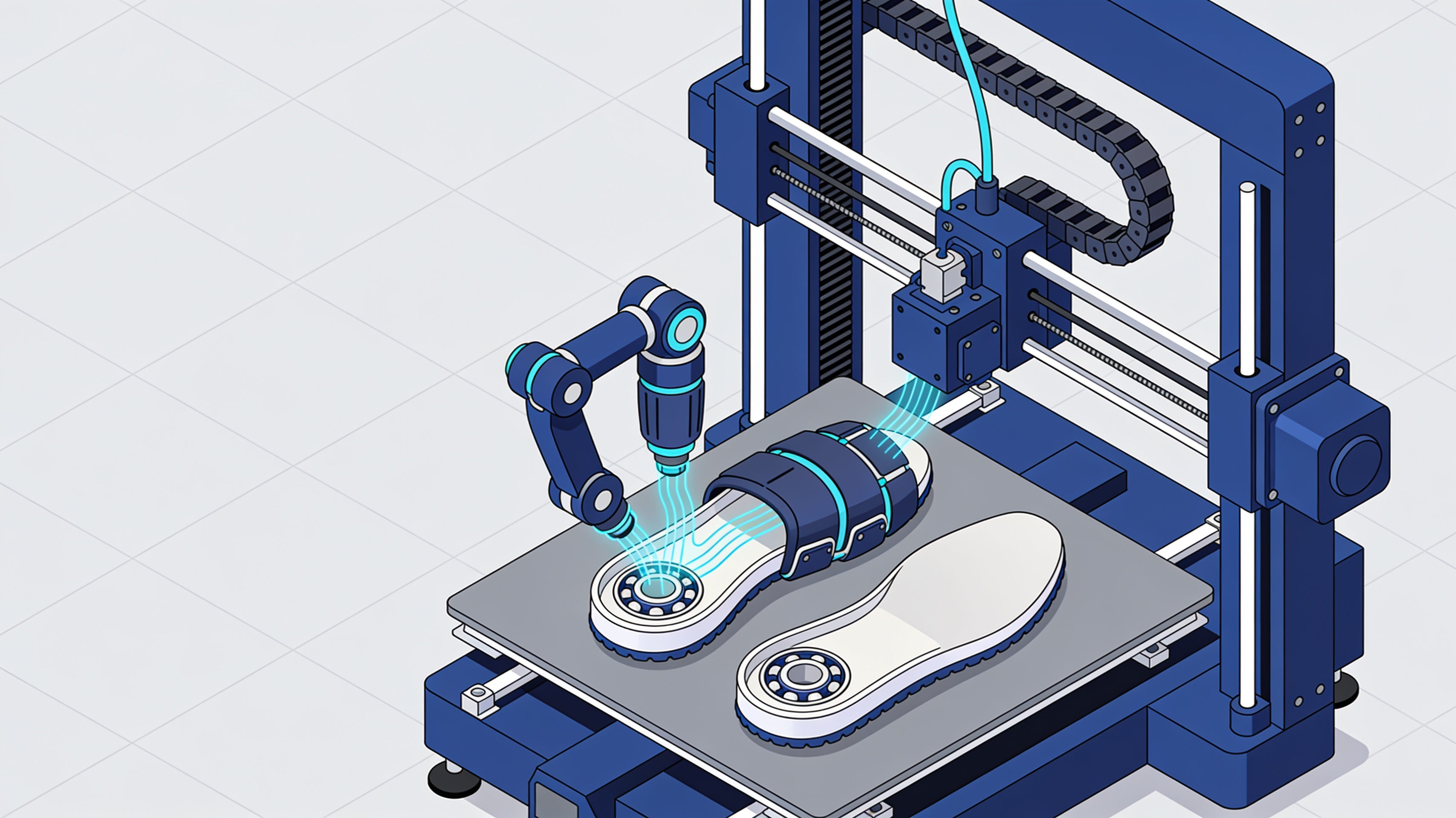
PollyPolymer raises $70 million for 3D printing applied to robotics
The Chinese company is betting on HALS technology for robotic components and footwear, with a platform up to 100 times faster than conventional systems.
PollyPolymer has closed a $70 million Series B funding round to expand additive manufacturing dedicated to the robotics sector. The investment, backed by several Chinese venture funds, is focused on the company's proprietary HALS (Hindered Asynchronous Light Synthesis) technology.
The company represents an integrated model in the Chinese additive manufacturing landscape. It produces 3D printers, markets them, and uses them for contract manufacturing services.
- $70 million Series B round with Chinese investors
- HALS technology: 20-100 times faster than conventional 3D printing
- Focus on robotic components: bionic muscles, joint protections, silent soles
- TAPS 6080 large-format system for industrial production
HALS technology and robotic applications
PollyPolymer's proprietary platform is based on an accelerated variant of photopolymerization processes, with specific applications for the expanding robotics industry.
HALS technology promises print speeds 20 to 100 times higher than conventional systems. According to industry analysis, it would be an evolved form of MSLA or DLP.
PollyPolymer has developed expertise for three main categories of humanoid components: bionic muscles, flexible joint protection, and silent soles with bearings for the feet. These applications meet the needs of advanced robotics, where lightness and customization are critical requirements.
The TAPS 6080 system represents the company's large-format solution for industrial production. The complete TAPS line offers different configurations for different print volumes.
The Chinese strategic context
The investment is part of China's Five-Year Plan, which identifies additive manufacturing for robotics as a priority market opportunity.
The funding comes at a strategic moment for China. The country's Five-Year Plan has identified additive manufacturing for robotics among the most promising market opportunities.
The investors“ decision to keep the round ”in-house" with only Chinese venture funds signals the desire to control this technology supply chain. It is an approach consistent with national industrial priorities.
The deliberate execution of this opportunity is considered crucial to turning weaknesses into strengths, avoiding exacerbating the existing challenges of China's manufacturing sector.
Beyond robotics: the footwear sector
PollyPolymer is diversifying the applications of its technology in the footwear segment, leveraging the same expertise in flexible materials and customization.
The company has also developed a showroom dedicated to footwear. The footwear sector represents a complementary application of HALS technology, with a focus on midsoles and customized components.
3D printing of footwear shares similar requirements with robotics: flexible materials, complex geometries, and customized production. This synergy allows PollyPolymer to amortize R&D investments across multiple vertical markets.
Implications for the AM market
PollyPolymer’s integrated model – a hardware manufacturer and service bureau – could influence the evolution of the additive manufacturing market in Asia.
The success of the financing round confirms investors’ interest in vertically integrated business models in 3D printing. PollyPolymer controls the entire value chain: technology development, system production, and printing services.
This approach reduces dependence on external suppliers and accelerates the innovation cycle. The company can test technological improvements directly in its own production lines, optimizing processes and materials in real time.
The availability of fresh capital will make it possible to expand production capacity and accelerate the development of new applications. China’s rapidly growing robotics sector offers a sizable domestic market to validate and scale the solutions.
article written with the help of artificial intelligence systems
Q&A
What is the value of PollyPolymer's funding round?
PollyPolymer has closed a $70 million Series B round, backed by several Chinese venture funds. The investment is intended to expand additive production dedicated to the robotics sector.
What is the HALS technology developed by PollyPolymer?
HALS (Hindered Asynchronous Light Synthesis) is the company's proprietary technology, based on an accelerated variant of photopolymerization processes. It promises printing speeds 20 to 100 times faster than conventional systems.
Which robotic components does PollyPolymer produce with 3D printing?
The company has developed expertise for three main categories of humanoid components: bionic muscles, flexible joint protections, and silent soles with bearings for the feet. These applications meet the needs for lightness and customization of advanced robotics.
What is PollyPolymer's large-format system for industrial production?
The TAPS 6080 system represents the company's large-format solution for industrial production. The complete TAPS line offers different configurations for different printing volumes.
Why is the financing strategic in the Chinese context?
China's Five-Year Plan has identified additive manufacturing for robotics as one of the most promising market opportunities. The round with only Chinese venture funds signals the intention to control this technological supply chain, in line with national industrial priorities.