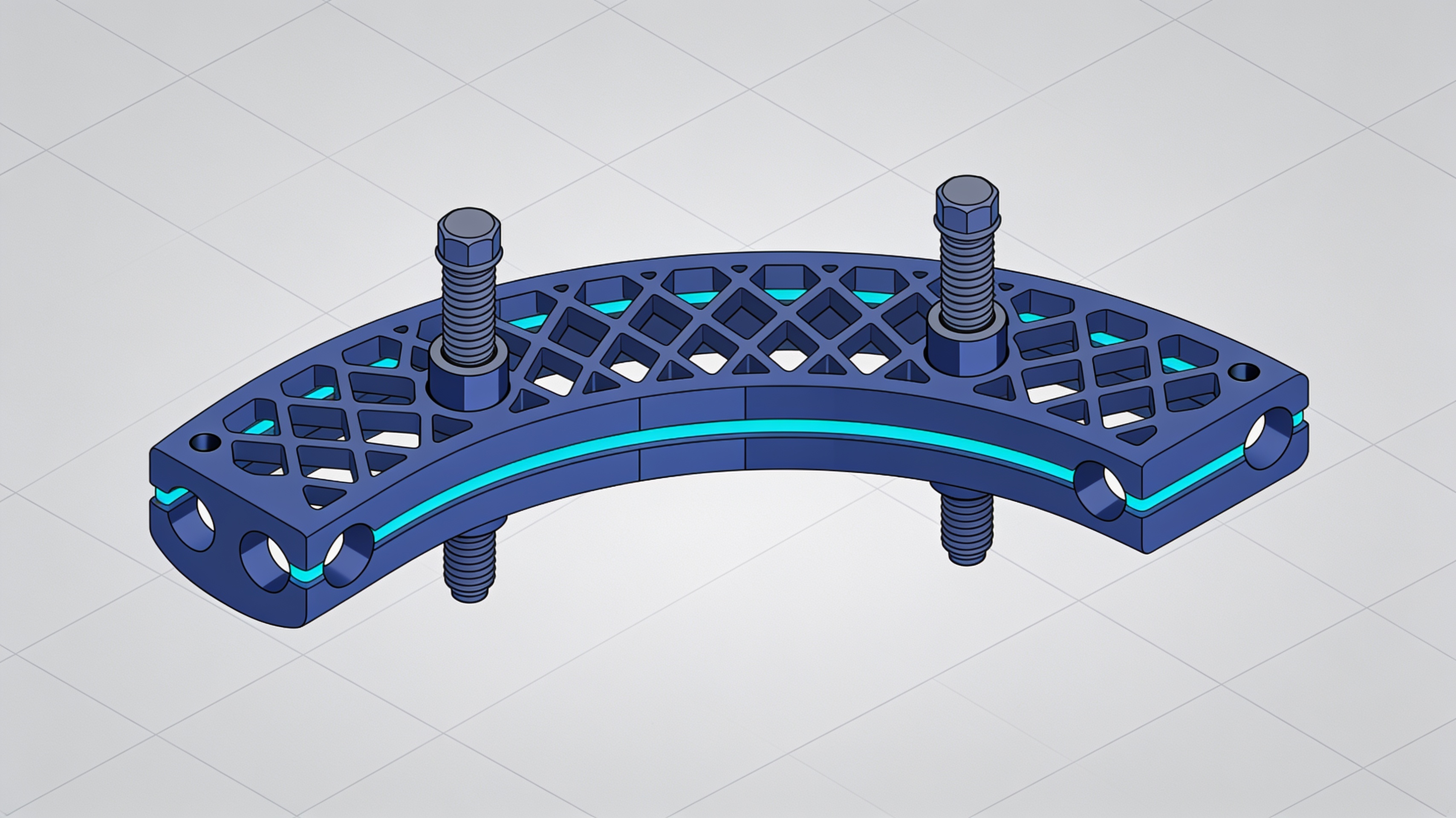
Providence launches the CORUS PCSS 3D-T cervical system with 3D-printed porous titanium
Providence Medical Technology has obtained FDA authorization for a posterior cervical stabilization system that incorporates porous titanium structures produced by additive manufacturing. The device represents an evolution of the CORUS family, designed to promote osseointegration during spinal fusion procedures.
- 510(k) clearance obtained on May 14, 2026, public announcement on October 13, 2026
- Posterior cervical fusion system C3-C7, up to three consecutive levels
- Porous titanium lattice structure manufactured with metal 3D printing
- FDA file K253676 available in the public database
Regulatory authorization and availability
Providence Medical Technology has completed the U.S. regulatory process for the CORUS Posterior Cervical Stabilization System 3D-T, obtaining clearance through the 510(k) pathway.
The Food and Drug Administration determined the device to be substantially equivalent on May 14, 2026. The public announcement of availability came on October 13, 2026.
The K253676 file documents the regulatory pathway and is accessible in the public FDA database. This pathway certifies regulatory compliance, not superior clinical efficacy compared with existing alternatives.
510(k) clearance attests substantial equivalence to already authorized devices. It does not require randomized clinical trials demonstrating therapeutic superiority over other treatment options.
Technical features of the system
The CORUS PCSS 3D-T is intended for stabilization of cervical segments during posterior fusion, with fixation by integrated screws and geometry optimized for osseointegration.
The device operates on segments between C3 and C7, with the possibility of treating up to three consecutive levels. Surgical access is posterior, with action on bilateral facet joints.
This is not a prosthesis intended to preserve joint movement. Its function is to immobilize and stabilize the segments in the context of a fusion.
Official indications include use as an adjunct to posterior cervical fusion. The system may be used in association with anterior stabilization devices at the same levels.
Additive manufacturing and porous titanium
The device's distinctive feature is the integration of porous titanium regions obtained by metal 3D printing, designed to facilitate bone growth.
The porous lattice structure offers accessible surfaces and interconnected pathways for bone tissue. This geometry cannot be achieved with traditional subtractive manufacturing techniques.
Surface topography, the continuity of available spaces, and local stiffness influence osseointegration. A porous structure can theoretically facilitate the ingrowth of new bone tissue and vascularization compared with solid surfaces.
Osseointegration does not automatically result from the use of 3D printing. Porosity, pore size, and structure architecture are critical parameters that require specific validation.
Implications for spinal implant design
The adoption of additive manufacturing for posterior spinal implants extends design possibilities beyond conventional geometries, but requires distinguishing between manufacturing capability and demonstrated clinical benefit.
Providence Medical Technology maintains the fixation approach already used in the CORUS family, integrating the porous titanium region. This approach preserves validated elements while adding new geometric features.
Metal 3D printing makes it possible to create complex lattice structures in a single production phase. This eliminates assembly operations and allows material continuity between dense and porous regions.
However, as emphasized by the manufacturer itself, regulatory authorization, promising geometry, and demonstrated clinical improvement are not equivalent. Clinical validation requires specific studies with adequate follow-up.
Clinical context and perspectives
The device fits into the landscape of posterior cervical fusion, where immediate mechanical stability and long-term biological integration are both critical.
The decision to use this type of implant depends on clinical evaluation, anatomy, and the patient's specific conditions. The previous generation of the CORUS platform was the subject of a randomized clinical study.
The availability of 3D-printed porous structures expands design options for spinal surgeons. The evolution of the field will require comparative clinical data to quantify the actual benefits compared with conventional systems.
Additive manufacturing continues to change the spinal implant landscape, shifting the boundary between what is technically feasible and what is clinically beneficial.
article written with the help of artificial intelligence systems
Q&A
When did Providence obtain FDA clearance for the CORUS PCSS 3D-T system?
The FDA determined substantial equivalence on May 14, 2026, while the public announcement of availability came on October 13, 2026. The K253676 file is available in the public FDA database.
Which cervical segments can the CORUS PCSS 3D-T system treat?
The device operates on segments between C3 and C7 and can treat up to three consecutive levels. Surgical access is posterior, with action on the bilateral facet joints.
Is the CORUS PCSS 3D-T a prosthesis that preserves joint motion?
No, it is not a prosthesis intended to preserve joint motion. Its function is to immobilize and stabilize the segments in the context of a posterior cervical fusion.
How is the porous titanium structure of the device produced?
The porous reticular structure is obtained through metal 3D printing, with accessible surfaces and interconnected pathways designed to facilitate bone growth and osseointegration.
Does 510(k) clearance demonstrate the clinical superiority of the device?
No, 510(k) clearance attests to substantial equivalence to already authorized devices and does not require randomized clinical trials demonstrating therapeutic superiority. It certifies regulatory compliance, not superior clinical efficacy.