
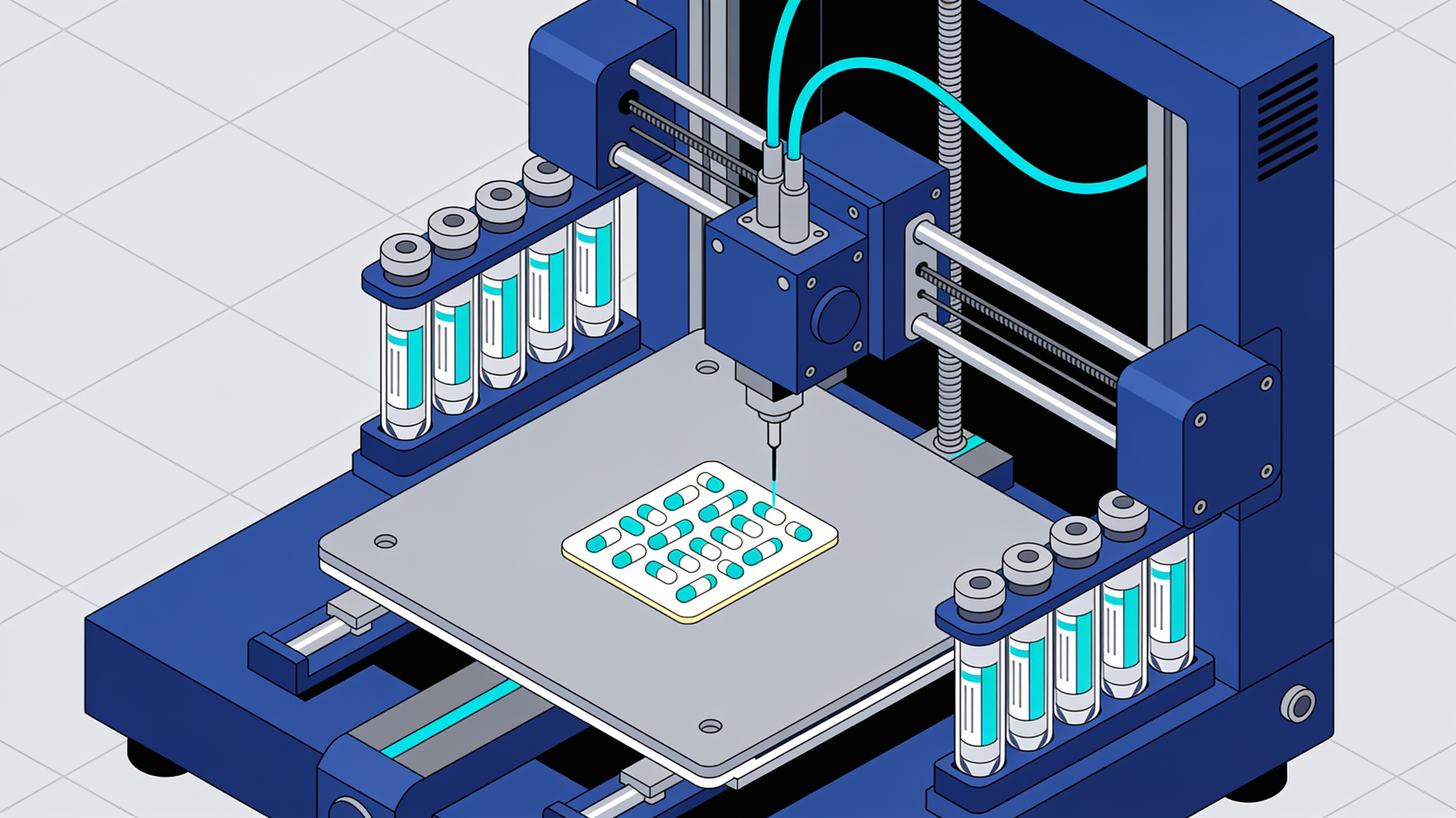
PharmaTher brings 3D drug printing to North America with the CraftMake platform
Canadian pharmaceutical company PharmaTher has obtained exclusive distribution rights for North America to Craft Health's CraftMake platform, with the goal of creating a distributed network of sites for on-demand production of 3D-printed drugs. The agreement, effective October 1, includes the distribution of printers, CraftControl software, CraftBlends materials, and related services.
The plan calls for up to 50 installations over the next 12 months, starting with compounding pharmacies and potentially expanding to hospitals, contract manufacturers, research institutions, and government facilities.
A distributed production network for personalized medicines
PharmaTher is building a model that replaces centralized production with a network of qualified sites capable of printing drugs locally, following validated digital recipes.
The M3DICINES National Network program represents a paradigm shift from traditional pharmaceutical manufacturing. Instead of producing every medicine in a central facility and shipping finished doses across the country, PharmaTher's model distributes validated formulations and digital production instructions to qualified sites.
Each site in the network will use the same CraftMake pharmaceutical 3D printing system. This standardized approach makes it possible to maintain quality and traceability while decentralizing physical production.
- Every site uses the same CraftMake platform to ensure uniformity
- Formulations are validated centrally, then distributed as digital recipes
- Production takes place locally, close to patients
- Target: 50 installations in 12 months across pharmacies, hospitals, and manufacturers
The first installations: pharmacies and GMP manufacturers
The first planned installations include PD Labs, a U.S. compounding pharmacy that will serve as a Center of Excellence for the United States, and a GMP-certified contract manufacturer not yet named.
The choice to start with compounding pharmacies is strategic. These facilities are already authorized to prepare customized formulations and represent a natural environment for pharmaceutical 3D printing.
When 3D printing makes sense in pharmaceuticals
Additive manufacturing of drugs meets needs that traditional factories struggle to satisfy: small batches, personalized dosages, and drugs with limited demand.
Traditional pharmaceutical factories are optimized for large volumes of the same product. The model becomes inefficient when different dosages, small batches, or drugs with limited demand are needed.
PharmaTher sees 3D printing as a solution for these scenarios. The same network can support proprietary products, partner programs, research projects, and clinical trial supplies.
CraftMake uses a room-temperature semi-solid paste extrusion process, unlike the laser sintering or binder jetting technologies used by other pharmaceutical systems.
Beyond selling printers: infrastructure for a production network
PharmaTher does not limit itself to selling printers. The company describes each CraftMake machine as an infrastructure element in a broader production system.
The operating model calls for PharmaTher and its partners to first develop and validate a formulation with its digital recipe. Participating sites then install a CraftMake system, complete qualification and training, and begin producing drugs locally.
This approach separates formulation development from physical production, enabling geographic scalability without replicating the entire R&D process at every site.
Outlook for the sector
PharmaTher's initiative represents one of the first attempts to create a distributed pharmaceutical manufacturing network based on 3D printing on a national scale. Success will depend on the ability to standardize processes, maintain regulatory compliance, and demonstrate economic advantages over traditional models.
In the next 12 months, the implementation of the first 50 installations will provide concrete indications of the model's feasibility and the operational challenges of distributed pharmaceutical manufacturing.
article written with the help of artificial intelligence systems
Q&A
What agreement did PharmaTher sign for North America?
PharmaTher obtained exclusive distribution rights for North America for Craft Health's CraftMake platform. The agreement, effective October 1, includes printers, CraftControl software, CraftBlends materials, and related services.
How many installations does PharmaTher's plan include and in which facilities?
The plan calls for up to 50 installations over the next 12 months. It starts with compounding pharmacies, with potential expansion to hospitals, contract manufacturers, research institutions, and government facilities.
What is the M3DICINES National Network program?
It is PharmaTher's model that replaces centralized manufacturing with a distributed network of qualified sites. Validated formulations and digital instructions are sent to the sites, which locally produce 3D-printed drugs.
What are the first planned installations?
The first installations include PD Labs, a U.S. compounding pharmacy that will serve as the Center of Excellence for the United States, and a GMP-certified contract manufacturer not yet named.
Why is 3D printing suitable for personalized drug manufacturing?
Traditional factories are optimized for large volumes of the same product and are inefficient with different dosages, small batches, or drugs with limited demand. 3D printing makes it possible to produce personalized formulations locally while maintaining quality and traceability.


