Perpetua or subscription? Choose the right model for your print farm
In the world of desktop print farms, the choice between a perpetual license and a subscription is becoming a strategic differentiator for labs, maker spaces, and small industrial realities. The licensing model influences operational costs, flexibility, and the capacity for growth over time.
Many fleet management systems have adopted subscription-only models. This guarantees predictable revenue for providers but can represent a growing fixed cost for those operating with limited budgets.
Perpetual license: when it really makes sense
A perpetual license proves advantageous for those with a structured growth plan and a desire to control long-term costs.
A lifetime license allows you to freeze the software cost at the time of the infrastructure investment. You can scale up to 1, 10, or 30 machines without subsequent fees.
The perpetual model is ideal for maker spaces, fablabs, and schools with defined annual budgets. Even small services with tight margins and variable volumes benefit from this solution.
- Maker spaces and fablabs with fixed annual budgets
- Print farms distributed across multiple locations that want to reduce administrative complexity
- Business with a stable growth plan over time
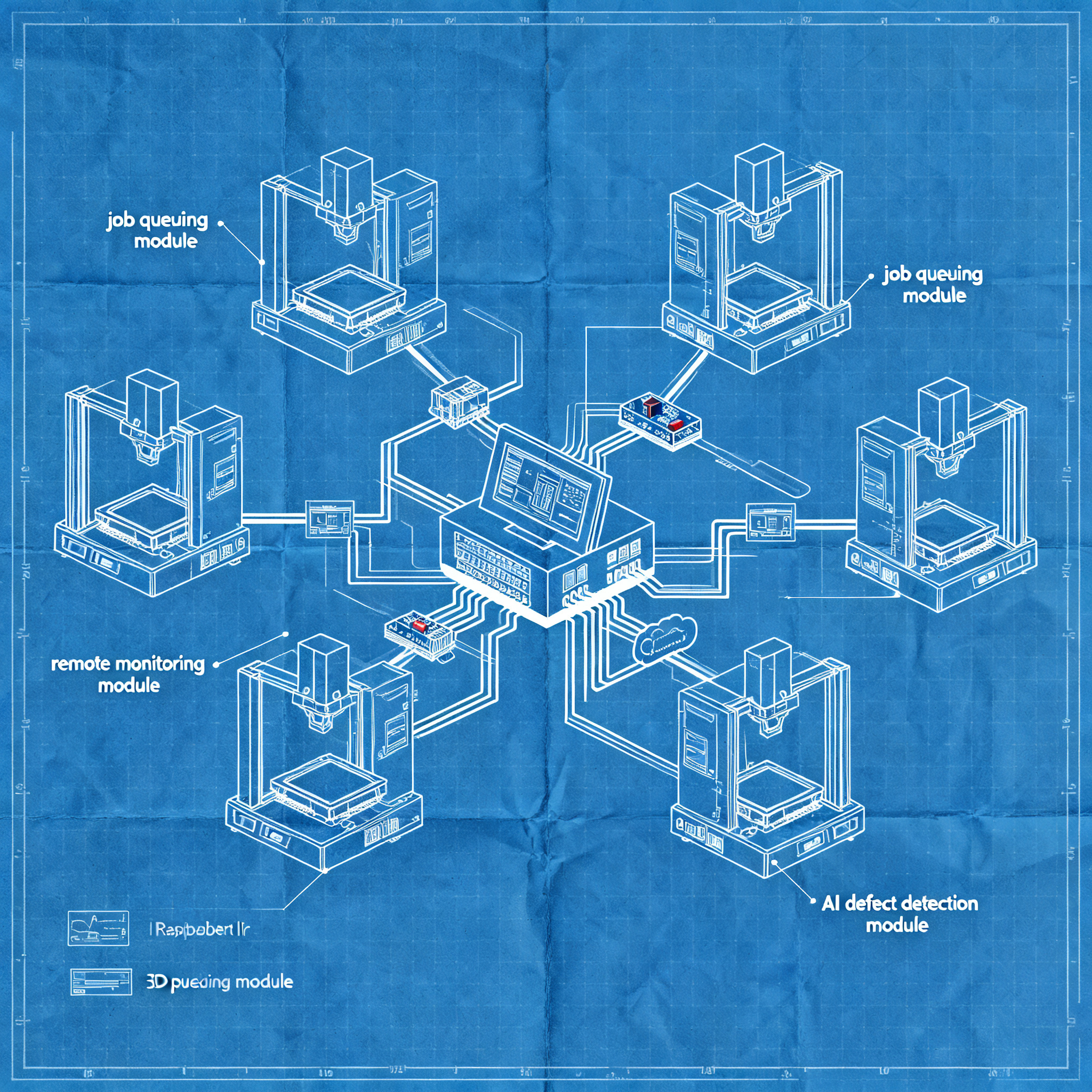
3DQue has introduced a lifetime license for AutoFarm3D Lite, available for 1, 10, or 30 printers. The system installs on Raspberry Pi 4 and manages job queues, remote monitoring, and AI defect detection.
The TCO in this model depends on the actual lifespan of the installation and future updates. Not on the size of the farm, making it easier to compare with solutions based on monthly fees.
Subscription: flexibility at what cost?
The subscription offers continuous access to advanced features and support, but it can become costly over time for businesses with limited budgets.
Subscription models guarantee continuous updates and access to evolving features. Prusa Connect has introduced paid plans that include additional storage, simultaneous cloud slicing, and access to the Farm Beta.
Prusa Connect's Farm Beta introduces automatic job distribution, Gantt chart planning, and quality control workflows. These functions are only available with active paid plans.
| Features | Free plan | Paid plan |
|---|---|---|
| Simultaneous cloud slicing | Sequential | Parallel |
| Farm Beta Access | Future | Immediate |
| Storage | Limited | Extended |
| Prusa Academy Courses | Paid | Included |
The main advantage is flexibility. You can turn the service on and off based on projects. For realities in the testing phase or with variable volumes, this model reduces the initial risk.
The downside emerges in the long term. An annual subscription repeated for 5-7 years can exceed the cost of an equivalent perpetual license.
TCO and operational model: how to choose
The total cost depends on factors such as duration of use, number of machines, and level of support required: a targeted approach is essential.
The Total Cost of Ownership varies based on the expected duration of use and the need for support. A perpetual license amortizes the initial cost over a multi-year horizon.
To calculate the actual TCO, consider three variables: expected duration of the installation, number of machines to manage, and frequency of necessary updates. A farm that plans to operate for 5+ years with stable growth favors the perpetual model.
Economic model evaluation
- Time projection: Estimate the operational lifespan of the farm (3, 5, or 7+ years).
- Recurring costs calculation: Multiply the annual fee by the number of expected years.
- Comparison with perpetual: Check if the lifetime cost is lower than the total subscription.
- Evaluate support: Consider whether you have internal expertise or need continuous assistance.
Print farms distributed across multiple locations aim to reduce administrative complexity. A perpetual license eliminates the management of multiple renewals and simplifies accounting.
The operational model influences the choice. Realities with internal IT teams and technical expertise can manage manual updates. Those needing continuous support find value in subscriptions.
Real cases: who chose what and why
Let's examine three different operational scenarios – maker space, university lab, manufacturing company – to understand the motivations behind each choice.
A maker space with 15 printers and a fixed annual budget chose AutoFarm3D Lite lifetime. The decision allowed to freeze software costs and allocate variable resources to materials and maintenance.
A university lab with variable pilot projects opted for paid Prusa Connect. Immediate access to Farm Beta and Prusa Academy courses justified the annual fee.
The choice is not definitive. Some realities start with a subscription to test the system, then migrate to perpetual once the farm stabilizes. Others maintain a mix: perpetual for basic functions, subscription for optional advanced modules.
A small manufacturing company with 30 Bambu Lab printers chose a hybrid solution. Perpetual license for basic management, subscription for MES integration functions and custom APIs.
The key difference lies in the growth model. Those who foresee rapid and unpredictable expansion prefer the flexibility of subscription. Those with a defined roadmap and wanting to stabilize operational costs choose perpetual.
Conclusion
The choice between perpetual license and subscription is not only economic, but strategic. Evaluating your operational model is the first step towards an informed decision.
The desktop print farm segment continues to grow, driven by brands like Bambu Lab, Creality, Prusa, and Elegoo. Widespread automation makes software management a central element of overall TCO.
Analyze your growth plan and compare real costs: which model brings you closer to your goals? The answer depends on expected duration, internal skills, and need for ongoing support.
article written with the help of artificial intelligence systems
Q&A
What are the main advantages of a perpetual license for a print farm?
A perpetual license allows freezing the software cost at the time of purchase and scaling the number of machines without further fees. It is particularly advantageous for entities with fixed budgets and stable growth plans, such as makerspaces and schools.
In which cases is the subscription model preferable?
The subscription model is ideal for organizations in testing phases or with variable volumes, as it offers flexibility and continuous access to advanced features and updates. However, over the long term, it may be more expensive compared to a perpetual license.
What does AutoFarm3D Lite with a lifetime license offer?
AutoFarm3D Lite with a lifetime license manages job queues, remote monitoring, and AI-based defect detection on Raspberry Pi 4. It is available for 1, 10, or 30 printers and simplifies accounting by eliminating annual renewals.
What features distinguish Prusa Connect's paid plan?
Prusa Connect's paid plan includes parallel cloud slicing, immediate access to the Farm Beta with features like Gantt scheduling and quality control, plus extended storage and included Prusa Academy courses.
How is the TCO (Total Cost of Ownership) calculated when choosing between perpetual and subscription models?
TCO takes into account the expected installation lifespan, the number of machines, and the need for updates or support. It compares the initial cost of a perpetual license with the total subscription fees over time.