AI in Process Control: How Not to Mess Up the Implementation
Artificial intelligence is transforming production process control, but its real integration requires a systemic approach that goes beyond pointwise optimization. Many companies implement AI on individual machines without considering the entire production chain, drastically limiting the achievable benefits.
From Local Optimization to a System-Wide Vision
The first applications of AI in additive manufacturing focused on isolated improvements, without addressing the real bottlenecks of industrial production.
Machine learning models have optimized toolpaths, compensated for thermal distortions, and detected anomalies during builds. These advancements have improved the quality and consistency of individual parts. But in most cases, AI tools remain confined to individual machines and isolated steps.
- Fragmented workflows between machines from different vendors
- Manual steps between preparation, printing, and post-processing
- Quality control systems disconnected from production
- Unrelated process data
The industrial reality involves complex multi-stage chains: digital preparation, material conditioning, printing, part removal, cleaning, heat treatments, surface finishing, inspection, and secondary processing. These steps are performed on equipment from different suppliers, with incompatible control systems, data formats, and protocols.
To truly transform additive manufacturing, AI must operate on the entire production cycle. It is not enough to optimize individual steps when there is a lack of coordination between machines, predictable throughput, and traceable compliance.
Data Architecture for Predictive Control
An effective AI system requires data infrastructure capable of unifying information from sensors, machines, and management systems in real time.
The transition to a “process-centric” logic represents the necessary paradigm shift. Instead of demonstrating quality piece-by-piece only through final controls, the goal becomes to qualify the process itself. Each build must possess sufficient digital evidence (data, logs, sensors) to support compliance.
This approach requires reliable data and robust models. Much of the useful information remains buried in machine logs, quality measurements, and non-conformance reports, without systematic correlation to extract general patterns.
Predictive AI anticipates process drifts and intervenes on parameters (power, speed, material feed) to keep behavior within expected limits. The sensor → measure → decision → correction cycle operates during the build, not after.
Modern platforms generate 3D models in real time during printing, comparing them with the original design. Algorithms recommend new parameters to compensate for detected defects, allowing the printer to continue automatically with corrections. Users no longer have to proceed with manual trial and error.
Integrated Automation and Open Standards
Interoperability between sensor systems, edge computing, and ERP/MES systems determines the success of AI implementation at industrial scale.
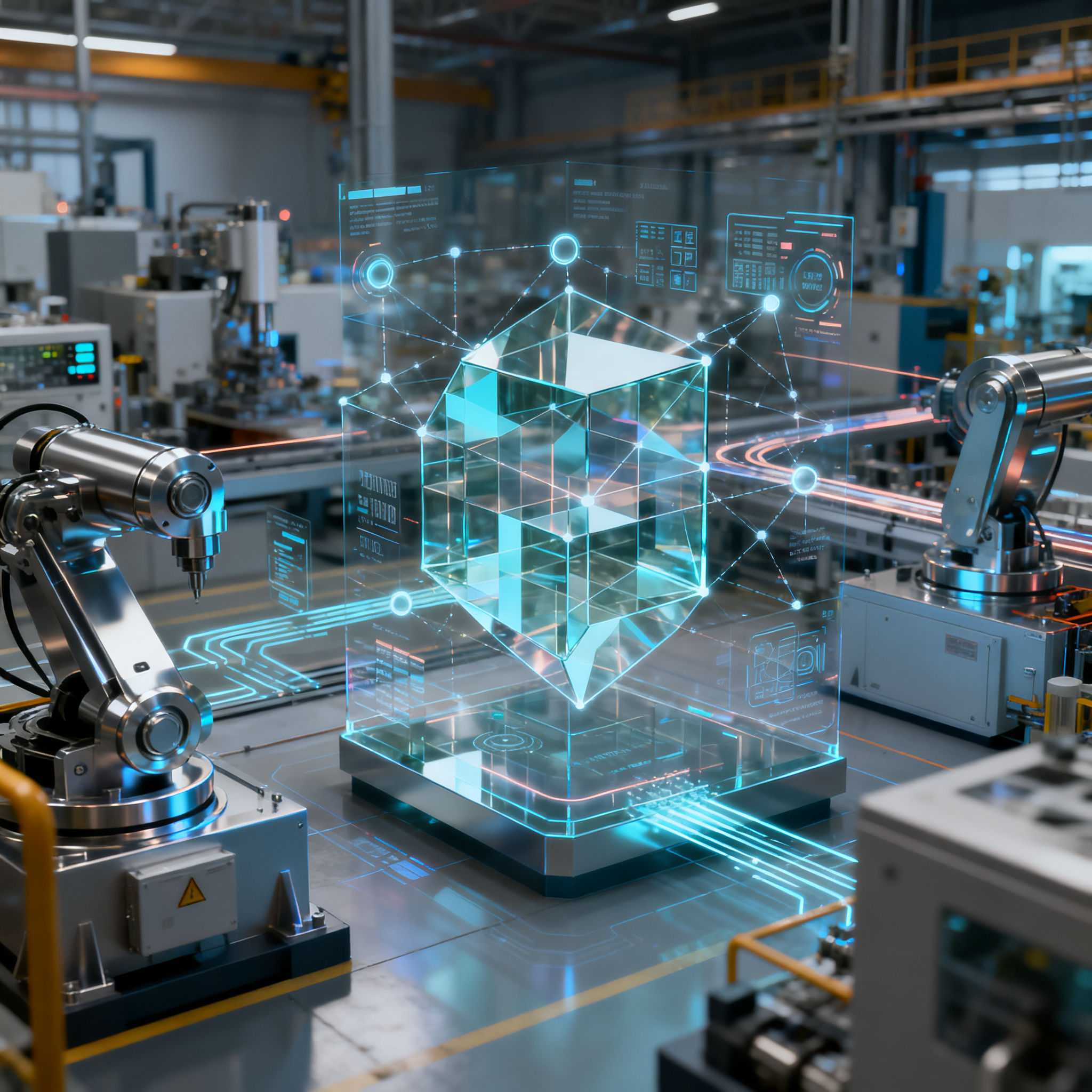
Advanced manufacturing environments combine multiple additive platforms with robotic handling systems, post-processing equipment, inspection technologies, CNC machines, and enterprise IT systems. To operate efficiently, these assets must function as a unified system, not as separate islands.
Software-defined automation provides centralized orchestration that connects equipment, data flows, and production workflows. In additive applications, these platforms unify data from printers, post-processing, robotics, inspection, and sensors to coordinate multi-stage workflows with automatic compliance.
| Approach | Closed architecture | Open platform |
|---|---|---|
| New tool integration | Difficult and expensive | Modular and configurable |
| Deploy custom AI models | Limited to vendor | Flexible |
| Workflow adaptation | Requires infrastructure rebuild | Software configuration |
| Multi-site scalability | Low | High |
Open architectures that support standard interfaces allow manufacturers to introduce AI techniques in a controlled manner, scale successful applications across facilities, and adapt processes without rebuilding the core infrastructure.
Cybersecurity becomes crucial when connecting an entire factory. In the industrial world, the primary concern is not losing data or time, but losing control of the process. Edge computing protects the physical integrity of the manufacturing infrastructure, preventing cloud vulnerabilities from causing operational downtime or remote compromise.
Operational Roadmap for Industrial Adoption
An effective implementation strategy connects machines, operators, and quality systems through clear data governance and verifiable milestones.
The shift from “file-centric” workflows to “task-centric” workflows represents the fundamental operational change. Instead of requiring the engineer to export, clean, and re-import at each step, the system executes the complete workflow by invoking appropriate tools and reporting only high-level choices or exceptions.
Implementation Plan
- Digital maturity assessment: Map existing assets, data formats, protocols, and current integration level between systems.
- Pilot use case identification: Select applications with clear ROI such as predictive quality control or product evaluation time reduction.
- Unified data infrastructure: Implement a data layer that correlates machine logs, in-process sensors, scanning parameters, and inspections.
- Controlled deployment of AI models: Introduce algorithms into qualified processes, validate results, scale progressively.
- Cross-system workflow automation: Orchestrate CAD, simulation, build preparation, execution, and post-process verification.
AI in additive manufacturing acts as a “digital nervous system” connecting design, job preparation, printing, post-processing, and quality control. Every print, process deviation, and correction becomes data that feeds a shared evolutionary model.
Immediate return on investment emerges in quality control. By monitoring ingredient humidity and temperature in real-time, AI optimizes energy consumption and predicts batch quality weeks in advance. There is no longer a need to wait for long tests to verify standard compliance.
Conclusion
Implementing AI in industrial control requires a systemic vision and a structured operational methodology. Local optimizations are not enough when fragmented workflows and disconnected data limit throughput and predictability.
Open architectures, software-defined automation, and unified data governance represent the pillars for scaling AI from a single machine to the entire factory. Only in this way can artificial intelligence transform additive manufacturing from a promising technology into a reliable, productive solution.
Start immediately by evaluating your current digital maturity level to map out a realistic roadmap. Identify use cases with clear ROI, build interoperable data infrastructures, and progressively scale successful applications.
article written with the help of artificial intelligence systems
Q&A
What is the main mistake in implementing AI for production process control?
The main mistake is focusing on optimizing individual machines or isolated steps, without considering the entire production chain. This approach limits the achievable benefits and does not address the real bottlenecks in industrial production.
What is meant by 'system vision' in the context of AI for additive manufacturing?
System vision involves integrating AI across the entire production cycle, coordinating machines, processes, and data from different stages such as preparation, printing, post-processing, and inspection. The goal is to achieve predictive and traceable control of the entire process, not just the individual part.
What are the advantages of closed-loop control via AI during production?
Closed-loop control allows AI to constantly monitor the process, intervene in real-time on parameters, and automatically correct any deviations. This reduces errors, improves final quality, and decreases the need for manual interventions or repeated trials.
Why are open architectures crucial for scaling AI in the industrial sector?
Open architectures allow modular integration of new tools and AI models, facilitating workflow adaptation and scalability across different facilities. Moreover, they support common standards that improve interoperability and reduce implementation costs.
How does AI contribute to compliance and traceability of production processes?
AI generates digital evidence through data collected from sensors, logs, and inspections, enabling qualification of the entire process rather than just the final product. This approach ensures greater traceability, documentable compliance, and less reliance on post-production checks.