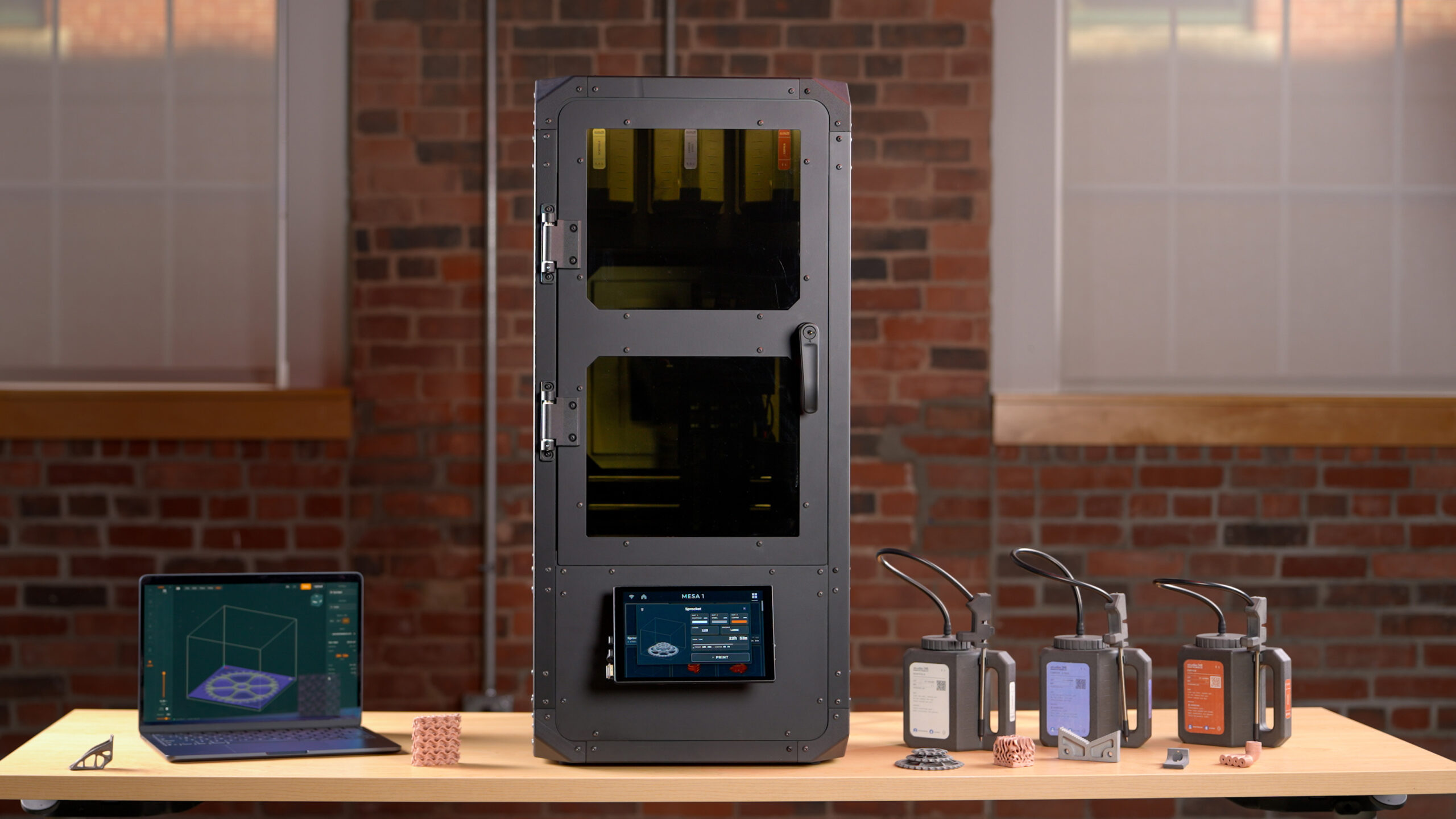
Studio 3e8 announces Mesa 1: desktop metal printer with integrated sintering
Studio 3e8 has presented Mesa 1, a desktop metal printer with an integrated furnace for direct sintering. The announced promotional price is $3,500, but inconsistencies remain and complete technical specifications are missing.
The Kickstarter campaign is scheduled for December 1, 2026. There are currently no independent validations published on the system.
A different approach from laser melting
Mesa 1 proposes an alternative path to powder bed technologies, depositing metal and support material in a crucible integrated into the machine's furnace.
The system does not use laser powder bed fusion (LPBF). Instead, it controllably deposits two materials: metal and a support scaffold.
The slicing program determines where to place each fraction. The component takes shape directly in a crucible placed in the machine's furnace.
- Controlled deposition of metal and scaffold
- Integrated sintering without external handling
- Initial materials: carbon steel and copper
- 120-volt power supply
The integration of the thermal phase
Indirect metal technologies traditionally separate shaping, binder removal, and heat treatment. Mesa 1 attempts to eliminate these intermediate steps.
Transfer between different devices introduces waiting times, additional equipment, and risks of damaging parts that are still fragile. The proposal to integrate the thermal phase into the same unit attempts to reduce these steps.
However, essential aspects remain to be clarified. Dimensional shrinkage management, component stability, and scaffold separation after treatment are not documented.
Missing materials and specifications
The company website lists carbon steel and copper as initial materials, but fundamental technical data for a serious assessment of the system are missing.
A 120-volt power supply is not enough to establish the availability of a version compliant with European grids and certifications.
No complete public specifications on essential parameters are available. Build volume, layer thickness, accuracy of final dimensions, measured density, tensile strength, and tolerances for parts of different mass are not documented.
Without these numbers it is impossible to seriously compare the system with an LPBF or with an industrial metal extrusion process followed by sintering.
Price inconsistency
The October 28 press release indicates a starting price of 3,500 dollars, but the website's main page lists an early-bird price of 10,000 dollars.
The discrepancy could depend on different configurations, limited availability, or pages updated at different times. It is not correct to choose one figure as the final price without explaining the inconsistency.
Until the Kickstarter campaign actually opens, scheduled for December 1, it remains to be clarified what the real price is and which configurations are actually available.
Preliminary assessment
Mesa 1 represents an attempt to simplify the desktop metal 3D printing workflow. Integrating sintering into the same unit could reduce complexity and operating costs.
However, the absence of independent validations, complete technical specifications, and clarity on price make a reliable technical assessment impossible. It will be necessary to wait for measured data on real parts and comparisons with established technologies before determining whether the system keeps the stated promises.
Q&A
What is Mesa 1's technology compared to laser powder bed fusion?
Mesa 1 does not use laser powder bed fusion (LPBF). Instead, it controllably deposits two materials, metal and a support scaffold, in a crucible integrated into the machine's furnace.
Which materials does Mesa 1 initially support?
The company's website lists carbon steel and copper as starting materials. No other materials are documented at this time.
What is the announced price of Mesa 1 and when does the Kickstarter campaign start?
The October 28 press release indicates a starting price of $3,500, but inconsistencies with the main page remain. The Kickstarter campaign is scheduled for December 1, 2026.
Which technical specifications are missing to evaluate Mesa 1?
There is no documentation of build volume, layer thickness, final dimensional accuracy, measured density, tensile strength, and tolerances on parts of different mass. Details on dimensional shrinkage, part stability, and scaffold removal are also missing.
Is Mesa 1 compatible with European power grids?
The stated power supply is 120 volts, which is not enough to establish the availability of a version compliant with European grids and certifications. There are no complete public specifications on this aspect.