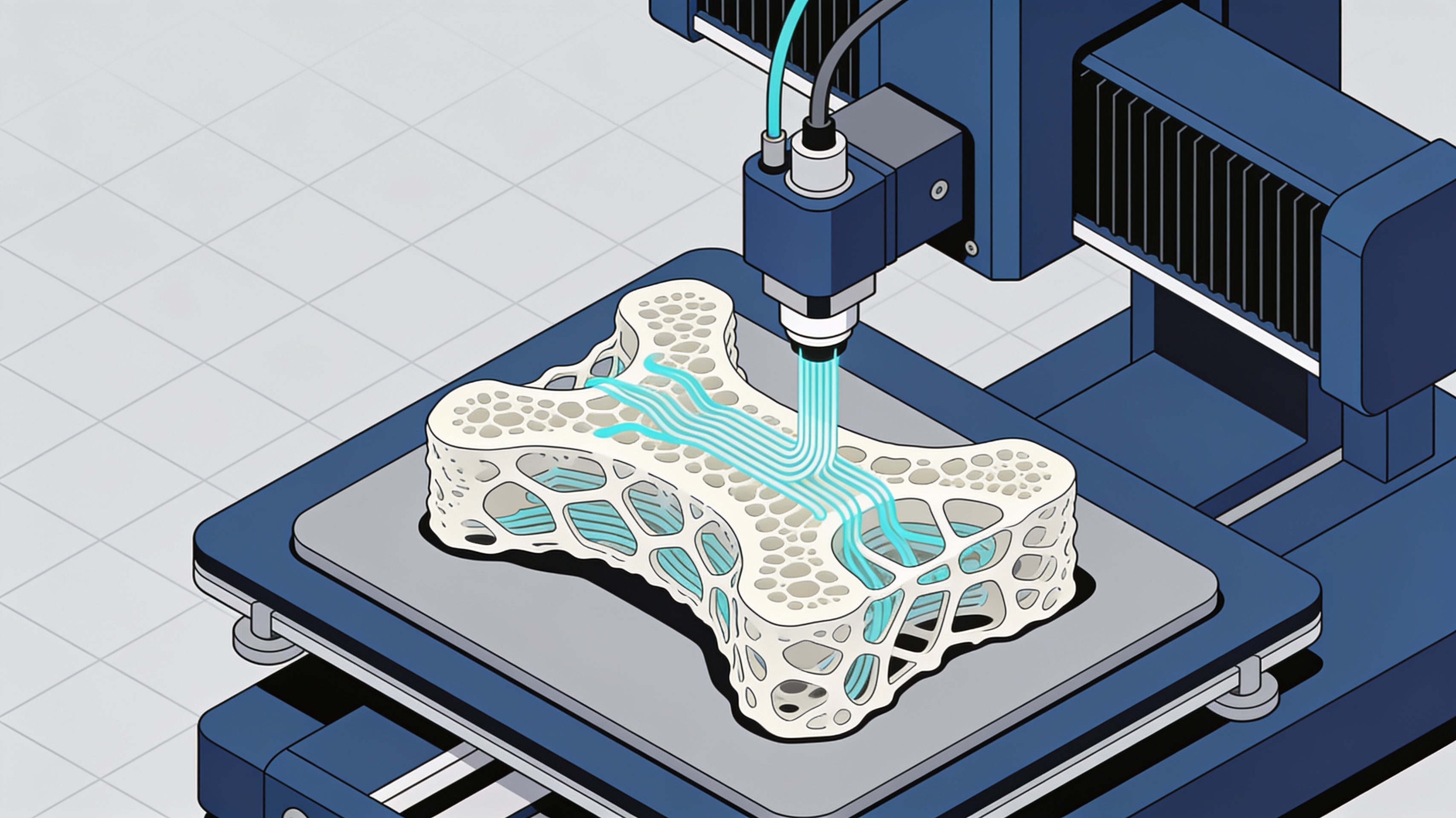
ScaffoldForge generates bone scaffolds in twelve seconds: real speed, validation still virtual
A conditional diffusion generative model promises to accelerate bone implant design by reducing times from hours to seconds. However, the results published in PLOS ONE concern only computer simulations, with no evidence on printed components.
Rapid design, but computational only
Yaohua Zhang, Hongyue Zhang and Huaqing Yang developed ScaffoldForge, a system that generates three-dimensional geometries for bone scaffolds in about 12 seconds. Comparison with traditional topology optimization indicates a 700-fold acceleration: from 8,400 seconds to 12.
The model uses trabecular parameters such as bone volume fraction, thickness, spacing, number and connectivity of trabeculae, anisotropy and permeability. These descriptors guide the generation of structures inspired by the microarchitecture of trabecular bone.
- Generation of bone scaffolds in 12 seconds versus 8,400 for the traditional method
- Estimated strength of 56.6 MPa, 8.2% higher than the reference
- All data derive from simulations, not from tests on printed components
- Limited training dataset, integrated with synthetic geometries
The problem of traditional design
Scaffolds for extensive bone defects must balance internal accessibility, structural continuity, mechanical behavior, and porosity distribution. Topological optimization requires long times to compare each modification with constraints and behavior models.
A printable geometry is not automatically suitable for interaction with biological tissue. ScaffoldForge seeks to rapidly propose geometries conditioned by specific structural descriptors.
The method includes physical constraints introduced into the training function. The geometries used for learning do not all derive from real scans: a synthetic procedure expands the number of available examples.
Mechanical performance: numerical estimates only
The declared compressive strength of 56.6 MPa does not derive from tests on manufactured scaffolds, but from computational assessments. Speaking of printed implants that resist better would be misleading.
The authors report a strength higher by 8,2% compared with the topology optimization reference. This value comes from simulation models, not from mechanical tests on real components.
The distinction is crucial in the biomedical field. An in silico estimate cannot replace experimental validation on printed, sterilized scaffolds subjected to compression tests.
In silico evaluation simulates mechanical behavior through mathematical models. It does not include process variables such as printing defects, post-process material properties, or sterilization effects.
Dataset limitations and generalization
The study uses a relatively limited number of real references, supplemented by procedurally generated geometries. The quality of the result partially deteriorates out of distribution.
The authors subject the model to checks on statistical similarity and generalization to cases different from those used in training. They acknowledge that performance decreases when the model encounters configurations not represented in the dataset.
This transparency is important in biomedical applications, where geometric similarity alone is not enough to predict tissue response. Biocompatibility depends on factors that go beyond computational morphology.
What is missing for industrial validation
Steps required for validation
- Manufacturing: 3D printing of scaffolds with geometries generated by the model
- Mechanical characterization: Compression tests on real components
- Biological validation: Biocompatibility and bone tissue interaction testing
- Post-process verification: Assessment after sterilization and surface treatments
The transition from simulation to additive manufacturing introduces process variables that influence the final properties. Printing parameters, orientation, supports, and post-treatment modify mechanical performance compared with computational predictions.
In the biomedical field, the gap between a generative model and a certified implant also includes preclinical studies, regulatory assessments, and sterilization tests. ScaffoldForge accelerates a specific design phase, but does not eliminate subsequent experimental validations.
Outlook for additive manufacturing
The generation speed offers potential for iterative optimization and patient-specific customization. Reducing computational times from hours to seconds makes the exploration of geometric variants feasible during surgical planning.
Integration with slicing software and printability verification represent the next logical steps. An effective generative model must produce geometries compatible with the constraints of the chosen additive technology, considering overhang angles, support requirements, and accessibility for removing unsintered powder.
The publication in PLOS ONE documents an advance in computational design. Validation through printed and tested components will determine the clinical applicability of the method.
article written with the help of artificial intelligence systems
Q&A
How long does ScaffoldForge take to generate a bone scaffold?
ScaffoldForge generates three-dimensional geometries for bone scaffolds in about 12 seconds, compared to the 8,400 seconds required by traditional topology optimization. This is a 700-fold acceleration according to the authors.
Which parameters does the model use to generate the scaffolds?
The conditional diffusion model uses trabecular parameters such as bone volume fraction, thickness, spacing, trabecular number and connectivity, anisotropy, and permeability. These descriptors guide the generation of structures inspired by the microarchitecture of trabecular bone.
Was the 56.6 MPa strength verified on printed scaffolds?
No, the compressive strength of 56.6 MPa comes from computational evaluations and not from tests on fabricated scaffolds. The authors report a value 8.2% higher than the topology optimization baseline, but only through simulations.
Where do the data used to train ScaffoldForge come from?
The training dataset is limited and supplemented with synthetic geometries: not all geometries used for learning come from real scans. A synthetic procedure was used to expand the number of available examples.
What limitations do the results published in PLOS ONE have?
The results concern exclusively computer simulations, without tests on printed, sterilized, or mechanically tested components. An in silico estimate cannot replace experimental validation in the biomedical field.