LLNL 3D prints ceramic lasers to overcome the limits of optical fibers
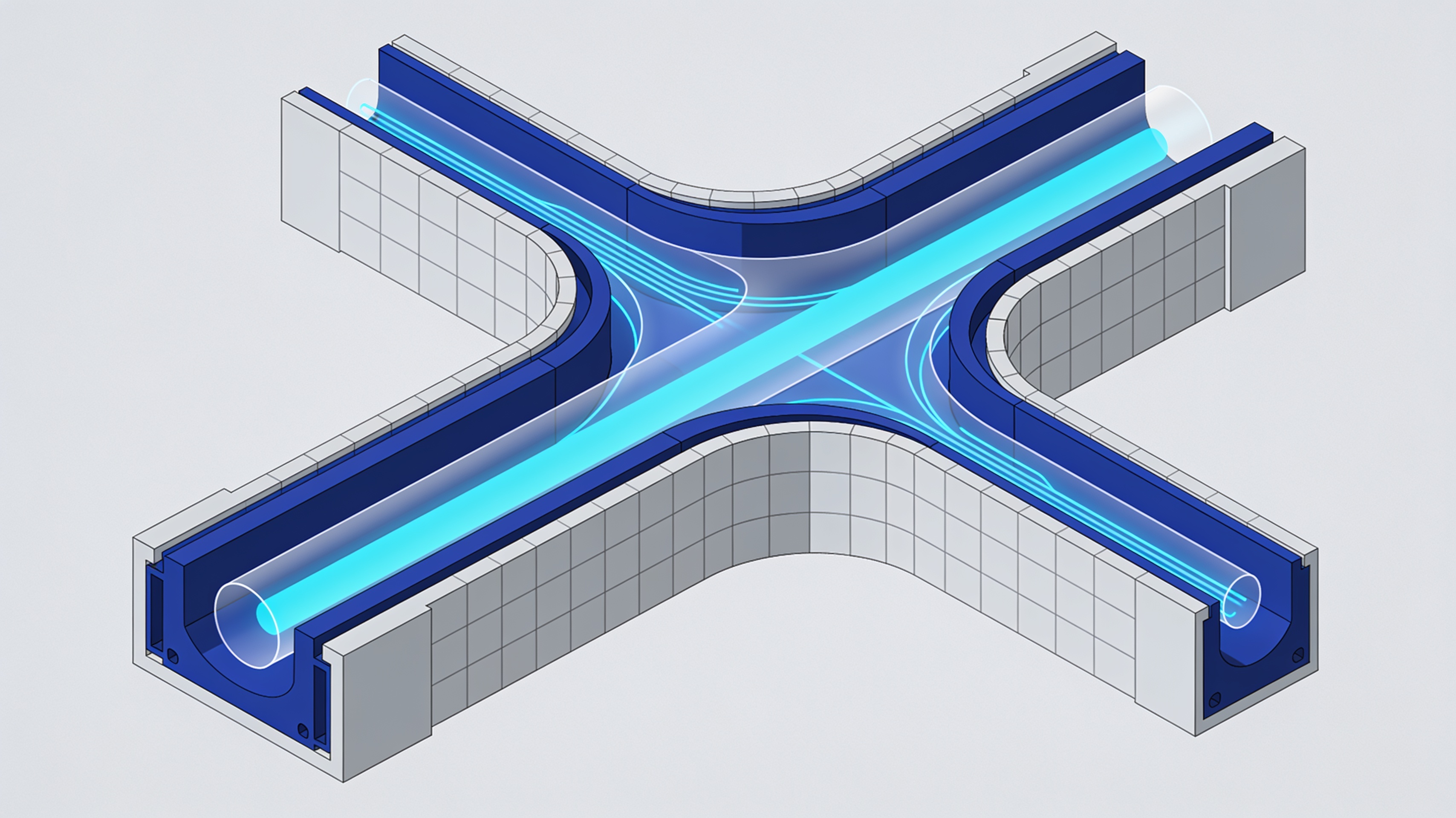
Researchers at Lawrence Livermore National Laboratory have created the first all-ceramic laser waveguide using 3D printing. The device, based on yttrium aluminum garnet doped with ytterbium (Yb:YAG), aims to overcome the physical limits of traditional silica optical fibers.
The technology used is Direct Ink Writing, which allows control of the material composition during fabrication. The result is a component that simultaneously functions as a transparent ceramic structure and an optical device capable of confining and amplifying light.
World's first demonstration of printed ceramic waveguides
The LLNL team published in Optics Letters the first demonstration of channel waveguides in transparent ceramic made with 3D printing and successfully used as laser devices.
The study was conducted by Ross Osborne, Jun Zhang, Mark Dubinskii, Nerine Cherepy, and Stephen Payne in collaboration with the DEVCOM Army Research Laboratory. The work appeared in 2026 in the journal Optics Letters with the title “All-ceramic channel waveguides fabricated via 3D printing”.
The uniqueness of the process lies not only in the geometric complexity. 3D printing directly creates an active region doped with ytterbium surrounded by undoped YAG material, integrating optical functionalities into the structure itself.
- First 3D-printed all-ceramic laser waveguide
- Material: Yb:YAG (yttrium aluminum garnet doped with ytterbium)
- Technology: Direct Ink Writing with composition control
- Dual function: transparent ceramic structure and active optical device
The role of waveguides in laser systems
Optical waveguides confine and direct light like a wire conducts electric current, exploiting total internal reflection to avoid losses.
An optical waveguide confines light in a central region (core) surrounded by an external material (cladding). Differences in optical properties between the two regions prevent radiation from scattering and guide it along a predetermined path.
In laser systems, the waveguide can contain the active material that amplifies light radiation. This allows combining confinement and amplification in compact structures.
Silica optical fibers represent the most common example. Fiber lasers achieve high powers while maintaining compact dimensions, good beam quality, and efficient heat dissipation thanks to the high surface-to-volume ratio.
Why go beyond traditional optical fibers
The intrinsic properties of silica glass pose physical limits on the power that can pass through a fiber, making alternatives necessary for high-energy applications.
Silica optical fibers have intrinsic limits related to the properties of the material itself. These physical constraints limit the amount of manageable power.
YAG ceramics offer superior thermal and mechanical characteristics. Composition control via 3D printing allows the creation of optical devices with potentially superior performance to conventional fibers.
Direct Ink Writing is not only used to achieve complex geometries, but to control the spatial distribution of materials during deposition, creating functional gradients impossible to achieve with traditional techniques.
Implications for high-power applications
The ability to print ceramic waveguides opens prospects for compact high-power laser systems, with applications in industrial, scientific, and defense fields.
Collaboration with the DEVCOM Army Research Laboratory suggests interest in defense applications. High-power laser systems require components capable of handling high energy densities without degrading.
3D-printed transparent ceramics could enable new compact laser architectures. The ability to integrate optical functionalities during fabrication reduces the need for post-production assembly and alignment.
Material composition control via additive manufacturing represents a paradigm shift. It is no longer just about replicating geometries, but about designing the spatial distribution of the component's physical properties.
article written with the help of artificial intelligence systems
Q&A
What material was used for the laser waveguide?
The device is based on ytterbium-doped yttrium aluminum garnet (Yb:YAG). This material allows integrating active optical functionalities directly into the ceramic structure.
Which 3D printing technology did the LLNL team employ?
The researchers used Direct Ink Writing technology. This process enables precise control over material composition during the component's fabrication itself.
What is the main advantage over traditional optical fibers?
The new ceramic waveguide aims to overcome the physical limits of traditional silica optical fibers. It offers a structure that acts as both mechanical support and an active optical device.
Where was the study on ceramic waveguides published?
The study appeared in 2026 in the journal Optics Letters under the title "All-ceramic channel waveguides fabricated via 3D printing". The research was conducted in collaboration with the DEVCOM Army Research Laboratory.
How does the active region of the printed device work?
3D printing directly creates an active region doped with ytterbium surrounded by undoped YAG material. This configuration allows confining and amplifying light within the structure.