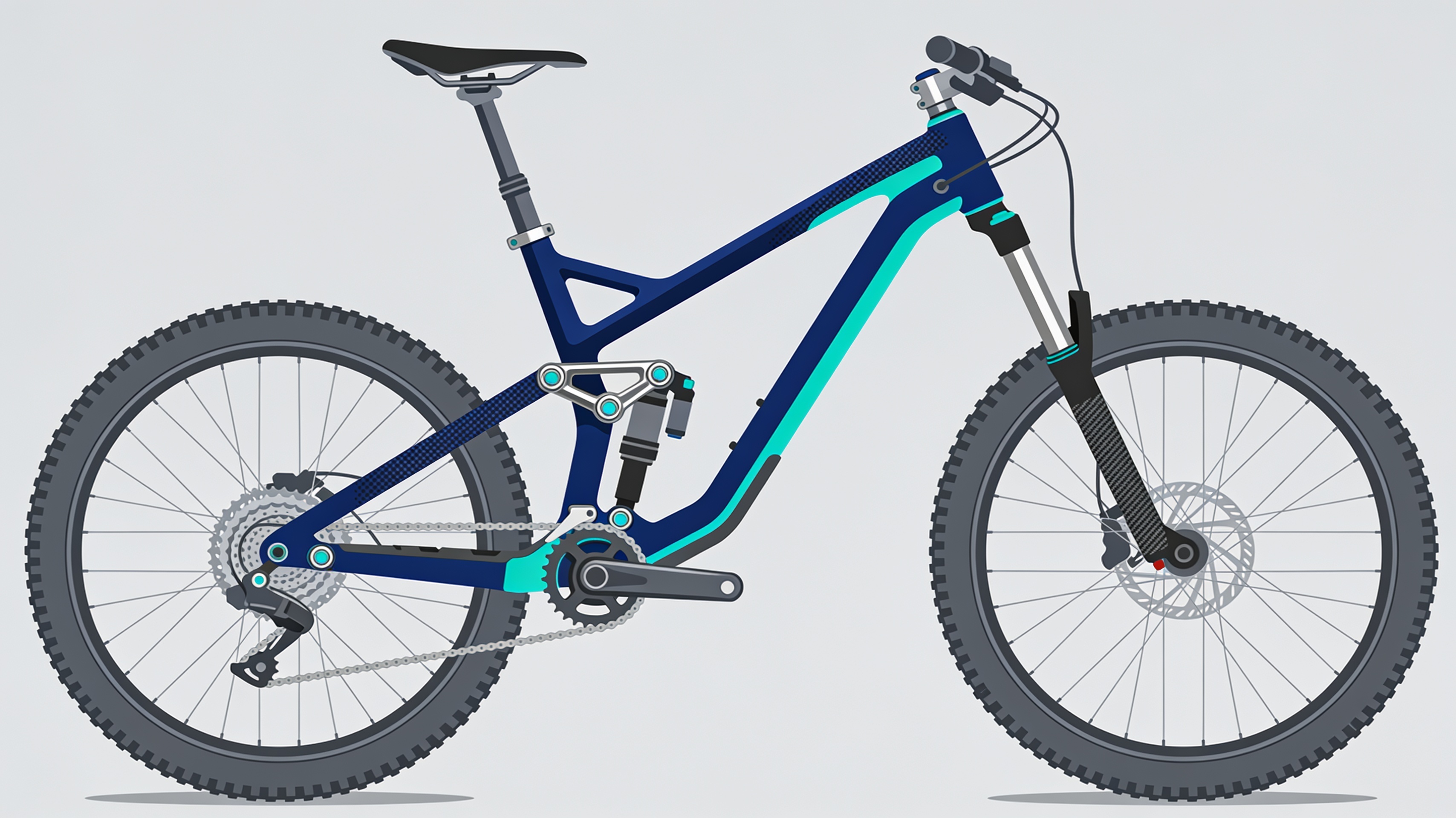
Burton Bikes Raptor I: the enduro mountain bike with a hybrid frame of 3D-printed titanium and carbon
After two years of development, New Zealand's Burton Bikes has completed the first working prototype of the Raptor I, an enduro mountain bike that combines structural joints in 3D-printed titanium and carbon fiber tubes. The project represents a systemic approach to frame design, where metal additive manufacturing and composite materials are integrated from the earliest stages of development.
The bicycle was designed by Kieran Burton in New Zealand. For its construction, he collaborated with RAM3D for 3D printing of the Ti-6Al-4V alloy joints and with C-Tech Composites for the carbon fiber tubes.
Hybrid architecture: different materials where needed
The Raptor I adopts a construction solution that is emerging in the high-performance bicycle sector: 3D-printed metal joints combined with composite tubes.
The structural joints, or lugs, were produced by laser fusion of a metal powder bed in Ti-6Al-4V titanium alloy. These components are then joined to the carbon fiber tubes.
The approach is not limited to combining two materials. The goal is to exploit the specific characteristics of each at the points of the frame where they are most effective. Titanium offers impact resistance and the ability to absorb concentrated stresses. Carbon fiber ensures lightness and rigidity in the tubular sections.
- Joints: 3D-printed titanium Ti-6Al-4V (RAM3D)
- Tubes: carbon fiber (C-Tech Composites)
- Category: enduro mountain bike
- Development time: about 2 years
From CAD to trails: the first real test
Kieran Burton worked for about two years before he could ride the first Raptor I. The project started from the frame geometry and suspension kinematics.
The transition from the digital model to field testing represents a crucial phase. It is not about adapting an existing frame, but a bicycle developed starting from the intended use conditions.
The enduro category imposes complex structural requirements. The frame must be rigid to ensure handling precision. It must withstand impacts and cyclic loads of downhill. It must maintain a low weight and allow the rear suspension to function according to the designed kinematics.
The first on-terrain test initiated the phase that no numerical simulation can completely replace: verifying the behavior of the whole when subjected to the irregular and multidirectional stresses of a real trail.
Continuous development
Burton stated that the work is not finished. Further testing and development sessions are planned.
The subsequent tests will serve to collect data on the bicycle's behavior and to identify any areas for improvement. This iterative approach is typical of high-performance product development, where simulations provide insights but final validation occurs in the field.
Additive manufacturing allows the creation of complex geometries optimized for load distribution, impossible to achieve with traditional techniques. The junctions can integrate multiple functions and reduce the number of required components.
An emerging approach in the industry
The solution adopted by Burton Bikes is gaining ground among high-performance bicycle manufacturers.
The integration of metal 3D printing and composite materials is not new in the cycling industry, but it is evolving from an experiment to a consolidated construction solution. Several manufacturers are exploring this direction for custom frames and niche productions.
The Raptor I represents an example of how additive manufacturing can enable new structural architectures. It does not simply replace a production process, but allows rethinking the distribution of materials in the frame.
The Burton Bikes project also demonstrates the importance of the ecosystem of specialized suppliers. The collaboration with RAM3D for additive manufacturing and C-Tech Composites for composites was essential to realize the concept.
article written with the help of artificial intelligence systems
Q&A
What materials make up the frame of the Burton Bikes Raptor I?
The frame combines 3D-printed Ti-6Al-4V titanium alloy structural joints with carbon fiber tubes. This hybrid solution leverages the strength of metal and the lightness of composites.
Which 3D printing technology was used for the titanium joints?
The joints were produced using Direct Metal Laser Sintering (DMLS/SLM). The process was carried out by RAM3D using Ti-6Al-4V alloy.
Who collaborated on the creation of the Raptor I mountain bike?
The project was led by Kieran Burton in New Zealand, with collaboration from RAM3D for the metal parts and C-Tech Composites for the carbon tubes. Total development took approximately two years.
For which cycling discipline was the Raptor I designed?
The bicycle was specifically developed as an enduro mountain bike to tackle complex trails. The design ensures stiffness, impact resistance, and optimized suspension kinematics.
What is the advantage of the hybrid architecture chosen for this frame?
This approach allows placing titanium where concentrated stresses need absorption and carbon where lightness and stiffness are required. The result is a high-performance frame leveraging the specific characteristics of each material.