A material that lights up to talk to you?
Imagine a material that lights up not to see, but to tell you what is happening around it.
Biology that communicates with light
*Marine organisms like Pyrocystis lunula transform chemical stimuli into visible light signals, paving the way for autonomous biological sensors.*
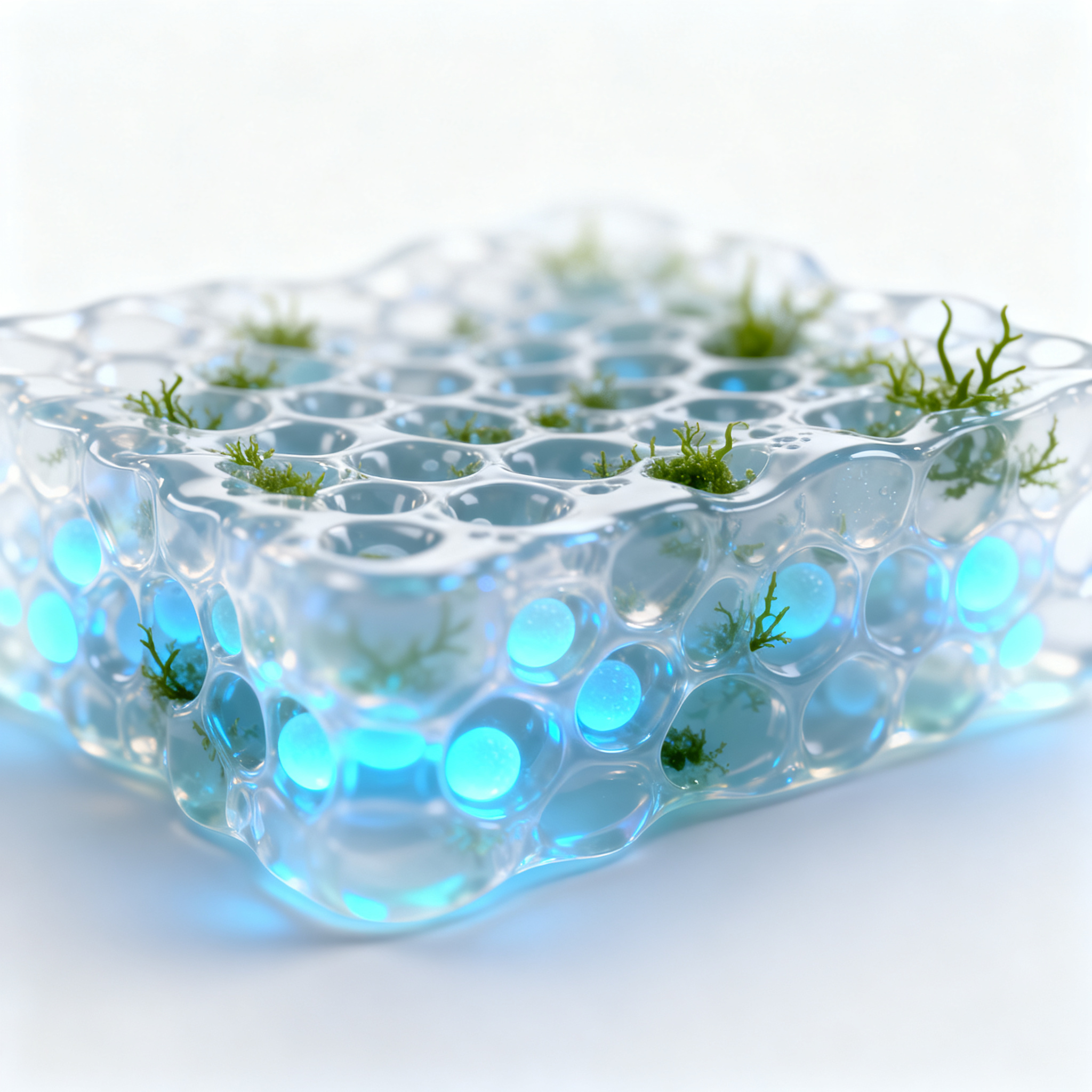
Bioluminescence is more than just a natural spectacle. Pyrocystis lunula, a marine dinoflagellate, produces flashes of blue light when disturbed. Researchers at the University of Colorado Boulder have 3D-printed structures containing these living algae, creating materials capable of emitting light on chemical command.
The crucial point is control. In nature, the flash lasts an instant and requires mechanical agitation. In the lab led by Wil V. Srubar III, light is activated by modifying the chemical environment around the cells. This makes the system repeatable: the algae maintained the ability to illuminate themselves through four consecutive weekly cycles.
- Pyrocystis lunula emits blue light when chemically stimulated
- Cells remain alive and functional inside 3D-printed structures
- Light can be reactivated for weeks without losing effectiveness
Bioluminescence works through an enzymatic reaction. Luciferin reacts with oxygen in the presence of luciferase, producing light without heat. In dinoflagellates, this mechanism is rapid and localized in specific organelles called scintillons.
Living sensors: the wireless alternative
*Bioactive materials can replace electronic sensors in environments where batteries and cables become an operational limitation.*
A traditional sensor requires power, electronics, data transmission. A living material that emits light communicates directly through a visible signal. No battery, no wiring, no electronic maintenance required.
The most plausible applications concern environmental monitoring and water quality. If Pyrocystis lunula reacts to specific chemical changes, a printed surface could light up in the presence of contaminants, pH changes, or biological stress. 3D geometry can be designed to channel liquids, expose cells to controlled flows, or separate zones sensitive to different stimuli.
The advantage over an electronic sensor is the direct biological response. The disadvantage is that a living material requires maintenance conditions: light, humidity, nutrients, adequate temperature. It is not a universal solution, but it may make sense in contexts where access is difficult and maintenance is impossible.
These materials do not replace LEDs or lamps. The amount of light produced is limited and operation requires controlled biological conditions. The value lies in the visual communication of environmental information, not in illumination.
From environment to message: how the process works
*The biochemical mechanism underlying bioluminescence allows living materials to translate external stimuli into repeatable light signals.*
3D printing organizes cells into a matrix. The bioink used at CU Boulder contains living algae dispersed in a hydrogel. Viscosity is regulated to maintain shape after extrusion without compromising cell viability. This balance is critical: too much rigidity kills cells, too much fluidity prevents structure construction.
Once printed, the material is kept in a controlled environment. The cells continue to live, breathe, and respond to stimuli. Chemical stimulation activates the enzymatic cascade that produces light. The signal is visible, localized, and can be repeated over time.
Activation process
- Print: Cells are deposited in a hydrogel matrix with controlled geometry.
- Maintenance: The material is nourished and maintained in stable biological conditions.
- Stimulation: A chemical trigger activates the bioluminescent reaction in living cells.
- Emission: Blue light is produced without heat and remains visible for the duration of the reaction.
The Living Materials Lab at CU Boulder has been working for years on materials that integrate living organisms. The goal is not to replicate biological functions with technology, but to directly use biology as a functional component.
Real applications: from structural monitoring to wearables
*Concrete use cases show where bioactive materials offer advantages over traditional technologies.*
Environmental monitoring is the most immediate direction. A printed material could be placed in a waterway, an industrial plant, or a remote environment. If it reacts to specific substances, light becomes a visual alarm without the need for electronics.
In soft robotics, biological sensors could be integrated into flexible surfaces. A submersible robot could use bioluminescent materials to signal operational conditions or structural damage. In space exploration, where weight and autonomy are critical, a self-sustaining biological system could make sense.
| Application | Biological advantage | Current limit |
|---|---|---|
| Water monitoring | Direct response to contaminants | Requires maintenance conditions |
| Soft robotics | Integration into flexible surfaces | Limited duration in extreme environments |
| Wearables | Battery-free visual reporting | Skin and sweat compatibility |
Functional living materials with conductive particles can also become part of bioelectronic circuits. Parallel research on 3D-printed mycelium has shown that biological growth can incorporate carbon nanoparticles, creating conductive networks after printing. This opens the door to hybrid sensors where biology and electronics coexist.
—
Living materials do not illuminate to be noticed, but to tell what is happening around them. Try to imagine a sensor that needs neither batteries nor maintenance: the future of sensing is already biological.
article written with the help of artificial intelligence systems
Q&A
What is Pyrocystis lunula and how is it used in the described materials?
Pyrocystis lunula is a marine bioluminescent dinoflagellate that produces flashes of blue light when stimulated. Researchers have incorporated it into a hydrogel-based bioink to 3D print living structures capable of emitting light on chemical command. The algae maintain the ability to light up for at least four consecutive weekly cycles.
What is the main advantage of a biological sensor over an electronic one?
A living material that emits light communicates directly through a visible signal, eliminating the need for batteries, wiring, and electronic maintenance. This makes it particularly useful in remote or hard-to-reach environments where traditional electronics are impractical or expensive to maintain.
How does the biochemical mechanism of bioluminescence work in these organisms?
Bioluminescence is based on an enzymatic reaction in which luciferin reacts with oxygen in the presence of luciferase, producing light without heat. In dinoflagellates this process is rapid and localized in specific organelles called scintillons, which allow localized and visible emission.
What are the main challenges in 3D printing living materials with algae?
The main challenge lies in balancing the viscosity of the bioink: too much rigidity kills the cells, while too much fluidity prevents maintaining the shape after extrusion. It is essential to find the optimal balance to preserve cell viability during and after the printing process.
In which application areas could these bioluminescent materials be most useful?
The most promising applications include environmental and water quality monitoring, soft underwater robotics, space exploration, and wearables. In all these cases the added value is autonomous visual signaling without the need for electrical power or wired data transmission.
Why can't these materials replace LEDs or traditional lamps?
The amount of light produced is limited and operation depends on controlled biological conditions such as light, humidity, nutrients, and adequate temperature. Their purpose is not to illuminate environments, but to visually communicate environmental information through direct biological signals.