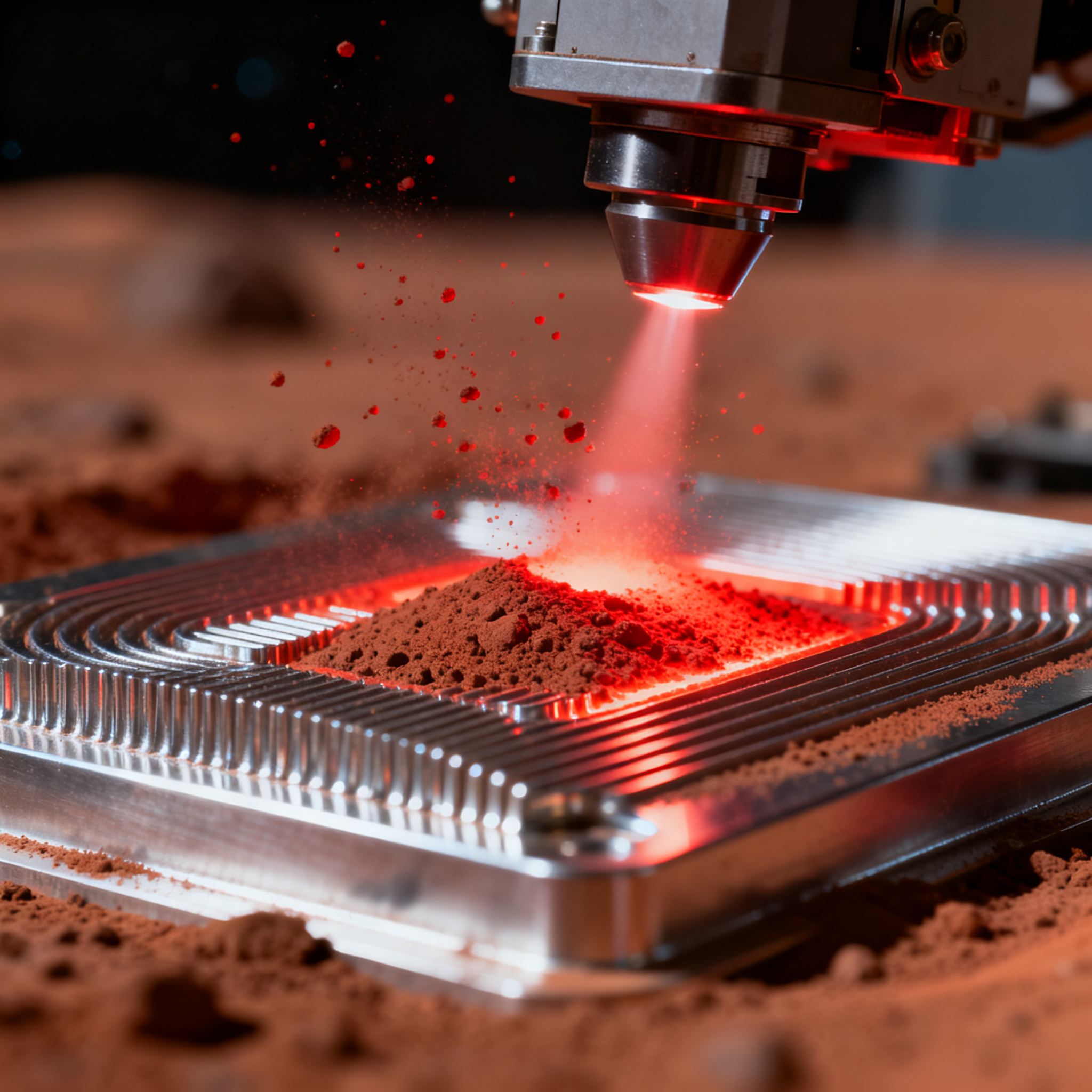
Can you really print on Mars?
The challenge of autonomous production on Mars requires concrete engineering solutions: here is how 3D printing could become the key to the sustainability of human missions.
There are no spare parts warehouses on Mars. Every broken tool, every worn-out component represents a critical problem for long-duration missions. Metal 3D printing offers a concrete answer: producing parts directly on the red planet, using local resources.
Washington State University has demonstrated that simulated Martian regolith can be mixed with titanium alloys to create resistant printed materials. These could become tools, structural components, or protective coatings. This is not science fiction: it is engineering applied to a real problem.
- Martian regolith mixed with titanium creates resistant printable materials
- Atmospheric CO2 can replace argon in metal printing processes
- In-situ production eliminates dependence on Earth-based supplies
- Earth-based tests are validating technologies for extreme environments
Martian materials: regolith and reactive alloys
The simulation of Martian materials such as regolith and the use of alloys like titanium allow for testing realistic solutions for in-situ construction in the laboratory.
Lunar regolith contains 90% of particles under 1,000 micrometers. This grain size makes it naturally compatible with powder bed printing techniques. On Mars, the situation is similar.
Researchers have demonstrated that mixing simulated regolith with titanium alloys produces printable materials with adequate mechanical properties. The process does not require exotic materials brought from Earth: it uses what is already available on the planet.
The European Space Agency is exploring how to convert lunar regolith into inks and powders for 3D printing. The project, led by the Danish Technological Institute with Metalysis, aims to create functional electronic systems directly on the Moon or Mars. Once oxygen is extracted from the regolith, a mixture of conductive metal alloys remains, usable for repairs and construction.
Martian atmosphere at the service of printing
Martian carbon dioxide can be used as an economical and sustainable alternative to noble gases in advanced printing systems.
Mars' atmosphere is composed of over 95% carbon dioxide. The University of Arkansas tested whether this CO2 could replace argon in laser metal melting printing. The results are promising.
Zane Mebruer and Professor Wan Shou used a powder bed laser system to print 316L stainless steel samples. They compared three environments: argon, CO2, and normal air. Argon gave the best results, but CO2 performed better than air.
| Environment | Superficial quality | Oxidation | Availability on Mars |
|---|---|---|---|
| Argon | Excellent | Minimum | None (imported) |
| CO₂ | Good | Moderate | 95% atmosphere |
| Air | Poor | High | Not present |
Bringing argon from Earth costs about 12,682 dollars per kilogram of launched cargo. Using local CO₂ eliminates this cost and the logistical complexity. It is not a perfect solution, but it opens up concrete possibilities.
The discovery has terrestrial implications as well. CO₂ is more economical and available than argon. For non-critical applications or experimental phases, it could become a valid alternative even on Earth.
Logistical autonomy: from spare parts to structure
The ability to produce critical components and architectural structures locally is fundamental for the sustainability of Martian bases.
A Martian mission cannot rely only on parts shipped from Earth. Tools break, parts wear out, equipment requires repairs. There is no traditional supply chain.
3D printing allows starting from a digital file and base material to obtain different forms. Instead of shipping thousands of spare parts, powders and production systems are sent. Common parts are printed when needed.
NASA has already tested polymer 3D printing systems on the International Space Station. ESA has experimented with metal printing in orbit. Redwire has developed solutions with regolith simulants. These projects demonstrate that space production is technically possible.
Applications go beyond spare parts. De-oxigenated regolith can create conductive inks for printed electronics. This means maintenance of planetary robots, electrical installations in habitats, communication networks.
Orbital debris represents a second source of material. About 9,500 tons of metal are currently orbiting Earth. Retired satellites and rocket stages could be captured, analyzed, and atomized into printable powder. NASA and ESA are exploring these recycling approaches.
Earth tests for extreme missions
Simulated terrestrial environments are demonstrating that 3D printing can work in conditions analogous to those on Mars.
Tests do not only occur in the laboratory. Purdue University has published a comprehensive review that identifies powder additive manufacturing as a viable strategy for building tools, habitats, and infrastructure in space.
Martian gravity is 38% of that on Earth. This influences dust distribution, molten metal behavior, and waste management. Martian dust is abrasive and infiltrates devices. Temperatures vary drastically.
Technical challenges to overcome
- Dust behavior: In microgravity, Van der Waals forces dominate, causing aggregation and clogging.
- Thermal control: Variations from -250°C to +250°C require advanced thermal management systems.
- Component quality: Mechanical testing, non-destructive controls, and adapted process standards are needed.
- Maintenance: Systems must be compact, robust, and repairable with limited resources.
The Chinese Academy of Sciences has conducted metal printing experiments in suborbital flight. The ESA installed a metal printer on the International Space Station in 2024, producing samples in prolonged microgravity. Re:3D is developing the GigabotXS, a compact printer that recycles packaging materials into new objects printed in space.
These tests demonstrate that the technology works. Continuous production, integration with orbital platforms, and certification of components for critical applications remain to be addressed.
From theory to the Martian reality
3D printing on Mars is no longer a futuristic concept. It is a technology in the process of concrete validation. Researchers have demonstrated that the CO₂ atmosphere can support laser melting of metals. Regolith can become a building material. Systems can operate in extreme conditions.
No one will install printers on Mars tomorrow. Human missions are expected in the 2040s. But when they arrive, they will need to produce and repair on site. 3D printing offers that capability.
The next steps require complete three-dimensional components, in-depth mechanical testing, and trials with different metal alloys. It is necessary to design machines specific for the Martian environment, not adaptations of terrestrial systems. Certification is needed to know which parts can be used and where.
Space production will arise from the integration of many technologies. 3D printing is one of these, but fundamental. Studying how it works on Mars also improves understanding of processes on Earth.
Discover how laboratories are already testing concrete solutions to bring additive production to Mars.
article written with the help of artificial intelligence systems
Q&A
How can Martian regolith be used for 3D printing?
Simulated Martian regolith can be mixed with titanium alloys to create printable materials with adequate mechanical properties. This process exploits local resources without requiring exotic materials from Earth. The resulting materials can be used for tools, structural components, or protective coatings.
Why is Martian CO₂ important for metal printing processes?
The Martian atmosphere is composed of over 95% carbon dioxide, which can replace argon as a process gas in laser fusion metal printing. Although argon offers better results, local CO₂ eliminates transportation costs (approximately $12,682/kg) and logistical complexities. This discovery also has implications on Earth, offering an economical alternative for non-critical applications.
What is the main advantage of in-situ production on Mars compared to Earth supplies?
In-situ production eliminates dependence on Earth supplies, which is essential because there are no spare parts warehouses on Mars. Every broken tool or worn component would represent a critical problem for long-duration missions. Printing parts directly on the planet reduces the need to ship thousands of spare parts, limiting shipments to powders and production systems.
What are the main technical challenges for 3D printing in a Martian environment?
Martian gravity, equal to 38% of Earth's gravity, influences powder distribution and molten metal behavior. Extreme temperatures, ranging from -250°C to +250°C, require advanced thermal management systems, while abrasive dust risks infiltrating devices. Furthermore, in microgravity, Van der Waals forces cause powder aggregation and clogging.
Besides mechanical spare parts, what other applications can 3D printing have on Mars?
De-oxygenated regolith can be transformed into conductive inks to create printed electronics, useful for robot maintenance, electrical installations in habitats, and communication networks. Furthermore, the technology enables the production of architectural structures and infrastructure directly on the planet. Even orbital debris could be recycled as a source of printable material.