
Jinqi Toys takes Snapmaker U1s to 2,300: the economics of multicolor printing changes with independent toolheads
The Chinese manufacturer of 3D-printed toys has built one of the largest desktop print farms dedicated to color. The case shows how hardware architecture can reduce waste and time in serial multicolor production.
Jinqi Toys, a Chinese company specializing in toys and decorative objects made with 3D printing, said it has reached about 2,300 Snapmaker U1 printers in its production equipment dedicated to multicolor. The case was analyzed by 3D Printing Industry on October 14, 2026, based on a Snapmaker case study and information released by the Chinese platform Nanjixiong.
The relevant figure is not just the size of the farm. It is the economic impact of a different color-change architecture on waste, cycle times, and product range.
- Jinqi Toys operates about 2,300 Snapmaker U1s for serial multicolor production
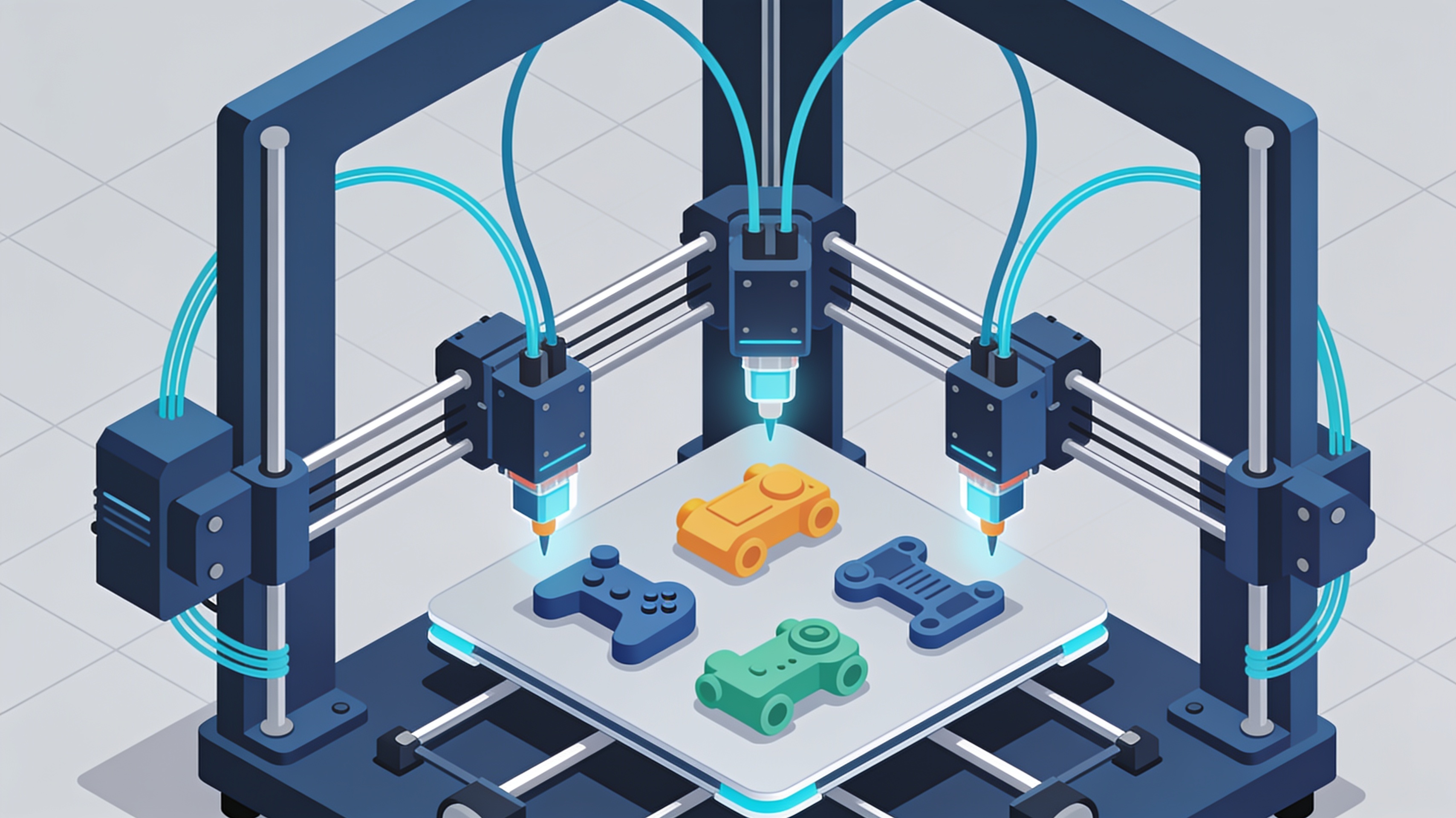
- The printer uses four independent toolheads instead of a single nozzle with filament changing
- The company reports a drastic reduction in purge waste compared with the previous system
- Color change takes about five seconds versus the longer times of single-nozzle systems
The waste problem in FFF multicolor printing
Many multicolor FFF systems use a single nozzle fed by different filaments. Each color change generates purge material that, in serial production, becomes a significant cost item.
Most multicolor FFF printers use a single print head. When the color changes, the machine must expel the material present in the extrusion path to avoid contamination.
For an occasional prototype, the waste is acceptable. In a farm that runs thousands of prints, each color change is repeated across numerous objects and becomes a significant cost.
Jinqi Toys reports having previously managed about 300 single-nozzle printers. According to manager Zeng Hao, in some jobs the purge material would have exceeded the mass of the finished product.
According to the company, the statement about waste refers to specific jobs; it is not a documented average percentage for all FFF printers.
The four independent head architecture of the Snapmaker U1
The Snapmaker U1 uses four separate print heads, each with its own filament. Color change becomes selecting a different head, without replacing material in the extrusion path.
The machine selects a different head and continues the job with the corresponding material. Snapmaker reports a change time on the order of five seconds in its own tests.
The advantage is not only in reducing waste. It is also in the machine time saved, which in a farm of 2,300 units multiplies for every production cycle.
The ecosystem is also built outside the company
Snapmaker has launched the $150,000 Innovation Fund to fund community projects. The first phase selected twenty proposals out of 109 applications received.
The fund aims to encourage user-developed accessories, hardware improvements, and software tools. The initiative was covered by the specialized press on October 15, 2026.
109 applications were received, and 67 proposals passed an initial evaluation. The projects involve firmware, slicing, filament management, and hardware accessories.
| Parameter | Single-nozzle system | Snapmaker U1 (4 heads) |
|---|---|---|
| Color change | Material purge | Head selection |
| Change time | Variable (longer) | ~5 seconds |
| Declared waste | Up to exceeding part mass | Drastic reduction |
What it means for the desktop market
A desktop printer no longer competes only on speed or precision. The economics of multicolor serial production depend on the hardware architecture and the support ecosystem.
A lab may need a guide for a particular material, an interface with enterprise software, or a device that simplifies recurring maintenance. The presence of an organized community reduces the distance between problem and solution.
Financial contribution does not automatically turn an amateur project into an industrial product. However, it can help the author cover prototyping, testing, and documentation costs.
The Jinqi Toys case shows that the desktop market can scale toward serial production when the hardware architecture reduces variable costs per part. The choice of 2,300 identical machines is not just a matter of volume: it is a bet on a different economic model for multicolor printing.
article written with the help of artificial intelligence systems
Q&A
How many Snapmaker U1 printers has Jinqi Toys installed?
Jinqi Toys stated it has reached about 2,300 Snapmaker U1 printers in its production setup dedicated to multicolor. This is one of the largest desktop print farms dedicated to color. The figure was shared through a Snapmaker case study and the Chinese platform Nanjixiong.
Why does the four independent heads system reduce waste compared with a single nozzle?
With a single head, every color change requires purging material in the extrusion path, generating waste. The Snapmaker U1 instead selects a different head already loaded with the correct filament, without replacing material. This eliminates the main source of waste in serial multicolor production.
How long does a color change take on the Snapmaker U1?
Snapmaker indicates a color change time of around five seconds. This figure is clearly lower than the typical times of single-nozzle systems with filament changing. This affects cycle times in serial production.
What were the problems with Jinqi Toys' previous farm of 300 printers?
Jinqi Toys previously operated about 300 single-nozzle printers. According to manager Zeng Hao, in some jobs the purge material could exceed the mass of the finished product. This is a statement referring to particular processes, not a documented average percentage.
Who analyzed the Jinqi Toys case and when?
The case was analyzed by 3D Printing Industry on October 14, 2026. The analysis is based on a Snapmaker case study and information shared by the Chinese platform Nanjixiong. The focus is the economic impact of the independent-heads architecture on waste, cycle times, and product range.


