
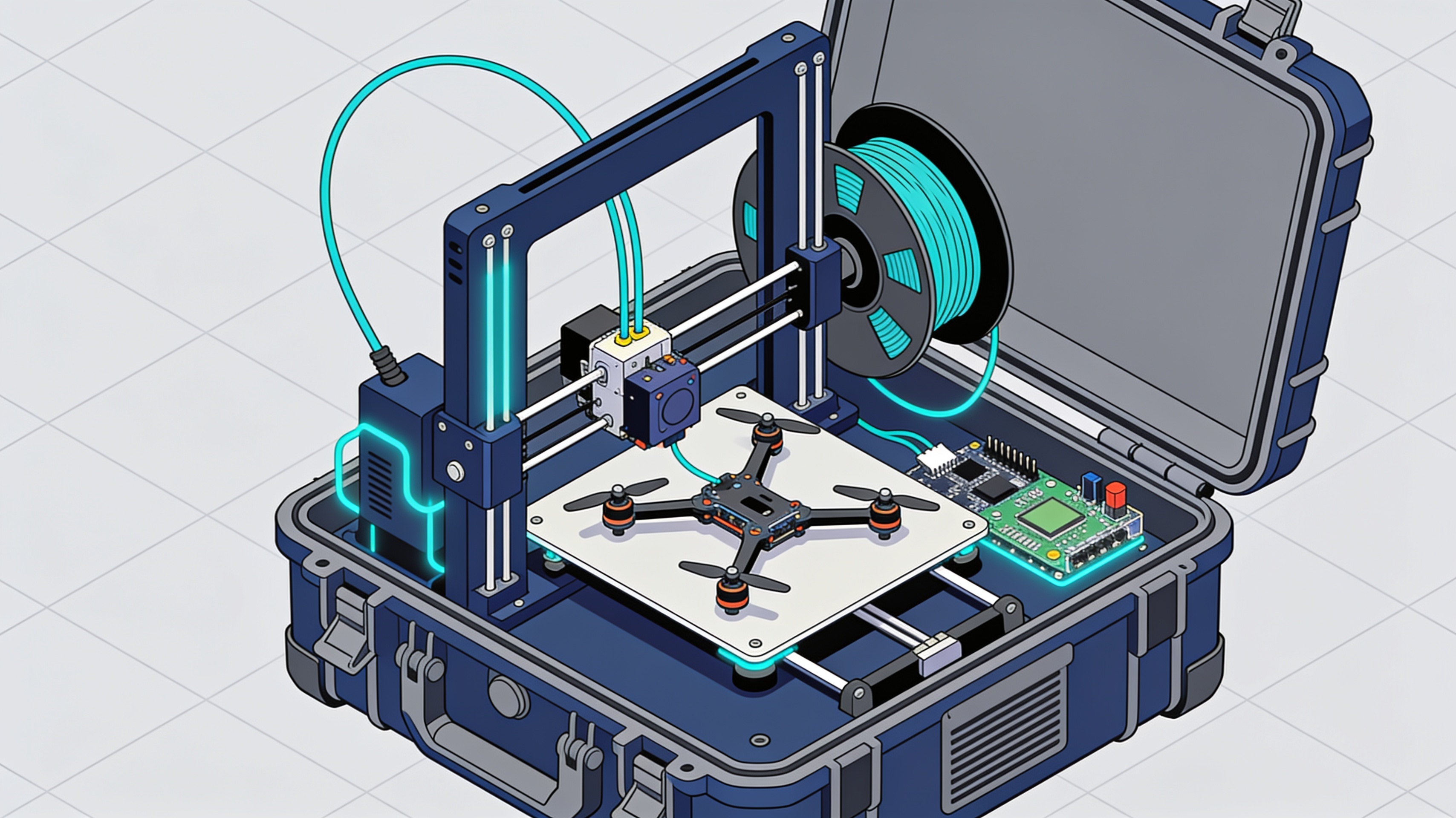
DropForce bets on distributed production and mobile factories for 3D-printed drones
The Austrian startup proposes transportable production units to manufacture structural drone components near the point of use. The model combines local 3D printing with external supplies of electronics and subsystems.
DropForce has presented an approach to additive manufacturing that shifts the focus from the finished product to industrial organization. The company does not sell individual printers, but mobile production systems designed for sensitive applications, including the defense sector.
The project was analyzed by 3DPrint.com on October 15, 2026. The analysis emphasizes the need to assess the difference between declared capabilities and actually verified production.
- DropForce proposes mobile factories to print structural drone components on site
- The hybrid model combines printed parts with electronics and subsystems supplied separately
- Configurations range from transportable cases (Tactical Case) to equipped containers
- 3D printing covers only part of the system: motors, batteries, and sensors remain external supplies
From product to production service
DropForce shifts the focus from the individual machine to the organization of transportable production units, proposing a distributed manufacturing model.
Most news about 3D-printed drones focuses on the aircraft: weight, range, frame geometry. DropForce changes perspective and proposes printing and assembly systems that are transportable in compact logistics units.
The goal is to reduce dependence on shipping complete structures from a single facility. If some parts are produced locally and combined with purchased components, the supply chain becomes more flexible.
The same logic has been applied in other sectors, from industrial maintenance to spare parts for specialized vehicles. For drones, however, it introduces specific issues of quality, assembly, and liability.
The proposed configurations
The company describes several production solutions, from the hand-transportable Tactical Case to structures mounted on vehicles or containers.
The Tactical Case is a ruggedized case transportable by one person, designed for distributed drone production. It represents the most compact configuration of the system.
The larger structures are mounted on vehicles or in containers. The commercial documentation associates these configurations with theoretical capacities of numerous drones per day, varying according to the scale of the facility.
The figures declared by the company must be interpreted with caution, considering the difference between theoretical capacities and production actually verified in the field.
The limits of additive manufacturing
A drone comprises much more than a printed frame. Most critical subsystems require external supplies and their own verification procedures.
3D printing can produce enclosures, supports, and load-bearing structures. However, it does not make the entire system manufacturable from undifferentiated raw materials.
Motors, batteries, sensors, control electronics, and communications require separate supply chains. The distributed model therefore combines printed components with commercial parts or parts supplied in kits.
It is a hybrid industrial system. The availability of non-printed components remains decisive: a facility with numerous printers cannot replace the supply of batteries or electronic devices needed for assembly.
Implications for distributed manufacturing
The project raises relevant questions for the evolution of additive manufacturing: from logistics to quality control, to liability for finished products.
Distributed production reduces delivery times and dependence on individual plants. However, it introduces complexity in quality management and component traceability.
Each production site must ensure uniform standards. The variability of 3D printing processes makes this challenge particularly critical for sensitive applications such as defense.
The model proposed by DropForce represents a significant test for the maturity of additive manufacturing. The ability to maintain consistent quality in distributed contexts will determine the success of this industrial approach.
article written with the help of artificial intelligence systems
Q&A
What does DropForce concretely propose in the additive manufacturing sector?
DropForce does not sell individual printers, but mobile production systems designed to manufacture structural drone components near the place of use. The model is designed for sensitive applications, including the defense sector.
What production configurations does DropForce describe?
Configurations range from the Tactical Case, a ruggedized case transportable by one person, to larger structures mounted on vehicles or in equipped containers. The scale of the facility determines the stated production capabilities.
Does 3D printing cover the entire drone produced by DropForce?
No, 3D printing covers only part of the system. Motors, batteries, sensors, and electronics remain external supplies that are combined with locally printed parts.
Why is DropForce's model defined as hybrid?
The model is hybrid because it combines structural parts printed in 3D locally with electronics and subsystems purchased from external suppliers. This reduces dependence on shipping complete structures from a single facility.
What aspects should be evaluated according to the 3DPrint.com analysis of October 15, 2026?
The analysis emphasizes the need to distinguish between capabilities declared by the company and production actually verified. Commercial numbers, such as drones per day, should be interpreted with caution based on the scale of the facility.


