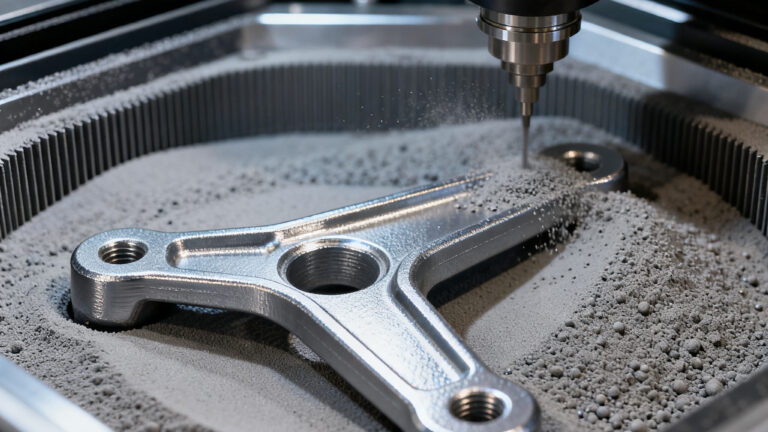
Settore Industriale: Manufacturing

Implementing Industrial Adoption of 3D Printing in Non-Traditional Sectors

Implementing Industrial Adoption of 3D Printing in Non-Traditional Sectors

Industrial adoption of 3D printing in non-traditional sectors, such as automation, robotics, and energy infrastructure, is growing thanks to structured operational plans. By integrating digital design, simulations, and rapid production, companies like Boston Dynamics and Siemens are optimizing products and processes, reducing costs, times, and the number of components.

Large-Scale Customization and Retail Integration: How the New Production Model Really Works

Large-Scale Customization and Retail Integration: How the New Production Model Really Works

The convergence between additive manufacturing and retail is redefining custom production, extending it from consumer goods to industrial sectors. Thanks to 3D printing, it is possible to produce multiple variants without additional costs, while artificial intelligence manages design complexity. Retail points are transforming into production and data collection nodes, enabling personalization

How Large-Scale Directed Energy Deposition Works: Advanced Melt Pool Control and Precision in Deposition

How Large-Scale Directed Energy Deposition Works: Advanced Melt Pool Control and Precision in Deposition

Large-scale Directed Energy Deposition utilizes real-time melt pool monitoring, targeted deposition, and dynamic modeling to ensure precision, metallurgical quality, and thermal control during the production and repair of large metal components.

Industrial Build Preparation Automation: The Concrete Plan to Reduce Errors and Times

Industrial Build Preparation Automation: The Concrete Plan to Reduce Errors and Times

Automation of build preparation in additive manufacturing reduces errors and time through standardized and repeatable processes. Solutions like AMIS Runtime enable intelligent nesting and continuous optimization, increasing density and production flexibility. Benefits include fewer human errors, greater machine efficiency, and cost reduction. Integration requires val

Modern Slicer Architectures: How Technical Debt Affects the Future of 3D Printing

Modern Slicer Architectures: How Technical Debt Affects the Future of 3D Printing

preFlight is a new open source slicer that renews the traditional architecture to improve precision, stability, and the management of technical debt accumulated in legacy slicers like PrusaSlicer. Designed with modern standards, it supports 64-bit pipelines, updated libraries, and innovations like Athena Perimeter Generator and Interlocking Perimeters, aiming for greater reliability and performance in the

New Era for Formlabs: Leadership Change with Entry of Rob Willett

New Era for Formlabs: Leadership Change with Entry of Rob Willett

Formlabs announces a leadership change with Rob Willett joining the board, while Carl Bass leaves after eight years. Willett, former CEO of Cognex, brings expertise in automation and machine vision, marking a strategic shift for the company aiming to expand its influence in professional additive manufacturing and prepare for a potential IPO.

Real-Time Intelligent Control: How AI Optimizes Industrial 3D Printing

Real-Time Intelligent Control: How AI Optimizes Industrial 3D Printing

Artificial intelligence is revolutionizing industrial 3D printing, enabling real-time controls, automatic corrections, and waste reduction. Through advanced sensing and predictive models, AI systems monitor and optimize parameters such as temperature and speed, improving production quality, efficiency, and reliability.

Additive Manufacturing and Digital Twin: How 3D Printing is Redefining the Digital Industrial Ecosystem

Additive Manufacturing and Digital Twin: How 3D Printing is Redefining the Digital Industrial Ecosystem

The integration between additive manufacturing and digital twin is revolutionizing the industry, enabling the transformation of virtual models into optimized physical components. This synergy reduces development times and costs, improves production efficiency, and allows for continuous innovation in sectors such as aerospace and energy.

Large-Scale Additive Manufacturing: Operational Playbook for Industry

Large Scale Additive Manufacturing: Operational Playbook for the Industry

Industrial 3D printing is a reality: it requires gradual integration, advanced materials, digital workflows, and measured ROI to scale successfully.

3D Scanning: How the Technology that Transforms Reality into Digital Actually Works

3D Scanning: How the Technology that Transforms Reality into Digital Actually Works

3D scanning transforms real objects into editable and printable digital models, accelerating reverse engineering and production with precision up to 50 µm.

How Software is Redefining Value in Additive Hardware

How Software is Redefining Value in Additive Hardware

How Software is Redefining Value in Additive Hardware In the 3D printing industry, it's no longer the hardware that makes the difference, but the software that makes it intelligent. While the technical specifications of macch…

How 3D Printing Transforms Product Innovation: Speed, Materials, and Digital Collaboration

How 3D Printing Transforms Product Innovation: Speed, Materials, and Digital Collaboration

How 3D Printing Transforms Product Innovation: Speed, Materials, and Digital Collaboration 3D printing is not just an emerging technology: it is a tool that is redefining the early stages of innovation in...

/