
How to Redesign Industrial Production of Metal AM: An Operational Playbook for Scalability and Efficiency
The real challenge of metal AM at scale is not the printer, but building an integrated production system that minimizes every physical movement and operational delay. Factories that achieve superior results do not improve individual processes, but redesign the entire production architecture as a single machine coordinated by a common layer of intelligence.
From Additive Printing to the Integrated Production Line
The traditional model treats the factory as a set of discrete operations: additive in one section, machining elsewhere, heat treatments and metrology often in separate facilities. This fragmented approach represents the real limit to scalability.
Industrial metal production still retains the logic of a previous era. Most factories operate as a collection of isolated disciplines, each with its own machinery, personnel, and data. Every time a component is moved, re-fixtured, or transferred between isolated departments, the distance traveled adds costs, variability, and delays.
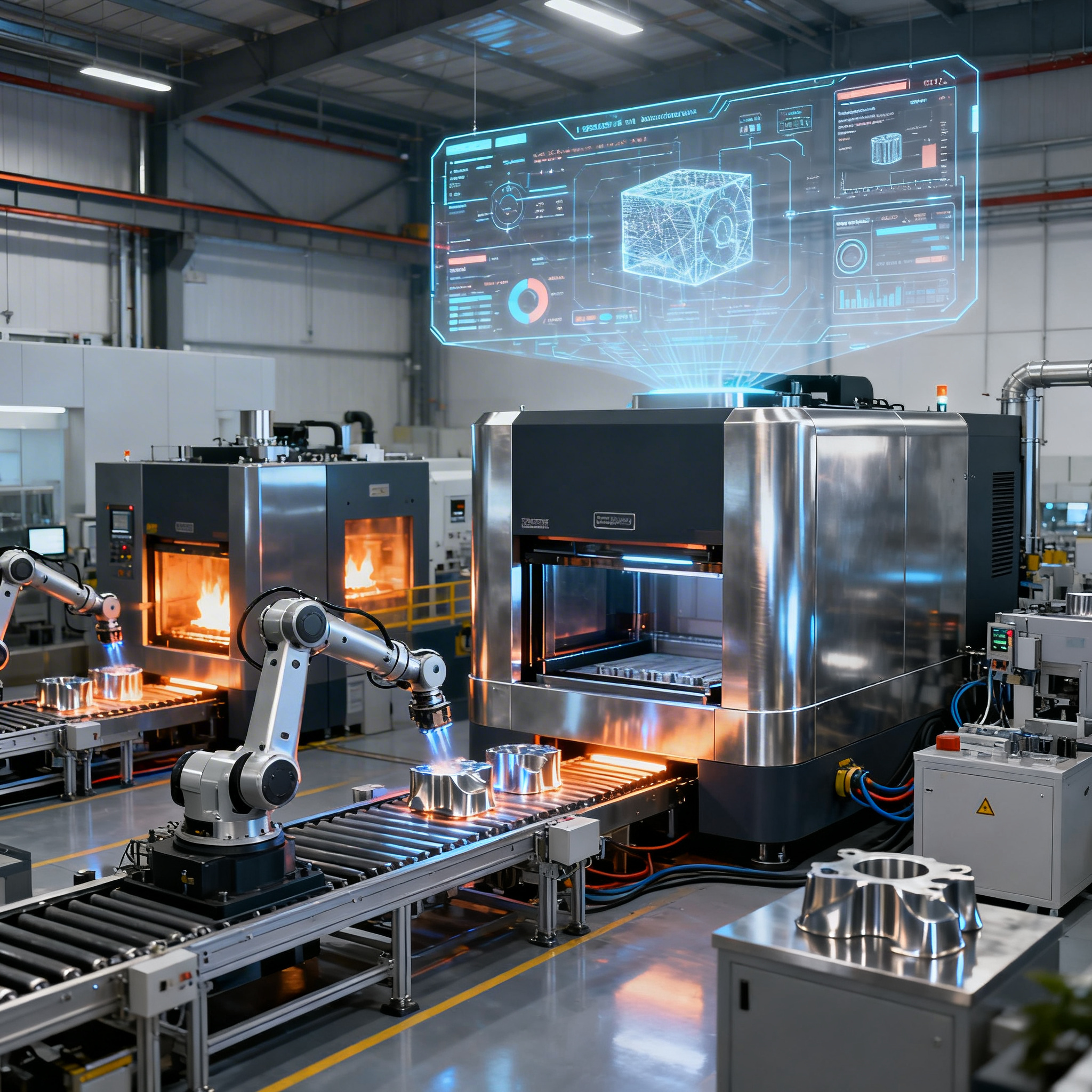
An alternative model is emerging in advanced metal production: environments that behave like a single integrated machine. Additive, machining, heat treatments, inspection, automation, and data systems are connected in a coordinated framework that operates from a shared layer of intelligence. The bottleneck is no longer the capacity of a single tool, but the physical and operational distance between them.
Factories that outperform competitors are those that shorten this distance, consolidate steps, and design flows where matter and energy follow the most direct path possible. Even well-managed operations reach a structural limit: every handoff introduces latency and variation, data remains trapped in local processes, and optimization focuses on individual steps instead of the entire chain.
Minimizing Physical Movements: Layout and Automation
Every manual movement represents a measurable loss of time and quality; intelligent automation enables the near-total elimination of unnecessary movements through redesigned physical layouts.
The application of metal AM for advanced tooling components concretely demonstrates these principles. When K-Rain adopted Xact Metal's XM200G system to produce mold inserts for underground sprinklers, it achieved significant reductions in cycle times not only by improving printing technology, but by rethinking the entire production flow of the component.
Competitive advantage derives from the ability to handle part families with stabilized designs, fixed parameter sets, and tight control of material supply. Additive manufacturing functions as a specialized production path within a broader manufacturing system, not as a generic alternative. Where performance advantages were marginal or achievable by optimizing conventional processes, adoption tended to stall; where gains were structural, additive persisted despite greater complexity and cost.
Automation must eliminate the need for manual handling between processes. Multi-robot systems such as Medusa, developed by Lincoln Electric with Oak Ridge National Laboratory, demonstrate how to coordinate three robots with high-deposition welding technology to print up to 45 kg of metal per hour, integrating materials, software, printing, machining, and inspection into a single workflow.
Convergence between Data and Process: Operational Intelligence
A common information system enables continuous monitoring and predictive control: data do not remain isolated within individual processes but inform upstream and downstream decisions in real time.
Qualification of AM processes for safety-critical components requires definition of process windows (laser/electron parameters, scanning strategies, orientations), controls on powder morphology and chemistry, post-process treatments and their impact on microstructure, inspections with acceptance criteria, and mechanical tests consistent with service conditions.
The goal of including superalloy and process qualifications within the MMPDS (Metallic Materials Properties Development and Standardization) perimeter reduces the risk of project-by-project reinterpretations and accelerates industrial scalability. The availability of accepted methods and datasets makes requirements, responsibilities, and verification criteria clearer along the supply chain.
Solutions such as PIP (Profilometry-based Indentation Plastometry) characterization according to ASTM standards make it possible to monitor the intrinsic variability of the process directly on parts, traceably document local mechanical properties, and build models based on real data rather than conservative assumptions. This favors the transition from quality control strategies based almost exclusively on destructive testing to a hybrid model where local non-destructive tests, digital data, and numerical models combine to build a digital twin that more closely matches real behavior.
Heat Treatments and Post-Processing: Uninterrupted Flows
Treatments must be an integral part of the production cycle, not distinct phases managed in separate facilities, to ensure operational continuity and complete traceability of the component.
The ESAM (Electroslag Additive Manufacturing) process developed by Oak Ridge National Laboratory with ARC Specialties demonstrates how to combine electroslag strip cladding with wire arc additive manufacturing to achieve deposition rates several times higher than conventional processes, while maintaining mechanical properties comparable to cast material.
The multi-process convergent approach couples the high productivity of ESC with the geometric control of WAAM: containment walls built with GTAW are filled with ESC deposition. Microstructural analysis showed strong ⟨001⟩ texture in the build direction, with iron dilution from the steel substrate confined to the first deposited layer.
The stacking strategy directly influences properties: direct stacking produces slightly higher yield strength and tensile strength, while staggered stacking results in significantly greater ductility. These differences mainly arise from variations in iron distribution and grain morphology, highlighting how heat treatments and deposition strategies must be designed together, not separately.
Integrated Metrology: Real-Time Quality
Embedding measurement systems directly into the production flow enables immediate feedback, reduced scrap, and in-process corrections instead of post-production inspections.
In regulated production environments, additive manufacturing faces increasing safety and liability exposure requirements. This shift is most visible in aerospace, medical devices, and energy sectors, where production adoption has been driven by application-specific performance requirements rather than general improvements in machine capability.
The industrial response has been to narrow scope and stabilize variables: AM is introduced for clearly defined part families, with frozen designs, fixed parameter sets, and tightly controlled material supply. Production volumes remain limited, but predictability improves.
Integrated metrology must support continuous process qualification through checks on density, porosity, lack-of-fusion, cracks, and NDT where applicable. Mechanical testing must be consistent with service (tensile, fatigue, creep/rupture, oxidation/corrosion) and, when aiming for design “allowables,” data collection must be in quantities and formats compatible with industry databases and handbooks.
Integrating measurement systems into the production flow makes it possible to move from post-production sample inspections to continuous monitoring that informs real-time operational decisions, reducing scrap and enabling corrections before defects propagate through the entire chain.
The Future Is in Integration, Not in Individual Technologies
The future of industrial metal AM lies not in the capabilities of individual machines, but in the seamless integration of all production processes into a single intelligent architecture that eliminates physical distances and information delays.
The emerging model replaces fragmentation with a tightly connected production architecture where each step functions as a subsystem of a larger machine. Additive and subtractive processes share a common data layer that is continuously updated, thermal behavior is predicted and integrated into the flow, and metrology provides immediate feedback.
Now evaluate your production layout: where can you eliminate a physical movement or an information delay? The answer to this question will determine your competitiveness in the coming years of industrial metal additive manufacturing.
article written with the help of artificial intelligence systems
Q&A
What is the real challenge to scaling industrial production with metal AM?
The real challenge is not the printer, but building an integrated production system that minimizes physical movements and operational delays. Winning factories redesign the entire production architecture as a single machine coordinated by a common layer of intelligence.
How can automation contribute to improving efficiency in metal AM production?
Smart automation almost completely eliminates unnecessary manual movements thanks to redesigned physical layouts. This reduces time, errors and variability, enabling continuous and more efficient production flows.
Why is it important to integrate heat treatments and post-processing into the production flow?
Integrating these processes avoids interruptions, ensures operational continuity and complete traceability. It also allows simultaneous optimization of mechanical properties and component geometry.
How do data influence the efficiency of industrial additive manufacturing?
A common information system enables continuous monitoring, predictive control and data integration between all processes. This allows real-time decisions and more consistent, traceable quality.
What makes an integrated approach winning compared to separate processes in metal AM production?
The integrated approach reduces physical and operational distances between processes, decreases latency and variability, and enables global rather than local optimizations. The result is a faster, more predictable and scalable production chain.


