
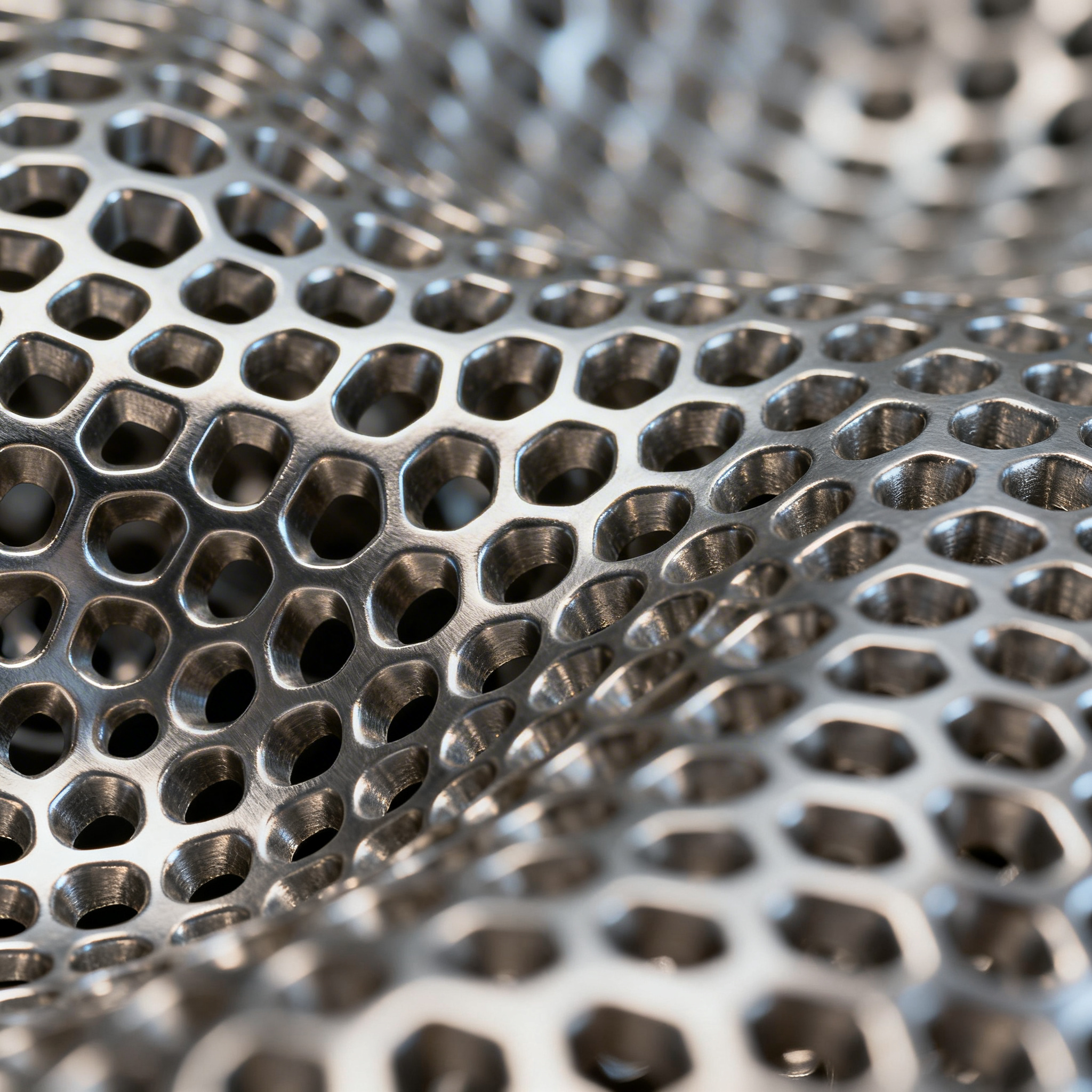
How Energy-Absorbing Metamaterials Are Revolutionizing Structural Safety
Thanks to a geometric design inspired by nature, titanium metamaterials can absorb energy more efficiently and predictably than traditional metallic materials. These bio-inspired lattice structures, produced by 3D printing with Selective Laser Melting (SLM) technology, combine low density and high specific strength, offering a stable stress plateau during deformation – a key characteristic for energy absorption applications in industrial, aerospace, and automotive fields.
Mechanical metamaterials represent a class of engineered structures in which geometry matters as much as or more than the base material: by modifying unit cells, thicknesses, and porosity, unusual combinations of stiffness, strength, toughness, and energy absorption capacity are obtained. In the case of titanium metamaterials, the key lies in the adoption of hierarchical lattices and internal gradients that distribute stresses uniformly, reducing stress concentration points and delaying localized failure.
Definition and Principles of Energy-Absorbing Metamaterials
Mechanical metamaterials are structures in which the engineered geometry affects macroscopic properties as much as chemical composition, making it possible to maximize absorbed energy per unit mass while maintaining strength and response stability.
Mechanical metamaterials differ from conventional materials because their performance derives mainly from the internal microstructure – the geometric architecture – rather than from chemical composition alone. In titanium energy-absorbing metamaterials, design focuses on maximizing specific energy absorption (energy absorbed per unit mass), while maintaining good strength and stability of mechanical response.
Recent studies on bio-inspired metallic metamaterials show that, by integrating material design and geometric architecture, very high specific absorption values can be achieved, with significant increases compared with traditional metallic lattices of similar porosity. The relative yield strength increases markedly, while stress oscillations during the plateau are reduced, making the mechanical response more predictable and suitable for components that must absorb repeated impacts without sudden collapse.
Bio-Inspired Geometries: The Key to Structural Optimization
Bio-inspired titanium structures adopt hierarchical lattices that imitate natural geometries such as lightweight skeletons and bone structures, distributing stresses uniformly and delaying localized failure.
The lattice architectures of titanium metamaterials imitate geometries found in nature, such as lightweight skeletons and bone structures, which over time have evolved optimal solutions for combining lightness and mechanical strength. These bio-inspired lattices incorporate internal gradients and structural hierarchies that distribute stresses more uniformly than conventional metallic structures.
Instead of collapsing abruptly under load, these cells deform progressively, offering a more stable stress plateau during compression. This characteristic is ideal for impact-resistant elements, crash boxes, and protective devices, where predictability of mechanical behavior is crucial to ensuring safety. The ability to control the failure mode through geometry represents a fundamental advantage over traditional metallic materials, which tend to exhibit localized and unpredictable failures.
The SLM Process: Enabling Geometric Complexity
Selective Laser Melting technology makes it possible to create complex lattices with thin walls and controlled porosity, impossible to achieve with subtractive or traditional casting techniques, optimizing shape and performance.
SLM 3D printing of titanium represents the enabling technology for the production of energy-absorbing metamaterials. This additive process makes it possible to create complex lattices with thin walls and controlled porosity, geometries that are impossible to achieve with subtractive techniques (milling, turning) or traditional casting.
The ability to print complex internal structures makes it possible to introduce density gradients – with denser areas alternating with lighter areas – and bio-inspired geometries that optimize stress distribution. The precise control of the microstructure offered by SLM technology allows designers to directly translate into physical components the architectures optimized through computational simulation, without the constraints imposed by conventional manufacturing processes.
Titanium: A Strategic Material for High Specific Strength
Titanium offers high specific strength (strength-to-weight ratio) and ductility, properties that make it ideal for structural applications with high energy absorption where lightness is critical.
Titanium is the material of choice for energy-absorbing metamaterials thanks to its unique combination of properties. High specific strength – the ratio of mechanical strength to density – makes it possible to create lightweight structures capable of withstanding significant loads. This characteristic is particularly important in aerospace and automotive applications, where every gram saved translates into performance and economic advantages.
The ductility of titanium also allows lattice structures to deform progressively without brittle fractures, contributing to controlled behavior during energy absorption. When combined with bio-inspired geometries achievable through SLM, titanium makes it possible to obtain metamaterials that offer low density, high specific strength, and a stable stress plateau during deformation – qualities essential for energy absorption applications.
Controlled Deformation Mechanisms and Stress Plateau
The designed geometry induces progressive and controlled deformation of the lattice cells, extending the stress plateau and increasing the total energy absorbed before structural collapse.
The mechanical behavior of titanium metamaterials under load is distinguished by the presence of a prolonged and stable stress plateau. During compression, the lattice cells deform in a controlled sequence rather than collapsing simultaneously, distributing energy absorption over time and space within the structure.
This progressive deformation mechanism is made possible by the bio-inspired geometry, which eliminates or reduces the stress concentration points typical of conventional structures. Hierarchical lattices and internal gradients guide the propagation of deformation along predefined paths, delaying localized failure and maximizing the energy absorbed before final collapse. The result is a more predictable and reliable mechanical response, an essential characteristic for safety components that must ensure consistent performance under critical conditions.
Comparison with Traditional Metallic Materials
Titanium metamaterials offer significantly higher energy absorbed per unit mass compared with conventional metal alloys with similar porosity, with more predictable and stable mechanical behavior.
The direct comparison between bio-inspired titanium metamaterials and traditional metallic structures highlights substantial advantages in terms of energy performance. Studies show significant increases in specific energy absorption compared with conventional metal lattices with comparable porosity, achieved through the joint optimization of material and architecture.
The relative yield strength of bio-inspired metamaterials is noticeably higher, while stress oscillations during the plateau are drastically reduced. This greater stability makes the mechanical response more predictable, eliminating the erratic behaviors typical of some traditional metallic structures. For critical applications such as impact-absorbing elements, crash boxes, and protective devices, this predictability translates into greater reliability and safety, allowing designers to size components with greater precision and confidence.
Conclusion
Titanium metamaterials represent an advanced solution for engineering applications where controlled energy absorption is crucial. The combination of bio-inspired geometries, SLM technology, and the intrinsic properties of titanium offers superior performance compared with conventional metallic materials, with advantages in terms of energy absorbed per unit mass, predictability of mechanical behavior, and the possibility of customizing structural characteristics.
Discover how to integrate these materials into your structural designs to improve safety and energy performance. The adoption of titanium energy-absorbing metamaterials can represent a significant competitive advantage in sectors where lightness, strength, and reliability are fundamental requirements.
article written with the help of artificial intelligence systems
Q&A
What are the main characteristics of titanium-based energy-absorbing metamaterials?
Titanium metamaterials have low density, high specific strength, and a stable stress plateau during deformation. These features make them ideal for applications requiring efficient and predictable energy absorption.
How does bio-inspired geometry affect the performance of these metamaterials?
Bio-inspired geometry, which mimics natural structures such as skeletons and bones, distributes stresses homogeneously and delays localized failure. This allows for progressive and controlled deformation, improving the predictability of mechanical behavior.
Why is SLM technology fundamental in the production of these metamaterials?
Selective Laser Melting (SLM) technology enables the creation of complex lattice structures with thin thicknesses and controlled porosity, which are impossible to achieve with traditional methods. This allows optimization of both shape and mechanical performance of components.
What advantages does titanium offer compared to other metallic materials in energy-absorbing metamaterials?
Titanium has high specific strength and ductility, making it ideal for lightweight yet strong applications. Combined with optimized geometries, it enables superior energy absorption and more stable mechanical behavior compared to traditional alloys.
In which industrial sectors are titanium metamaterials applied?
These materials are particularly useful in aerospace, automotive, and industrial sectors where maximum safety and controlled energy absorption capabilities are required, such as in crash boxes and protective devices.


