The infallible eye? In-process control in aerospace AM
In the high-precision environment of aerospace additive manufacturing, monitoring is no longer enough: it is necessary to inspect during the process, with reliable and calibrated measurements. The difference between seeing what happens and measuring precisely determines the industrial success of additive production.
Post-production inspections can represent over half the cost of a qualified metal component. For large and complex aerospace parts, they sometimes become physically impossible. In-process digital quality control responds to this challenge with traceable data and immediate decisions.
The limit of passive monitoring
Cameras and sensors offer visibility, but do not guarantee measurable and repeatable quality between different machines or productions.
Most metal powder bed fusion systems use combinations of optical imaging, infrared cameras, photodiodes, or AI-based anomaly detection. These tools provide useful visibility, but remain fundamentally subjective and uncalibrated.
In traditional manufacturing, qualitative decisions never derive from subjective monitoring. Machined parts are verified with calipers, CMMs, and measuring instruments that produce traceable data based on units of measurement. AM, on the other hand, has tried for years to deduce quality from relative signals that vary from machine to machine.
- Traditional monitoring systems rely on blackbox AI and uncalibrated signals
- Lack of repeatability across different machines and builds
- Production decisions require objective and traceable data
As AM programs scale, this gap becomes a business risk. The industry does not need more monitoring, but in-process inspection that enables anticipatory decisions and reduces downstream surprises.
Measure to control: the Phase3D approach
Objective measurement of layer thickness enables immediate and traceable evaluations over time.
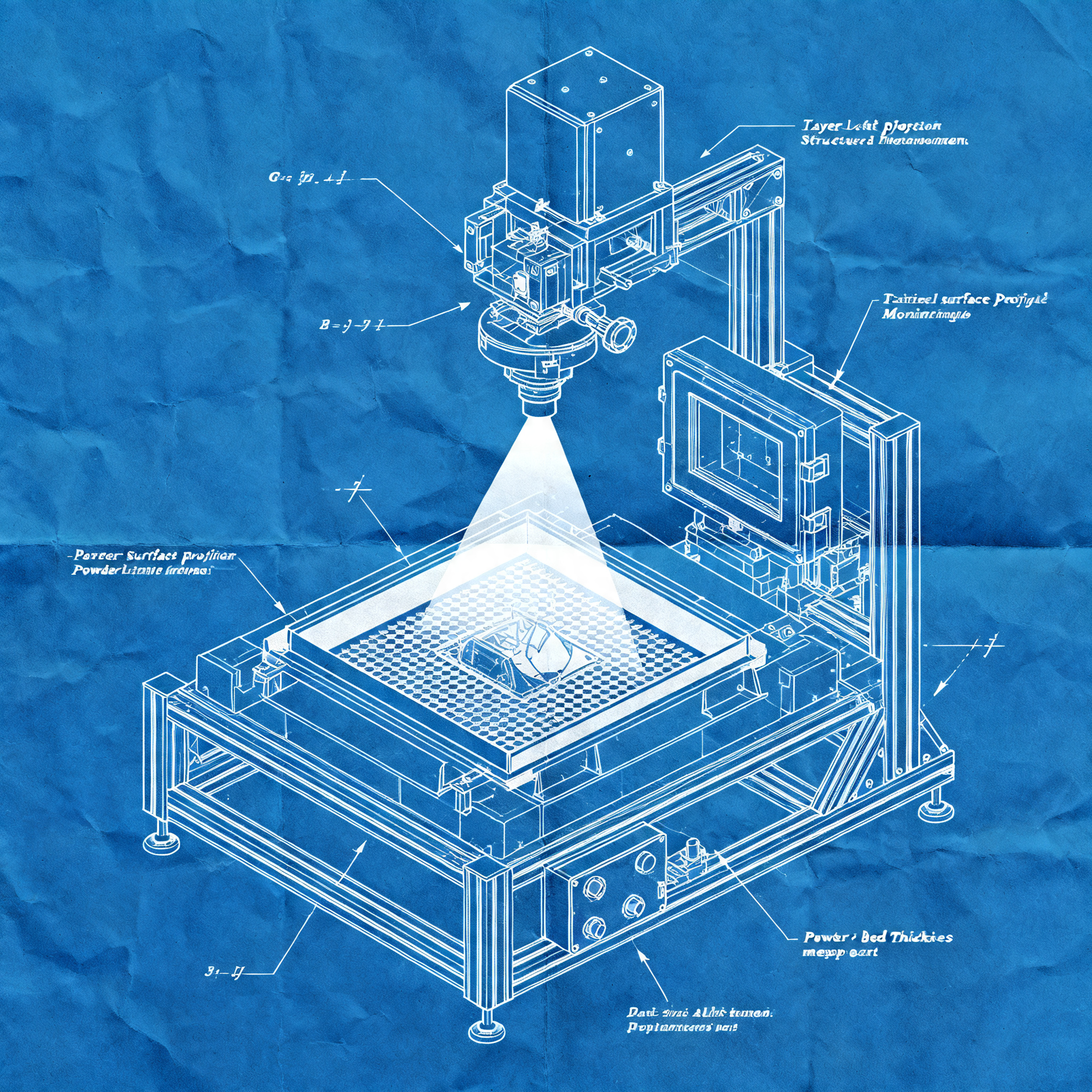
Phase3D applies structured light metrology to AM. Instead of indirectly estimating process state, it directly measures the three-dimensional surface profile of each layer during build.
The Fringe Inspection product generates quantitative measurements of powder layer uniformity, fused surface topology, and actual layer thickness. These measurements are calibrated and unit-based, so comparable across machines, materials, and facilities.
This approach transforms AM from a monitored process to a controlled process. When relevant anomalies are measured and controlled, qualification becomes a continuous process rather than a costly final hurdle.
Structured light enables calibrated layer-by-layer thickness measurements, providing data comparable across different productions and manufacturing sites.
Eliminating dead time: in-process inspection of critical parts
For complex and large components, integrated inspection avoids interruptions and reduces post-production scrap.
The qualification of aerospace AM machines requires three phases: Factory Acceptance Testing, Installation Qualification, and Operational Qualification. The latter verifies that the printed material meets specifications through compositional, microstructural, and mechanical testing.
In-process inspection drastically reduces dependence on post-production controls. For large aerospace components, where final inspection may be impractical, layer-by-layer control becomes essential.
Facility qualification systems require approved quality systems and qualified inspection processes. Integrating objective measurements during printing accelerates the entire qualification cycle, reducing time and associated costs.
Real-time certification of the future
The future of aerospace AM is not just printing, but certifying every phase of the process in real-time. When quality becomes predictable through objective measurements, additive manufacturing becomes truly industrial.
The competitive advantage will be defined by the ability to produce confidently at scale. Objective inspection transforms AM from an observed process to a controlled process, where every layer contributes to the final traceability of the component.
Discover how to integrate a digital quality control system into your production chain.
article written with the help of artificial intelligence systems
Q&A
Why is in-process quality control crucial in aerospace additive manufacturing?
In-process quality control is crucial because it enables traceable data and immediate decisions, reducing reliance on costly post-production inspections that are sometimes impossible to perform on complex parts.
What is the main limitation of traditional monitoring systems in AM?
Traditional systems only provide subjective and uncalibrated visibility, lacking repeatability between different machines and productions, unlike objective and standardized measurement tools.
How does Phase3D's approach to in-process inspection work?
Phase3D uses structured light metrology to directly measure the three-dimensional surface profile of each layer, providing quantitative and calibrated data on layer uniformity and thickness.
What benefits does in-process inspection bring to large aerospace components?
It allows avoiding interruptions, reducing post-production waste, and making quality control feasible on parts that are otherwise difficult to inspect, while also speeding up the machine qualification process.
How does objective inspection change the paradigm of additive manufacturing?
It transforms AM from an observed process to a controlled one, where each layer is measured and certified in real-time, ensuring traceability and predictability of final quality.