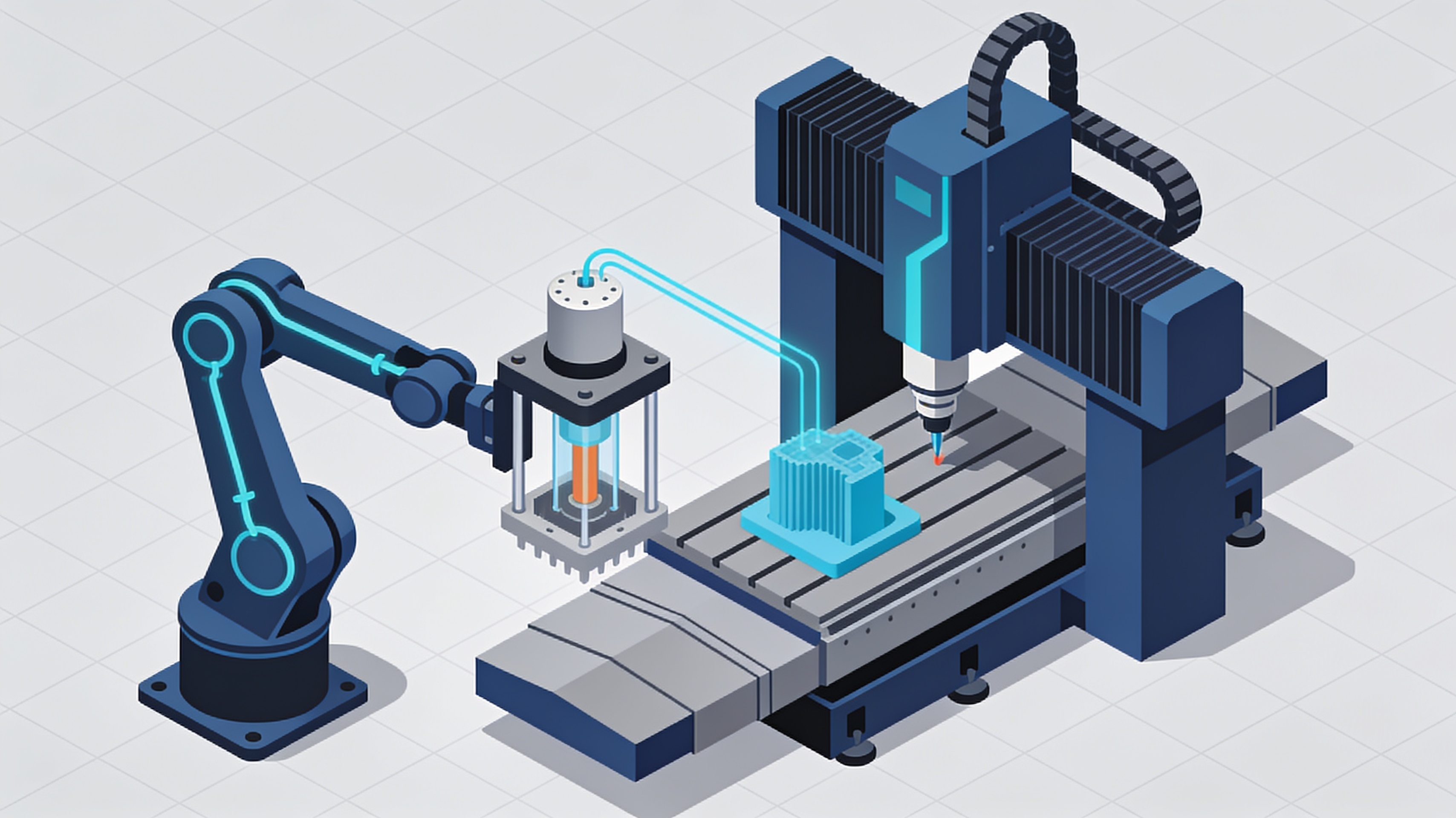
IMTS 2026: Machine Tools, Automation, and Additive Manufacturing Converge in Chicago
The International Manufacturing Technology Show (IMTS) will return to Chicago from September 14 to 19, 2026, confirming itself as the leading North American event dedicated to production technologies. The event at McCormick Place will bring together machine tool builders, automation specialists, and additive manufacturing leaders, showing how these once-separate technologies are becoming increasingly interconnected.
- IMTS 2026 will be held in Chicago from September 14 to 19 with thousands of exhibitors
- Focus on the integration of CNC machining, robotics, and industrial 3D printing
- Presence of leaders such as FANUC, Mazak, and Siemens with hybrid solutions
- Growing role of robotic automation in additive processes
From Separation to Integration
Traditional and innovative manufacturing technologies are converging in highly automated production environments.
Traditional CNC machining, robotics, artificial intelligence, and additive manufacturing are no longer independent disciplines. According to Charles R. Goulding, founder of R&D Tax Savers, these technologies are becoming integral components of production environments designed to maximize productivity, quality, and flexibility.
IMTS 2026 represents a unique opportunity to observe this evolution. The event demonstrates how established manufacturing processes continue to evolve alongside the most advanced innovations.
FANUC and Additive Manufacturing Automation
Industrial robots are becoming key elements in integrating additive processes into production lines.
FANUC, whose industrial robots are now ubiquitous in modern factories, will be among the main exhibitors. The company has demonstrated how robotic systems can be integrated into metal additive manufacturing cells for automated part handling.
Robots are used for post-processing, inspection, and production flow management. Instead of treating additive manufacturing as a standalone technology, manufacturers integrate robots into the entire production cycle to reduce labor requirements and improve consistency.
Robotic integration in additive processes is not limited to part handling but includes finishing operations, quality control, and automated management of the production workflow.
Hybrid Production: The Mazak Case
Hybrid systems combine additive deposition and subtractive machining in a single machine.
Mazak will present its HYBRID Multi-Tasking production systems, which integrate laser deposition and CNC machining. This technology represents the evolution of the convergence between additive and subtractive.
Hybrid systems allow building complex geometries through additive deposition and completing them with precision CNC machining. This approach reduces setup times and improves production efficiency.
Siemens and Digital Twins
Advanced software is becoming crucial for optimizing additive manufacturing processes.
Siemens, with its 3D printing division and NX CAD software, uses digital twins to simulate additive manufacturing processes. This technology allows optimizing printing parameters before physical production.
The company has also formed strategic partnerships, such as the one with Nvidia, to integrate artificial intelligence into production processes. The collaboration aims to improve the predictability and efficiency of additive manufacturing systems.
Applications in the Medical Sector
Additive manufacturing is transforming the production of personalized medical devices.
The medical sector represents one of the most promising fields of application. EOS, a private company specialized in 3D printing, produces titanium orthopedic implants using additive technologies.
The ability to customize implants and medical devices is revolutionizing the orthopedic sector. Additive manufacturing allows creating complex geometries impossible to achieve with traditional methods.
Future Prospects
IMTS 2026 will show how technological integration is redefining the very concept of the factory.
The September event will represent an opportunity to understand the direction of modern manufacturing. The integration between machine tools, automation, and additive manufacturing is no longer a futuristic vision, but an operational reality.
With thousands of exhibitors and visitors from around the world, IMTS 2026 confirms its role as a privileged platform to observe where industrial production is heading. The technological convergence presented in Chicago will define the production standards of the coming years.
article written with the help of artificial intelligence systems
Q&A
When and where will IMTS 2026 be held?
The International Manufacturing Technology Show (IMTS) 2026 will take place in Chicago at McCormick Place from September 14 to 19, 2026. The event will bring together thousands of exhibitors dedicated to manufacturing technologies.
What is the main theme of the IMTS 2026 edition?
The event focuses on integrating traditional CNC machining, industrial robotics, and additive manufacturing. Technologies are no longer viewed as separate disciplines but as interconnected components to maximize productivity.
How does FANUC contribute to 3D printing automation?
FANUC demonstrates how its industrial robots can be integrated into metal additive manufacturing cells to automatically handle parts. Robots are used for post-processing, inspection, and production flow management.
What will Mazak present regarding hybrid manufacturing?
Mazak will showcase its HYBRID Multi-Tasking systems, which combine additive laser deposition and subtractive CNC machining in a single machine. This solution allows both processes to be performed without moving the part.
What advantages does the convergence of these technologies offer?
Integrating CNC, robotics, and 3D printing creates production environments designed to maximize quality, flexibility, and productivity. This approach reduces labor requirements and improves consistency throughout the entire production cycle.