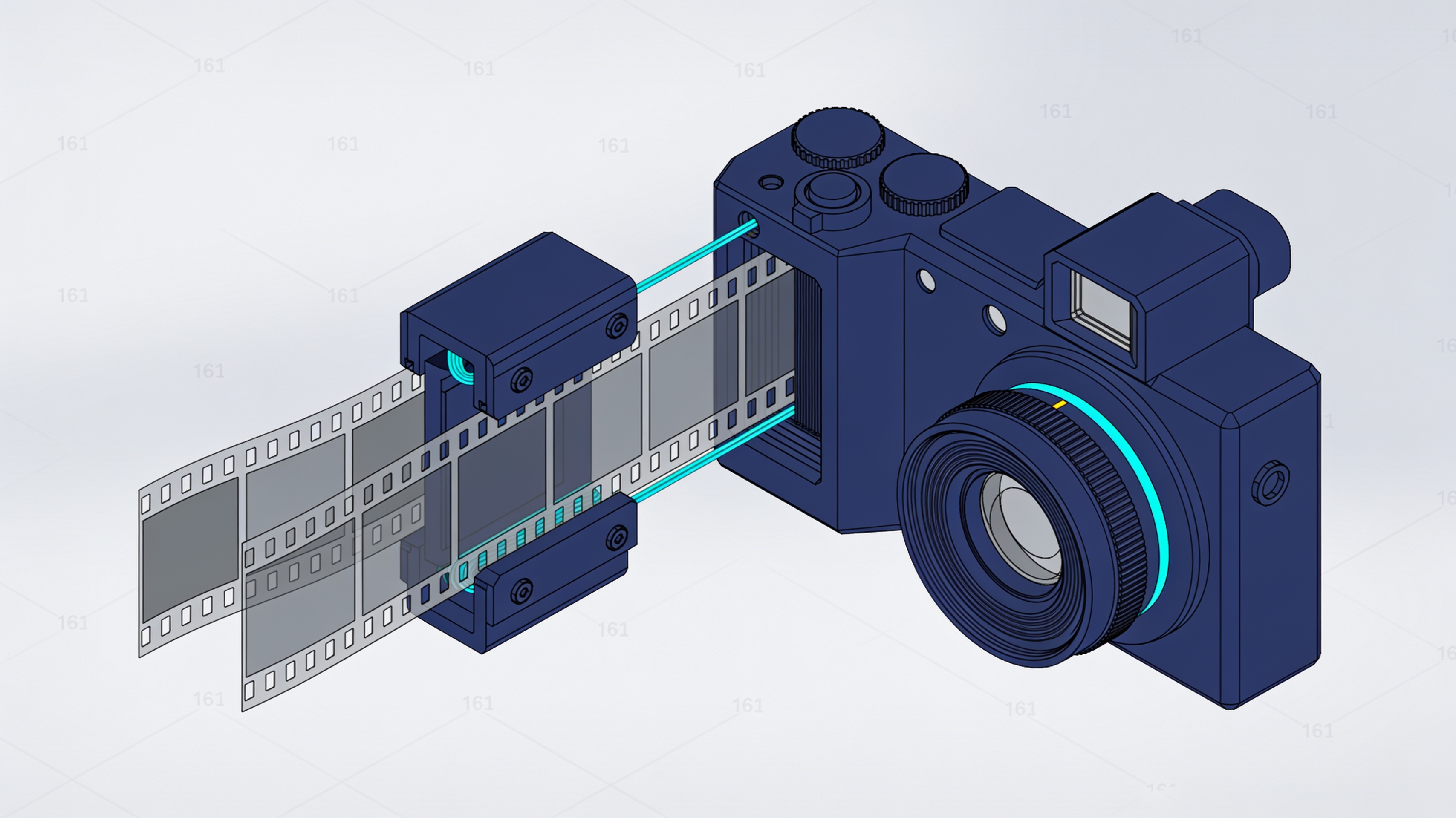
3D-printed variable-speed shutter: the technical challenge solved by Camera Things
3D printing has opened new possibilities in the construction of handmade cameras, but one component has always remained particularly tricky: the variable-speed shutter. Camera Things has developed an innovative solution that overcomes this historical limitation.
- First working 3D-printed shutter with variable speed
- Sliding design with adjustable opening via a blind strip
- Simple mechanism based on elastic band and linear movement
- Current limitation: half-frame format, full-frame version in development
The historical problem of DIY shutters
Building a film camera is within reach of many, but making a shutter with adjustable speed has always represented an almost insurmountable technical barrier.
3D printing has democratized the construction of handmade cameras. Anyone can now create complex camera bodies starting from a CAD file. However, the variable-speed shutter has remained the Achilles' heel of these projects.
Experimenters have always had to settle for fixed speeds. This drastically limits photographic possibilities, especially in variable light conditions.
The solution from Camera Things
The developed design uses a sliding two-strip mechanism that simulates the effect of a traditional curtain shutter, with the innovation of an adjustable aperture.
The operation is ingenious in its simplicity. To arm the shutter, both strips are pulled sideways. The blind strip is then pushed back, and the shutter activates by sliding under the force of a rubber band.
The innovative element lies in the adjustment. The blind strip can be partially repositioned to modify the width of the shutter aperture. The result is a strip of light of variable width that passes over the film, equivalent to the speed variation of a conventional shutter.
Operating mechanism
- Arming: Both strips are pulled sideways
- Preparation: The blind strip is pushed back (partially or completely)
- Shutter: The elastic band slides the shutter, creating a variable slit of light.
Limits and future developments
Space constraints forced the designer to use a half-frame format, pushing him toward a complete redesign with vertical slats.
The current design only works in half-frame format due to dimensional limitations. This means that each standard 35mm frame is divided into two smaller exposures.
Camera Things is abandoning this approach. The next design will use a more complex system of vertical slats to achieve full-frame format. Unfortunately, the current project files have not been made available, but experienced CAD users should be able to replicate the concept.
This is not the first 3D-printable shutter ever made, but it represents the first publicly documented working example with variable speed.
Implications for the maker community
The project demonstrates how 3D printing can solve complex mechanical problems that traditionally required precision machining or commercial components.
Artisanal photography has a long tradition. From experiments with cardboard and tape to precision machining on aluminum, building cameras has always been possible. But 3D printing has introduced a new paradigm.
Components that required tight tolerances and complex operations become accessible. The true value of this project lies not only in the technical solution, but in the demonstration that barriers considered insurmountable can fall with the right approach.
The photographic maker community will now be able to experiment with variable shutters. This opens up creative possibilities previously reserved only to those who owned professional equipment or advanced mechanical precision skills.
article written with the help of artificial intelligence systems
Q&A
What is the main innovation of the Camera Things shutter?
It is the first 3D-printed shutter capable of varying exposure speed. It uses a sliding design with an adjustable blind strip to modify the aperture.
How does the shutter's firing mechanism work?
The system is cocked by pulling two strips sideways and positioning a blind strip. A rubber band then slides the mechanism, creating a variable light slit on the film.
Why did previous DIY shutters only have fixed speeds?
Historically, building a shutter with variable speed represented a nearly insurmountable technical barrier for artisan makers. 3D printing has now allowed this specific limit to be overcome.
What are the current format limitations of this shutter?
The current design works exclusively in half-frame format due to dimensional constraints in the available space. Each standard 35mm frame is thus divided into two smaller exposures.
What future developments are planned for the project?
The designer is working on a complete redesign using vertical blades. The goal is to overcome current limitations and create a version compatible with full-frame format.