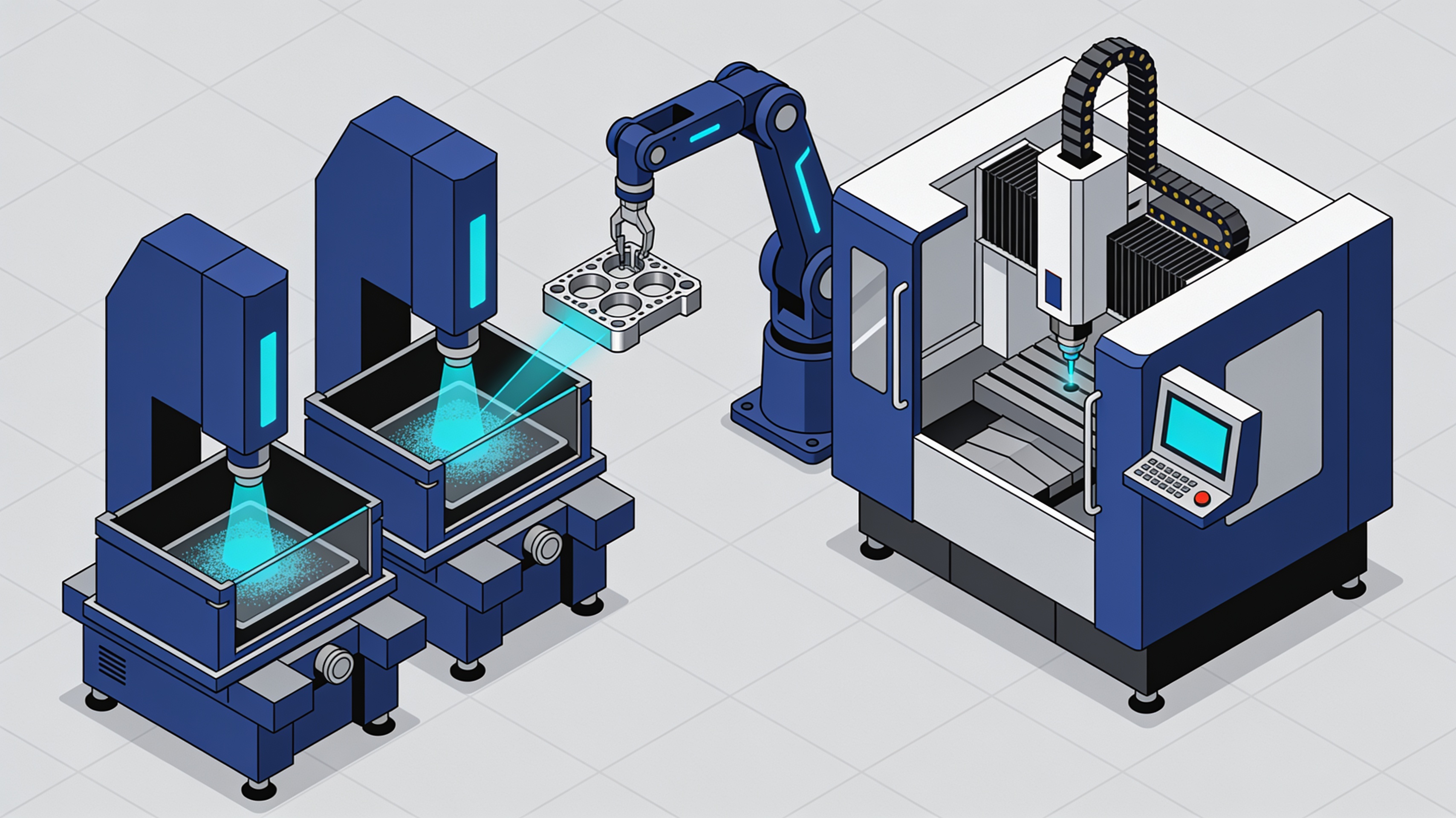
Hofmann CNC integrates Eplus3D's dual-laser metal 3D printing into precision production
The collaboration between Eplus3D and Hofmann CNC brings metal additive manufacturing into an established German machine shop. The investment in the dual-laser EP-M300 does not just add a technology: it builds a hybrid production path between printing and CNC machining.
Hofmann CNC, a company specializing in precision mechanical machining, has acquired an EP-M300 metal printer configured with dual lasers. The announcement, released by Eplus3D on October 21, 2026, marks the entry of laser powder bed fusion into a company that already possesses milling, turning, and dimensional finishing expertise.
The partnership also includes the development of a local application center dedicated to demonstrations, feasibility assessments, and project development. The goal is to offer customers an integrated combination of metal printing and precision machining.
- Hofmann CNC invests in a dual-laser EP-M300 to integrate additive into existing CNC machining
- A German application center is created for demonstrations and project development
- The goal is to build hybrid processes: additive creates complex geometries, CNC ensures tolerances and finishes
- The medical sector is identified as an application area to explore
When additive manufacturing enters the workshop
Integrating metal printing into a traditional machining company requires a different approach compared with the isolated adoption of the technology.
The distinction is fundamental. When a metal printer is installed in a workshop that already has milling machines and lathes, the goal is not simply to add production capacity.
The challenge consists of building a complete path: from digital geometry to the finished component with surfaces, tolerances and inspections suitable for the intended use. Additive manufacturing produces shapes that are difficult to obtain by subtraction. CNC comes in where dimensional precision, controlled roughness and mechanical fits are required.
What was actually announced
The press release provides information on the partnership and the machine, but does not quantify production results already achieved.
The two companies announced the investment in the EP-M300 dual-laser and the extension of the collaboration to the application center. Hofmann CNC will make available to customers the combination of metal PBF printing and precision machining already present in its own facility.
Eplus3D thus expands its industrial presence in Germany through a local collaboration.
The press release does not quantify the value of the investment, does not identify production volumes, does not publish productivity indicators and does not declare process certifications already obtained. Even the medical perspective is described as an area to be explored, not as an acquired authorization.
These limitations do not reduce the interest of the operation. However, they prevent an industrial agreement from being turned into a story of already demonstrated serial production.
The EP-M300 platform and the dual laser
The EP-M300 belongs to Eplus3D's family of metal powder bed fusion machines. The dual-laser configuration increases productivity on medium-to-large build volumes.
The machine is compatible with several metal alloys: steels, nickel, aluminum and titanium. The process uses inert gases such as argon or nitrogen to protect the melt pool from oxidation.
The dual laser source makes it possible to reduce build times on complex geometries. Each laser works on different areas of the powder bed, increasing the overall speed of the process.
Application prospects
The medical sector is indicated as an area of future interest, but no specific authorizations for implantable devices have been declared.
Laser powder bed fusion finds application in the medical sector for the production of customized prostheses, surgical instruments and anatomical components. Integration with precision CNC machining is particularly relevant for components that require biocompatible surfaces and tight tolerances.
Hofmann CNC will be able to leverage this combination to offer customers components that start from additive printing and are completed with controlled mechanical finishing.
Conclusions
The collaboration between Eplus3D and Hofmann CNC represents a model of integration between additive manufacturing and traditional machining. The investment in the EP-M300 dual-laser is not an isolated technological experiment: it is the insertion of metal printing into an already structured production chain.
The German application center will be able to concretely demonstrate how the additive-subtractive hybrid responds to real industrial needs. The actual production results will emerge in the coming months, when the pilot projects are completed and evaluated.
article written with the help of artificial intelligence systems
Q&A
Which metal 3D printer did Hofmann CNC acquire?
Hofmann CNC acquired an Eplus3D EP-M300 metal printer configured with dual lasers. The announcement was released by Eplus3D on October 21, 2026. The machine uses laser powder bed fusion (PBF).
What is the goal of the collaboration between Eplus3D and Hofmann CNC?
The goal is to build a hybrid production workflow that combines metal 3D printing and precision CNC machining. Additive manufacturing creates complex geometries, while CNC ensures tolerances, controlled surface roughness, and mechanical fits. The partnership also includes the development of a local application center.
What will the announced application center be used for?
The German application center will be dedicated to demonstrations, feasibility assessments, and project development. It will offer customers an integrated combination of metal printing and precision machining. Eplus3D thus expands its industrial presence in Germany.
Why is integrating metal printing into a CNC workshop different from an isolated adoption?
In a workshop that already has milling machines and lathes, the goal is not just to add production capacity. The challenge is to build a complete path from digital geometry to the finished component, with surfaces, tolerances, and inspections suited to the intended use. An integrated approach between additive and subtractive manufacturing is therefore required.
Which application sectors were indicated for this collaboration?
The medical sector is indicated as an application area to explore. The combination of metal PBF printing and precision machining will be made available to Hofmann CNC's customers. However, the press release does not quantify production results already achieved.