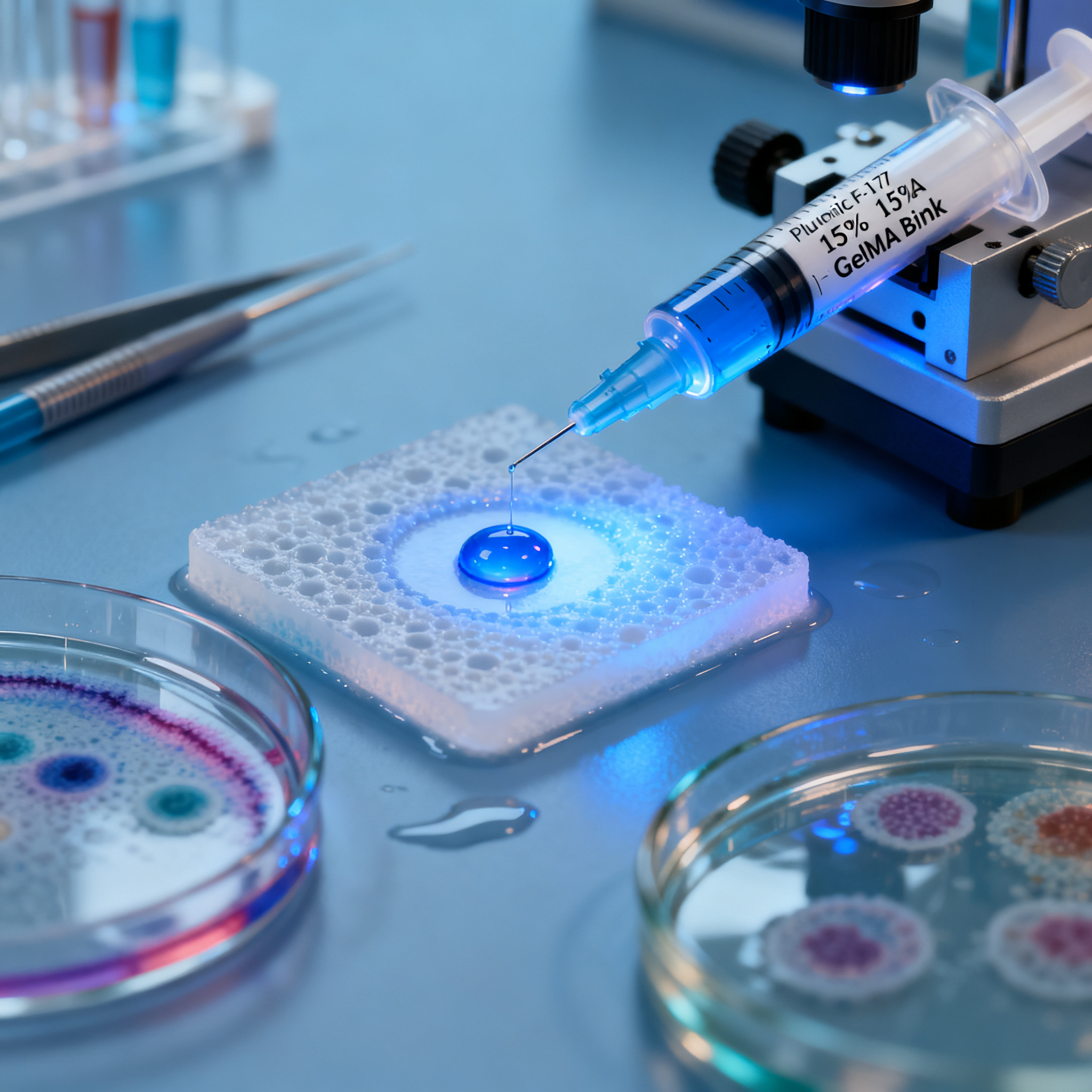
Why does 15% GelMA work?
3D bioprinting is redefining pharmacological testing thanks to modular systems that balance mechanical precision and biological compatibility. The key is not only to automate, but to choose materials and parameters that keep cells alive during and after the process.
Custom bioink for live cells
The composition of GelMA and the addition of LAP directly influence cell survival during and after printing.
The bioink used in the most effective bioprinting protocols combines 15% GelMA (wt/v) with 0.5% LAP (wt/v) as a photoinitiator. This formulation is photopolymerized with light at 405 nm for 1 minute, ensuring reproducible results.
Printing speed directly affects cell viability. Experimental data shows that at low speed, viability reaches the 90,1%, drops to 82,1% at medium speed and falls to 65,5% at high speed. For this reason, operational settings prioritize low or medium speeds.
| Printing speed | Cell viability | Application |
|---|---|---|
| Low | 90,1% | Precision tissue models |
| Medium | 82,1% | Effectiveness/time compromise |
| High | 65,5% | Not recommended |
The choice of GelMA at 15% is not random. This concentration offers the right balance between the mechanical rigidity needed to maintain the shape and sufficient permeability for nutrients and oxygen.
‘Embedded’ supports: the trick for complex structures
Using viscoelastic matrices such as Pluronic allows for the integration of delicate geometries without damaging the cells.
Printing occurs in “embedded” mode in a support bath composed of Pluronic F-127, nanoclay Laponite-RDS e calcium chloride. This approach allows for the printing of complex geometries that would otherwise collapse under their own weight.
The support bath acts as a temporary viscoelastic matrix. The bioink is extruded directly inside it, where it maintains its shape until photopolymerization. After crosslinking, the support is easily removed.
Pluronic F-127 is a thermoreversible polymer that becomes gel at body temperature but remains liquid at room temperature, facilitating post-print removal without mechanical stress on the cells.
In tests with mouse myoblasts C2C12, cell distribution is evaluated with live/dead tests and confocal microscopy comparing the first and last printed construct. This protocol verifies that viability remains constant during consecutive printing sessions.
From laboratory to production: operational modularity
Systems like MagMix allow rapid integration on existing platforms, increasing scalability and process repeatability.
MagMix is designed as a modular system compatible with the CELLINK Bio X, one of the most widespread industrial platforms. The architecture includes housing, magnetic propellers, and gears to transfer motion.
Components are produced via 3D printing, with parts manufactured on Stratasys J35. The actuator is controlled via microcontroller, allowing precise adjustments of mixing parameters.
- Adaptability to syringes of different sizes
- Multiple extrusion configurations
- Integration on existing platforms without structural modifications
The repeatability of bioprinted tissues is fundamental for using them as models to compare drugs or pathological phenomena with controlled variability. In the United States the FDA is promoting the New Approach Methodologies (NAMs) to reduce dependence on animal testing.
Solutions that improve standardization and quality of constructs fit into this regulatory trajectory. The current experimental window covers tens of minutes and a defined number of consecutive constructs.
Conclusion
Effective bioprinting is not just automation, but the targeted choice of materials and parameters that preserve cell life. The combination of 15% GelMA, controlled photopolymerization, and embedded supports creates a reproducible system for tissue models.
Practical limits concern scalability: verifying performance on longer prints, larger geometries, and bioinks with different rheological properties remains a challenge. The path toward larger-scale constructs requires further validation.
Explore how to configure a reproducible bioprinting process starting from empirical cell viability data. Operational modularity and integration with industrial platforms now make accessible a technology that until recently was confined to advanced research laboratories.
article written with the help of artificial intelligence systems
Q&A
Why is 15% GelMA used in 3D bioprinting?
15% GelMA provides an ideal balance between mechanical stiffness, necessary to maintain the construct's shape, and permeability, essential for nutrient and oxygen transfer to cells. This concentration ensures high cell viability and reproducible results.
What is the role of LAP in the bioink?
LAP (Luciferin Additive Photoinitiator) is a photoinitiator added to GelMA that enables controlled photopolymerization of the bioink when exposed to 405 nm light. This process is crucial to maintain cell viability during printing.
How does printing speed affect cell viability?
Printing speed directly impacts cell viability: low speed achieves 90.1% viability, while high speed drops to 65.5%. Therefore, low or intermediate speed settings are preferred to obtain quality constructs.
What is the 'embedded' mode and why is it useful?
The 'embedded' mode involves printing the bioink inside a viscoelastic support bath, such as Pluronic F-127 and Laponite. This method supports complex structures preventing collapse and allows easy removal of the support after printing without damaging cells.
What advantages does a modular system like MagMix offer?
MagMix allows rapid integration with existing platforms such as the CELLINK Bio X, increasing scalability and repeatability. It is adaptable to different syringes and configurations, enabling precise control of mixing parameters and improving operational efficiency.